 Skip to content

Custom Tire Covers for Auto Dealerships
- Dealer programs commonly fall within 50–500 pieces, while selected structures also support smaller trials and larger volume production.
- Core U.S. spare-tire platforms include 31”, 32”, 33”, and 35”, with larger aftermarket sizes developed when required.
- Standard OEM samples typically require 3–5 working days; camera and new-structure samples require additional development time.
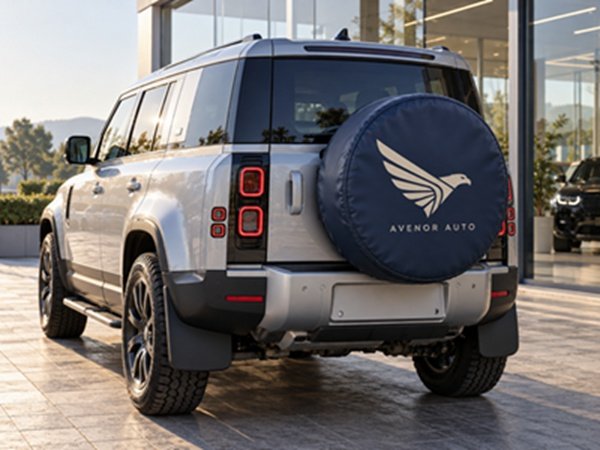
- Logo, website, phone number, QR code, city name, campaign message, and dealership-specific artwork can be incorporated according to the selected construction and printing process.
A Dealer Tire Cover Program Built Around Real Vehicles
A dealership tire cover should do more than carry a logo. It must fit the vehicle, keep branding visually balanced, suit the expected outdoor environment, remain repeatable across later orders, and arrive in a format that works for vehicle delivery, accessory sales, promotions, or multi-location distribution.
From Dealer Branding to Production
- Szoneier develops custom tire covers around the actual commercial program rather than treating every order as one generic printed cover. A dealership may need one logo across several tire sizes, separate artwork for multiple locations, premium covers for Jeep or Bronco inventory, protective covers for RV sales, or a mix of standard and camera-compatible versions.
- Development begins with the vehicle mix, tire information, quantity, branding assets, intended use, and packaging requirement. Those inputs determine the product structure, material, printing route, pattern, sample plan, quality checkpoints, and reorder file.
- For a simple program, the starting point may be a standard logo cover in several common sizes. More complex programs can involve exact-fit patterns, camera openings, multiple dealership identities, premium materials, individual size labels, custom packaging, or recurring replenishment.
- The goal is repeatability. Approved artwork, material references, patterns, samples, packaging instructions, and project specifications are retained so later orders do not need to be rebuilt from the beginning.

Key Facts for Dealership Tire Cover Projects
50–500 Piece Dealer Range
31–35 Inch Core Sizes
3–5 Day Standard Samples
Multiple Branding Elements
Multiple Sizes per Program
Repeatable Reordering
Approved material, artwork, pattern, color reference, golden sample, packaging standard, and SKU information can be retained for later production. Repeat orders are often faster than first production because the engineering and approval work has already been completed and verified.
Tire Cover Programs for Different Dealership Operations

Jeep Dealerships

Ford Bronco Dealerships

RV Dealerships

Trailer Dealerships

Used Vehicle Dealers

Dealer Groups
Multi-location groups need more than one product. Different stores may require separate logos, phone numbers, city names, URLs, QR codes, or packaging identifiers while sharing the same base construction. A controlled program can separate branding data from core product specifications so the group gains purchasing consistency without forcing every location to use identical artwork.
Four Ways Dealerships Use Branded Tire Covers

Vehicle Delivery Branding

Customer Gift Programs

Accessory Resale

Mobile Brand Exposure
Common Problems in Dealer Tire Cover Programs
Wrong Fit Across Inventory
Camera Interference
Branding Changes Between Orders
Supplier Cannot Scale
A source that handles 30 printed covers may not manage 500 mixed-size units with the same control. Scaling changes material purchasing, print economics, cutting method, sewing flow, packing, inspection, and carton planning. A dealer program should have a production path that works for market testing as well as later commercial replenishment.
From Dealer Brief to Repeatable Tire Cover Program

Define the Program Before Designing the Cover

A useful project brief
Tire Cover Styles for Auto Dealership Programs

Dealer Logo Spare Cover

Jeep Dealer Cover

Bronco Dealer Cover

Camera-Compatible Cover

RV Dealer Cover

Premium Dealer Cover
Fitment Control for Mixed Dealership Vehicle Inventory
Tire Size Comes Before a Generic Vehicle Assumption
A dealership may sell several vehicles that look similar from the rear while using different tire diameters and widths. Wrangler trims, Bronco configurations, used vehicles, aftermarket wheel packages, dealer-installed upgrades, and off-road modifications create additional variation.
Szoneier’s standard universal size platform extends from smaller spare tires into 42”+ custom development. Important U.S. ranges include 29–31”, 31–33”, 33–35”, 35–37”, 37–40”, 40–42”, and specialty sizes beyond those ranges. The 31–33” platform covers many Jeep and Bronco applications, while 33–35” and 35–37” ranges become increasingly relevant to upgraded off-road vehicles.
For example, a tire marked 285/70R17 has a theoretical outside diameter of about 32.7 inches, which places it close to a 33-inch product platform. A 315/70R17 is approximately 34.4 inches, making an exact 35-inch approach more appropriate in many Wrangler applications. Production still confirms actual tire and vehicle data before assigning the final pattern.
Dealer Fitment Should Be Managed by SKU
For a mixed dealership program, each tire size should have its own fitment reference rather than being treated as an interchangeable variation. A useful data set includes:
- Vehicle make and model
- Model year where relevant
- Tire sidewall size
- Actual outside diameter when available
- Tire width
- Spare carrier
- Rear camera
- Aftermarket modifications
- Assigned pattern
- Installed or sample verification
When data is incomplete, a tire-sidewall photo, rear vehicle photo, existing cover, or physical measurement can help establish the right direction. The result is a cleaner dealership assortment. The sales team can identify which cover belongs to which vehicle, the warehouse can separate SKUs correctly, and a later replenishment order can use the same pattern reference instead of guessing from a previous finished cover.
Camera-Compatible Tire Covers Need Separate Engineering
Camera Position Changes the Pattern and the Artwork
- Szoneier maintains separate camera-pattern references for relevant vehicle platforms instead of assuming every opening is identical. For Wrangler JL, core camera-pattern platforms include 31”, 32”, 33”, 35”, and selected larger sizes; 32”, 33”, and 35” are especially important commercial platforms.
- The artwork is checked after the camera area is defined. A centered dealership logo may need to move upward, downward, split around the opening, or adopt a circular composition. Phone numbers, website text, and QR codes should remain outside seam lines and important opening zones.
- An attractive digital mockup is not enough if the production opening blocks the camera or cuts through important branding.
Reinforcement Must Match Material and Construction
A camera hole removes material from a highly visible area of the cover. The opening may therefore need binding, reinforcement, stitching, or another finishing method suited to the selected front material and surrounding structure.
- The final inspection should evaluate more than hole diameter. Camera position, surrounding finish, logo clearance, seam quality, product fit, and usable camera area all matter.
- Material choice also affects the result. Premium PVC and marine vinyl work well for many automotive applications because they provide a clean exterior surface and can be engineered into exact-fit and camera-compatible constructions. Different materials may require different reinforcement and sewing details.
- Standard camera-hole construction does not automatically require a higher product MOQ; selected digitally printed structures can still be developed at very low quantities. More complex custom structures, materials, and packaging can introduce their own minimums.
Choose Material by Vehicle, Positioning, and Outdoor Use

PVC and Vinyl for Flexible Dealer Programs
- Dealer programs benefit from PVC when artwork plays a major role. Full-color graphics, dealership logos, promotional messages, photographs, gradients, and variable designs can be produced without requiring a traditional screen for every image. Premium PVC grades can also create a cleaner automotive appearance than lightweight promotional fabrics.
- Standard stock PVC paired with digital printing can start from very low quantities. As volume rises, the same visual concept can be evaluated against other materials or print routes to improve commercial efficiency.
- “Vinyl” alone is not a complete specification. Surface, backing, thickness, grade, flexibility, and print method still need to be recorded so repeat orders reproduce the same product rather than simply using another material sold under the same generic name.

PU Leather for a Softer Premium Appearance
- Stock PU in standard colors can support low-quantity development when paired with compatible digital or transfer processes. Special grain, texture, thickness, or color introduces material minimums that can rise to roughly 100–300 pieces per color depending on the required specification and material source.
- PU should not be selected simply because it sounds more premium. Long outdoor exposure, print durability, color stability, flexing, edge construction, and target price still need to be evaluated. Some dealer programs are better served by premium PVC or marine vinyl because the finished product must combine stronger outdoor use with a clear automotive surface.

420D, 600D, and 900D Oxford for Protection-Led Programs
- 420D provides lower weight, easier folding, and a lower cost position. It can work for standard promotional programs, moderate outdoor use, and products where shipping volume matters.
- 600D offers a stronger structure and better abrasion resistance while remaining easier to fold and package than heavier options. It is a strong core choice for many RV and outdoor dealership applications.
- 900D provides a heavier-duty position but also adds weight, bulk, and cost. It should be selected because the use environment requires the upgrade, not simply because a larger Denier number appears stronger in marketing. Standard stock 420D and 600D commonly start around 30 pieces, while 900D commonly starts around 50 pieces; custom colors and special coatings can require significantly higher material quantities.

Marine Vinyl for Premium Automotive Programs
- It is especially suitable for Jeep, Bronco, premium off-road accessories, dealer programs, and camera-compatible covers. A structured vinyl face provides a refined appearance and supports digital graphics, selected patch treatments, binding, and reinforced camera construction.
- Standard stocked marine vinyl can support programs beginning around 30 pieces. Special colors, textures, or formulations can introduce higher material minimums.
- The material should still be approved through a physical sample because surface grain, stiffness, print appearance, seam response, and installed fit cannot be evaluated fully from a swatch photograph.
Dealer Logos Need Production Artwork, Not Just a File
Prepare Artwork Around the Finished Cover
- Logo work can include vectorization, edge cleanup, font checking, color definition, background removal, resolution improvement, spacing adjustment, or reconstruction of simple graphic elements. The purpose is not to alter dealership identity but to create a controlled production file.
- The approved layout should define print size, location, text, color reference, safe area, and camera clearance where relevant. Important logo features should not disappear into the tire-cover curvature or sit too close to seam allowances.
- Szoneier’s print-preparation checks include file size, resolution, DPI, color mode, fonts, bleed, tire diameter, camera hole, safe zone, logo permission, Pantone reference, background, and print profile.
- A production proof is versioned so later revisions remain traceable rather than overwriting an approved file.
Match the Printing Process to Quantity and Material
There is no single printing method that fits every dealer program.
- Latex or UV digital printing works well with printable PVC and selected premium automotive surfaces when full color, gradients, photographs, or low quantities are required.
- Screen printing becomes attractive for larger repeated dealership logos. A 500-piece dealer-logo program, for example, can pair 600D with screen printing to improve consistency and commercial efficiency.
- Dye sublimation suits compatible polyester products when large full-color graphics or continuous surface artwork are required.
- Heat transfer can be useful for selected short-run logo applications.
- TPU or silicone patches, embroidery, and hot stamping are better treated as premium branding options rather than universal solutions.
Szoneier records material ID, ink, printing conditions, color reference, and approved sample information for repeat production because identical digital color values can reproduce differently on different substrates. Print QC evaluates position, size, color, resolution, adhesion, scratch performance, folding response, and camera artwork clearance where applicable.
Construction Details Affect Fit, Finish, and Service Life

Elastic Hem

Bungee Closure

Side-Wall Depth

Binding and Edge Finish

Reinforced Camera Opening

Controlled Sewing
Dealer MOQ, Sampling, and Production Lead Times
Dealer programs can begin with a test quantity and scale into larger replenishment orders. Final minimum quantities depend on product structure, material, printing, accessories, and packaging rather than one universal MOQ.
Program Stage | Typical Quantity | Typical Use | Standard Production Reference |
Individual / Proof Unit | 1 pc selected structures | Artwork or fit review | 2–4 working days |
OEM Sample | 1–several pcs | Material, construction, branding approval | 3–5 working days |
Small Dealer Test | 30 pcs | Initial branded batch | 5–7 working days |
Dealer Entry Program | 50–100 pcs | Promotional or single-location program | 7–10 working days around 100 pcs |
Standard Dealer Program | 300–500 pcs | Commercial dealer / brand order | 10–15 working days around 500 pcs |
Larger Program | 1,000 pcs | Group or volume production | 12–18 working days |
Volume Program | 5,000 pcs | Large recurring or network order | 20–30 days |
Standard time references assume approved artwork, available materials, established specifications, and normal scheduling. Camera construction, marine vinyl, mixed artwork, multiple sizes, new structures, special packaging, or material development can extend production time.
Repeat orders can often run faster because approved artwork, material, pattern, color, golden sample, and packaging references are already available. Internal lead-time guidance indicates repeat production may shorten standard timing by approximately 15–30% depending on material availability and project complexity.
Material and packaging minimums remain separate. A tire cover itself may support a smaller order while a custom-colored fabric, molded logo component, printed polybag, or custom carton requires a larger minimum.
Sampling Turns a Dealer Concept Into a Production Standard
Digital Approval Before Physical Production
- The first approval stage is normally a digital proof or mockup. It allows the dealership to review logo position, scale, text, color direction, safe area, and the overall visual relationship between branding and the tire-cover shape.
- For camera versions, the proof also shows how the design interacts with the opening. Important logo elements can be repositioned before material is printed or cut.
- A digital approval should not be treated as confirmation of actual material texture or exact physical color. Screens render color differently, and the same artwork can reproduce differently across PVC, polyester, PU, or marine vinyl.
- Once the layout is approved, Szoneier prepares the physical sample using the selected material, pattern, print method, and construction. Standard OEM samples typically require 3–5 working days. Marine vinyl samples generally fall around 4–7 working days, camera versions around 5–7 working days, and new-structure development around 7–12 working days.
Golden Sample Controls the Bulk Order
- The approved physical sample becomes more than a sales sample when it is designated as the golden sample.
- The golden sample establishes the reference for material appearance, size, shape, logo location, print quality, seam details, camera opening, accessories, and overall workmanship. One retained production reference can be used alongside the approved dealership sample to support bulk inspection and later replenishment.
- Revisions should create a new version instead of silently changing the original specification. Minor artwork corrections may be handled digitally, while changes to size, material, pattern, camera structure, or major construction normally require another physical verification.
- For commercial projects, Szoneier retains the relationship between the golden sample and the project specification so a repeat order can return to an approved standard rather than rely on memory or photographs of the previous shipment.
Quality Control Runs Through the Production Sequence

Material Check

Artwork Version Control

Pattern Control

First-Piece Approval

Inline Inspection

Final Inspection

Personalized Verification

Repeat-Order Control
Packaging Can Match Vehicle Delivery or Dealer Retail

Standard Individual Polybag

Branded Polybag

Hang Tag

Retail Box

Dealer Kit

Barcode and Size Identification
Repeat Orders Should Not Restart From the Beginning
SKU and Pattern Record
Approved Artwork Record
Golden Sample Reference
Faster Replenishment
One Szoneier Program From Development Through Delivery
Product Development and Manufacturing Under One Project
- Fitment decisions affect pattern development.
- Pattern dimensions affect artwork positioning.
- Material choice affects print method.
- Print method and volume affect commercial cost.
- Camera requirements affect both artwork and construction.
- Packaging affects labeling, carton quantity, and store allocation.
Flexible Production for Different Order Volumes
Small customized quantities and larger commercial programs do not use exactly the same production route. Low-quantity digital programs benefit from flexible artwork processing, digital printing, controlled cutting, and short-run sewing. Higher-volume programs use more standardized material preparation, repeated printing, batch cutting, production-line sewing, inline quality control, and optimized packing. The purpose of scale is not simply to make more units. It is to preserve approved specifications while increasing production efficiency. Szoneier therefore separates what can remain flexible—artwork variants, selected sizes, branch identification—from what should remain fixed—approved material, core construction, pattern rules, QC requirements, and packaging standards.
Representative Dealer Program Configurations
Regional Jeep Dealer Program — 180 Pieces
The dealership supplies a master vector logo and three branch identifiers. The logo design remains consistent, while the website line and city name vary by location.
Premium PVC is selected for the main program because the dealership wants a clean automotive appearance, good logo reproduction, and manageable program cost. Digital printing is used during initial validation because it allows the group to test artwork and branch variations without committing to a large screen-print setup.
A camera-safe artwork layout is created for JL/JLU products. The 35” version receives an independent fit and camera review because upgraded tire width and carrier configuration can differ from smaller platforms.
After digital approval, physical samples are made for the primary standard and camera configurations. Approved samples establish the production reference.
Program Data
- Total quantity: 180 pcs
- Tire platforms: 32” / 33” / 35”
- Branding: 1 master logo + 3 location variations
- Product mix: Standard + Camera-Compatible
- Packaging: Individual labeled polybag
- Reorder structure: SKU by size, camera version, and dealership location
RV Dealer Network — 600 Pieces
The priority is not a full photographic print. The dealership wants a clean one-color logo, weather-oriented product construction, easy warehouse identification, and competitive cost across several locations.
A 600D Oxford construction is selected as the main product position because it offers a stronger structure and better durability than a lighter promotional option without the additional bulk of a 900D program. Screen printing is selected for the repeated dealer logo because the 600-piece quantity provides better economics for a simple repeated graphic.
Each size receives its own SKU and external size label. Packaging remains compact so stores can distribute covers to service or delivery teams without excess retail packaging.
A golden sample is approved for material, logo position, construction, and packing before bulk production.
Program Data
- Total quantity: 600 pcs
- Main material: 600D Oxford
- Branding: 1-color dealership logo
- Printing: Screen printing
- Product use: Vehicle delivery + service promotion
- Packaging: Size-labeled individual bags
- Distribution: Allocated by dealership branch
Used-Vehicle Dealer + One-Piece Fulfillment Program
A used-vehicle group wants a flexible tire-cover program because inventory changes weekly. Holding hundreds of units in every possible size would create unnecessary stock.
The program begins with 90 standard branded covers across several common spare-tire sizes for vehicles already in inventory. Selected printable PVC structures are also configured for one-piece fulfillment when a branch requires an unusual size, personalized graphic, location-specific message, or special promotional cover.
For stocked items, the dealership uses one master logo and standard packaging. One-piece orders can carry a different artwork ID, tire size, dealership location, and shipping destination.
The fulfillment workflow separates each order by SKU, artwork, tire size, vehicle information, personalization field, shipping address, and tracking reference. Selected printable PVC, PU, and polyester structures can support one-piece fulfillment when the construction and printing route are compatible.
Program Data
- Opening stock: 90 pcs
- Replenishment: Standard batch reorder
- Special orders: 1 pc per order
- Artwork: Master dealer logo + optional local variation
- Fitment: Size database + photo-assisted confirmation when needed
- Fulfillment: One product → one package → one address → one tracking number
Frequently Asked Questions for Auto Dealership Tire Covers
- PVC works well for flexible branded graphics and low-quantity programs.
- PU offers a softer premium appearance.
- 420D and 600D Oxford suit protection-oriented programs.
- 900D supports heavier-duty positioning.
- Marine vinyl works well for premium automotive and exact-fit applications.

Start Your Custom Dealership Tire Cover Program
- Dealership type: Jeep, Bronco, RV, trailer, used vehicle, dealer group, or another operation
- Vehicle models: Make, model, and year where relevant
- Tire information: Tire-sidewall size, required cover size, or clear tire photos
- Rear camera: Yes, no, or unknown
- Quantity: Total units and approximate quantity by size
- Branding: Logo, website, phone, QR code, branch name, or advertising message
- Material position: Economy, standard, premium, heavy duty, or open to recommendation
- Packaging: Bulk, individual polybag, branded bag, hang tag, retail box, or dealer kit
- Destination: Country, warehouse, dealership locations, or individual fulfillment requirement
- Target timing: Sample deadline, launch date, promotion date, or required delivery window
