 Skip to content

UV Resistant Oxford Tire Covers
- 420D Oxford for standard functional RV and trailer programs where weight, packing efficiency and cost remain important.
- 600D Oxford as a core premium option for stronger construction, repeatable bulk production and extended outdoor applications.
- 900D Oxford for heavy-duty programs where abrasion resistance, structure and long-term outdoor exposure carry higher priority.
- Material specifications can include PU or PVC coating, waterproof targets, UV performance requirements, color, finish, logo process and packaging.
- Szoneier develops complete covers around the material rather than treating “600D” as a finished product specification.
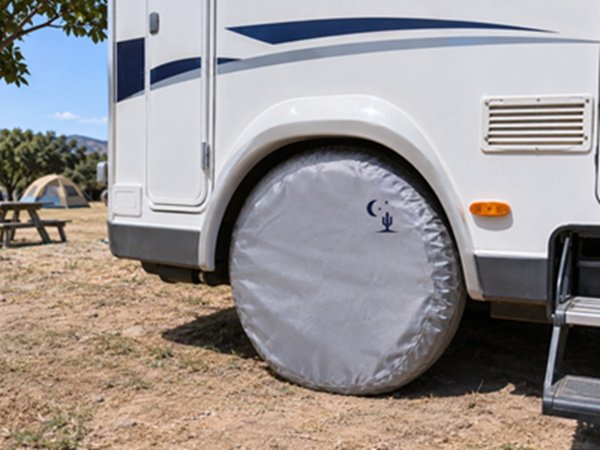
What UV Resistant Oxford Really Means for Tire Covers
UV resistance is not created by the word “Oxford” or a higher denier number alone. Reliable outdoor performance comes from the way the base fabric, coating, color system, surface finish and finished construction work together.
A Material System, Not One Claim
- A specification such as “600D Oxford, waterproof and UV resistant” is too broad for a controlled production order. Szoneier evaluates polyester base fabric, fabric weight, weave construction, coating system, waterproof requirement, UV performance, color, finish and final application before approving an Oxford material for a tire cover program.
- Denier mainly describes the yarn class. A heavier yarn may improve body, abrasion resistance and structural feel, but it does not automatically establish the finished fabric’s resistance to ultraviolet degradation. Two fabrics both sold as 600D Oxford can perform differently when coating weight, resin formulation, pigment stability, weave density and finishing conditions are different.
- Outdoor exposure also matters. A cover used seasonally in a moderate climate does not face the same conditions as an RV stored outdoors through prolonged summer heat, direct sun and repeated rain. Product development therefore starts with the intended environment rather than a generic “heavy-duty” label.
- For higher outdoor requirements, material review can include accelerated UV aging, color-change evaluation, coating adhesion, water resistance, tear performance and other project-specific checks before bulk approval. Szoneier also considers stitching, hems, elastic or bungee retention and fit because strong fabric cannot compensate for weak construction.
- A useful purchasing specification identifies the whole material system rather than stopping at 420D, 600D or 900D.

What Strong Oxford Tire Cover Programs Need
Controlled UV Performance
Correct Material Grade
Stable Product Fit
Repeatable Bulk Quality
Flexible Brand Development
Reliable Order Execution
Oxford Materials for Different Outdoor Tire Cover Programs

420D Oxford for Standard Programs
- 420D polyester Oxford sits in the standard functional range for Szoneier tire cover development. It is especially relevant for RV single-wheel covers, 2-packs, 4-packs, trailer covers and other programs where outdoor protection must remain balanced with manageable product weight and retail cost.
- A PU-coated construction can provide a lighter, more flexible finished fabric while improving water resistance compared with untreated Oxford. 420D is easier to fold and pack than heavier constructions, making it useful where carton volume, fulfillment costs or shelf packaging matter. For standard retail or moderate outdoor exposure, moving immediately to 900D may create unnecessary weight and cost without producing an equally large commercial benefit.
- 420D still requires proper specification control. Fabric weight, coating, color, waterproof requirement, stitching and retention structure should be defined before production. UV performance should be selected according to the expected environment rather than assumed from denier.
- For value-focused RV, trailer and private-label programs, 420D can provide a strong standard tier when material and construction are correctly matched.

600D Oxford for Premium Core Products
- 600D polyester Oxford is one of Szoneier’s primary premium choices for RV, trailer, heavy-duty and repeat OEM programs. Compared with lighter Oxford, it normally provides more body, stronger abrasion resistance and a more substantial hand feel while remaining manageable for folding, sewing, packing and shipment.
- The material works particularly well where a brand wants a clear upgrade from an entry-level cover without moving immediately to the weight and packing volume associated with extra-heavy fabrics. Common applications include premium RV wheel covers, 4-packs, dual-axle products, long-storage covers, fleet programs and branded bulk orders.
- PU-coated 600D is useful when flexibility, manageable weight and general outdoor performance must stay balanced. PVC-coated versions can be considered when a stronger moisture barrier and heavier construction are more important. The final choice should be based on coating specification rather than a simple PU-versus-PVC label.
- For long-term outdoor programs, Szoneier can add UV-related material validation and compare approved samples before bulk production. 600D is often the most balanced starting point for brands seeking a premium Oxford tire cover with scalable manufacturing economics.

900D Oxford for Heavy-Duty Use
- 900D Oxford moves into the extra-heavy-duty tier. Greater fabric body and abrasion resistance make it relevant for long-term outdoor storage, commercial RV use, high-use environments, heavier protective construction and programs where a visibly stronger material forms part of the product positioning.
- Higher denier also brings tradeoffs. Fabric weight rises, folded volume increases, sewing becomes more demanding and packed units occupy more space. For ecommerce programs, those differences can affect fulfillment cost and carton efficiency. A heavier material can therefore be commercially worse than 600D when the intended application does not require the added structure.
- Szoneier uses 900D as an upgrade material rather than treating it as the automatic answer for every outdoor application. Coating, UV treatment, stitching, hem construction and fit still require separate review.
- For severe outdoor exposure or premium heavy-duty ranges, 900D can provide a credible specification when the performance requirement justifies the added cost and weight. For more balanced programs, 600D may remain the stronger commercial decision.
Compare 420D, 600D and 900D Oxford Options
Denier affects fabric body and durability, but the strongest commercial specification balances protection with finished weight, packaging, cost and intended exposure.
| Specification Area | 420D Oxford | 600D Oxford | 900D Oxford |
| Szoneier Position | Standard | Premium Core | Extra Heavy Duty |
| Typical Feel | Lighter, flexible | Substantial, balanced | Heavy, structured |
| Abrasion Level | Standard | Higher | Highest of the three |
| Packing Volume | Lower | Medium | Higher |
| Sewing Load | Lower | Moderate | Higher |
| Outdoor Position | Standard outdoor | Premium outdoor | Long-term/heavy use |
| Common Uses | RV, trailer, multipacks | Premium RV, OEM, fleet | Heavy-duty, storage |
| Ecommerce Fit | Strong | Strong | Evaluate freight impact |
| Typical Cost Position | $ | $ | $ |
| Selection Logic | Cost/performance balance | Broad premium choice | Performance-led upgrade |
A higher denier can add strength and structure, but coating, UV treatment and finished construction still determine how the complete cover performs outdoors.
How Szoneier Builds UV Performance Into Oxford Fabric
Base Fabric and Surface System
Polyester Oxford provides the structural base, but final outdoor behavior depends on more than the yarn. Fabric weight, weave density and surface quality affect dimensional stability, abrasion and coating consistency. Coating selection then changes the way moisture, flexibility, weight and surface aging behave.
- A UV-resistant requirement can involve stabilized coating formulations, suitable pigments, controlled material color and outdoor-compatible finishes. Dark surfaces may absorb more solar energy than lighter or reflective surfaces, while coating chemistry can influence cracking, flexibility and adhesion after exposure.
- Szoneier does not assign an unsupported number of outdoor years to a fabric simply because a supplier calls it “UV resistant.” Climate, installation, exposure angle, temperature, maintenance and storage all change real service conditions. A specification is instead built around measurable construction details and the intended use environment.
UV Exposure and Color Retention
- Where a project requires stronger validation, accelerated UV exposure and color-change evaluation can be included in material screening. Results help compare candidate materials under controlled conditions but should not be converted directly into an unconditional number of years outdoors.
- Printing must also be considered separately. A durable Oxford base does not guarantee an equally durable printed logo if the ink, pretreatment or adhesion is unsuitable for the surface.
Exposure Level Determines the Specification
Moderate seasonal use, year-round driveway storage, fleet operation and high-heat RV storage place very different demands on a cover. Szoneier therefore evaluates use environment, product type, expected life, budget, fulfillment model and required appearance together.
- A standard 420D construction can be enough for normal protection. A UV-focused 600D may offer a stronger premium balance. 900D can serve heavier storage programs. Reflective or silver-coated Oxford becomes relevant when solar heat management matters in addition to UV exposure.
- The result is a specification selected for the application rather than a heavier fabric chosen for marketing effect.
PU Coating Versus PVC Coating on Oxford
The coating behind an Oxford fabric influences flexibility, barrier performance, weight and finished feel. Actual results still depend on coating formulation and applied weight.
| Performance Area | PU-Coated Oxford | PVC-Coated Oxford |
|---|---|---|
| Weight | Generally lighter | Generally heavier |
| Flexibility | Softer and easier to fold | More structured |
| Hand Feel | Less rigid | Heavier barrier feel |
| Water Barrier | Strong when correctly specified | Strong, often more substantial |
| Packing | More compact | Larger folded volume |
| Sewing | Easier on lighter constructions | May require heavier handling |
| Typical Position | Standard to premium | Waterproof/heavy-duty premium |
| Selection Driver | Weight + flexibility balance | Barrier + structure priority |
Coating type should never be the only purchase specification. Coating thickness, formulation, adhesion, fabric weight and intended climate determine actual performance.
Match Oxford Construction to Real Outdoor Exposure

Moderate Climate
- Standard functional tier
- Lower packed volume
- Suitable for regular outdoor use

Long-Term UV Exposure
- UV-related material validation
- Coating and color control
- Stronger construction options

High Heat
- Silver surface options
- Heat-reflective construction
- Useful for exposed RV storage

Wet Conditions
- Coating specification matters
- Seam design remains critical
- Drying and ventilation considered

High Wind
- Strong retention
- Reinforced edge construction
- Correct finished dimensions

Commercial Outdoor Use
- Repeatable material specification
- Multi-size order control
- Replacement program compatibility
UV Resistant Oxford Tire Cover Product Options

RV Single Wheel Covers

RV 2-Pack Covers

RV 4-Pack Covers

Dual Axle Covers

Triple Axle Covers

Spare Tire Covers

Fleet Tire Covers

Heavy-Duty Storage Covers
Construction Details That Decide Outdoor Service Life
Seams, Thread and Reinforcement
Seams are common stress points because fabric panels transfer pulling and wind loads through a narrow stitched area. Material strength therefore needs to be matched by appropriate thread, stitch formation, seam allowance and reinforcement.
For heavier 600D and 900D constructions, sewing settings must suit the combined thickness of base fabric, coating, folded hems and reinforcement layers. Excessively tight stitches can concentrate stress, while weak or widely spaced construction may fail before the fabric itself reaches its performance limit.
High-load areas deserve separate attention. Corners, openings, elastic channels, joining points and pull locations can require additional reinforcement depending on cover geometry. For long multi-wheel covers, the seam plan also affects how load distributes across the complete product.
Szoneier checks sewn construction against the approved physical sample rather than allowing operators to reinterpret details during production. The goal is not simply neat stitching; the seam must maintain the structural performance required by the product.
Elastic, Bungee and Edge Control
Retention determines whether the cover remains properly positioned. A cover that repeatedly flaps in wind can experience accelerated abrasion, seam loading and coating wear even when the fabric itself is strong.
Elastic hems provide fast installation and work well for many standard wheel-cover formats. Bungee systems with cord locks allow greater adjustment and can be useful where a wider fit range or stronger retention is required. Other structures can include drawstrings, straps or project-specific closures.
Material elasticity, channel size, attachment method and finished tension should be controlled. An overly tight edge can make installation difficult and overstress seams. A loose edge allows movement and reduces protection.
Szoneier evaluates the retention system together with tire dimensions and fabric weight. Heavier Oxford may require a different balance from a lightweight cover because the retained mass and wind load are greater.
Fit and Pattern Accuracy
Outdoor durability is closely connected to fit. A pattern that is too small stretches fabric, seams and elastic continuously. An oversized pattern creates excess movement, wrinkles and wind loading.
Pattern development therefore uses actual tire dimensions rather than wheel or rim diameter alone. Tire sidewall information, actual outside diameter, width and product format provide a more reliable basis for development.
Long-term programs also benefit from approved pattern records. Once a size has been validated and accepted, repeat production can return to the same dimensional reference instead of rebuilding the product from memory.
A well-fitted 600D cover can outperform a poorly fitted 900D cover because the complete structure experiences lower uncontrolled stress.
Size Information Needed Before Pattern Development

Tire Size Data
- Tire sidewall size
- Actual outside diameter
- Actual tire width

Product Configuration
- Single or multi-wheel
- Axle spacing where required
- Retention preference

Large RV Applications
- RV or trailer type
- Actual measured diameter
- Photo when needed
Logo and Graphic Options for Oxford Tire Covers

Screen Printing for Repeat Logos
- Screen printing is a strong option for medium and large orders using simple solid-color branding. A one- or two-color dealer, fleet or brand logo can be economical on 420D or 600D Oxford when artwork, ink and surface compatibility are confirmed.
- The process becomes especially attractive as volume rises because repeat impressions distribute setup cost across more units. Logo size, number of colors and fabric texture still affect the final result. Highly textured Oxford can reduce edge sharpness compared with a smoother surface, so a physical printed sample remains valuable for brand approvals.
- Color targets can be referenced by Pantone, but final color must be evaluated on the actual fabric because substrate color and surface texture influence appearance. A monitor color is not a manufacturing standard.
- For repeat programs, Szoneier records approved logo dimensions, location and physical appearance to help control future orders.

Full-Color Graphics Need the Right Oxford
- Full-color photographs, gradients and complex illustrations should not be forced onto an unsuitable dark or coarse Oxford simply because the base material is durable.
- Szoneier can use white printable or sublimation-compatible polyester constructions when full-area graphics form part of the product concept. Sublimation is particularly suitable for compatible polyester surfaces where detailed, vivid graphics are required.
- On black or dark Oxford, full-color decoration may require a white underbase, transfer construction, compatible digital process or a separate patch solution. Without a suitable base, dark fabric can reduce color brightness, accuracy and fine detail.
- Material selection therefore begins with the artwork requirement as well as durability. A premium graphic product may use a different Oxford construction from a solid-color heavy-duty cover even when both products need outdoor performance.

Patches and Premium Branding
- Some logos are better developed as an applied component rather than printed directly onto the Oxford. Woven labels, TPU patches, silicone patches, embroidery and other constructions can create a stronger premium identity depending on logo complexity and material surface.
- Applied branding introduces additional considerations: edge construction, attachment strength, flex behavior, color consistency, MOQ and placement. Heavy patches also create a local load on the fabric and must be positioned away from severe folding or tension zones.
- Szoneier reviews the finished branding method together with fabric, size and expected use. The goal is not to show the largest possible menu of decoration techniques; the goal is to select a method that can be repeated consistently across the planned production quantity.
From Oxford Specification to an Approved Production Sample
Development and Sample Approval
- A new Oxford tire cover project normally begins with application, tire dimensions, target quantity, material position, color, branding and packaging requirements. Szoneier then develops the specification and confirms whether an existing material can satisfy the program or whether a special construction is required.
- Digital mockups can typically be prepared within 1–3 working days after sufficient artwork and product information is available. A standard OEM sample is typically around 3–5 working days, while basic or more customized constructions can move into approximately 5–7 working days or longer when special materials, structures or revisions are involved. Timing is confirmed per project rather than treated as a fixed promise.
- The physical sample is checked for material, size, fit, sewing, edge construction, retention, logo position, printing and packaging details relevant to the program.
- Corrections are made before approval so avoidable problems remain in development rather than moving into hundreds of finished units.
Golden Sample Control
- After the final sample is accepted, it becomes the physical reference for bulk production. Szoneier uses the approved construction together with specifications, artwork records and production information to control repeatability.
- Golden sample control is particularly important for Oxford programs because two materials with the same commercial denier name can differ in weight, coating, texture and finished appearance. The approved sample establishes what the production order is actually expected to look and feel like.
- Bulk inspection can then compare material, dimensions, stitching, logo location, retention and overall workmanship against an agreed physical standard rather than relying only on written descriptions.
- For repeat orders, approved material, pattern, artwork, color, packaging and golden-sample information also reduce the amount of redevelopment required. Existing approvals can shorten preparation while keeping the original specification traceable.
Material Tests for Outdoor Oxford Tire Cover Programs

Fabric Weight Check

Tensile and Tear Checks

Water Performance

Coating Adhesion

Accelerated UV Aging

Color Change Evaluation
Bulk Quality Control After the Sample Is Approved
Material and Process Control
- Incoming Oxford is checked against the approved material requirement before it is released into production. Relevant controls can include material type, surface, color, weight, coating condition and visible defects.
- Cutting then transfers the approved pattern into production quantities. Dimensional control matters because even a durable fabric creates problems when panels are cut inconsistently. Multi-size programs require clear separation and identification so one size does not enter another SKU.
- During sewing, inspections focus on seam construction, stitch quality, reinforcement, edge finishing, elastic or bungee assembly and visible workmanship. Logo or printing control remains tied to the approved location, size and appearance.
- Quality should be controlled where a defect can occur. Waiting until final packing to discover a repeated sewing or material problem increases rework and delivery risk.
Final Verification and Repeat Orders
- Final inspection checks the finished cover against the approved specification, including dimensions, appearance, construction, branding and packaging. Bulk programs can use sampling inspection logic according to agreed requirements, while special programs can add higher inspection levels where commercially justified.
- Repeatability becomes especially important for brands carrying the same SKU over several seasons. Approved materials, patterns, artwork, packaging and sample references allow later orders to return to an established baseline.
- When a material or construction changes, Szoneier treats the change as a controlled revision rather than silently substituting a different Oxford because the new fabric carries the same denier description.
- Clear revision control protects product reviews, retailer specifications and long-term consistency better than a generic claim of “strict QC.”
How Oxford Tire Covers Move Through Production

Requirement Review

Material Approval

Pattern and Cutting

Logo Preparation

Sewing and Assembly

Inline Inspection

Final Inspection

Packing and Shipment
One Szoneier Manufacturing System From Development to Bulk
Product Development
- Material and structure review
- Pattern and fit development
- Golden sample control
Material and Branding Engineering
- Oxford specification control
- Printing and logo selection
- Outdoor material validation
Bulk Production and QC
- Multi-SKU production control
- Inline and final inspection
- Repeat-order records
MOQ and Production Scaling for Oxford Tire Covers
Oxford projects normally begin with development or a small commercial batch, then scale after material and construction are approved. Special fabric or packaging can carry separate minimums.
Order Stage | Typical Quantity | Typical Use | Production Reference* |
Development | Sample | Material / fit approval | Approx. 3–7+ working days |
Small Batch | 30 pcs | New brand or test run | Approx. 5–7 working days |
Initial Scale | 100 pcs | Multi-size launch | Approx. 7–10 working days |
Commercial Batch | 500 pcs | Retail / private label | Approx. 10–15 working days |
Larger Program | 1,000 pcs | Established OEM SKU | Approx. 12–18 working days |
Repeat Supply | Varies | Approved recurring SKU | Often faster after approvals |
Oxford projects normally begin with development or a small commercial batch, then scale after material and construction are approved. Special fabric or packaging can carry separate minimums.
Oxford Tire Cover Programs for Different Brand Models
RV Accessory Brands
Amazon Brands
Automotive Accessory Brands
Dealers and Distributors
Fleet Programs
Private-Label Programs
Oxford Tire Cover Production Scenarios
Premium RV Brand — 480-Piece Multi-SKU Launch
A representative RV accessory program begins with four wheel-cover sizes and a premium positioning requirement. The brand wants stronger outdoor durability than an entry-level fabric but needs to keep folded volume and freight under control.
- Szoneier proposes a 600D PU-coated polyester Oxford construction as the primary development route. The fabric provides more body and abrasion resistance than a lighter standard grade while remaining more manageable than 900D for a four-piece retail program.
- The initial 480-piece order is divided among four approved sizes. Material color stays common across the program so production can be consolidated, while each size uses its own validated cutting pattern. A one-color brand mark is positioned away from major fold and tension zones.
- Development begins with a physical sample to confirm fabric, fit, seam construction, elastic retention and branding. After approval, the golden sample becomes the visual and construction reference for bulk production.
- Quality control focuses on finished dimensions, seam consistency, elastic installation, print position and pack-out accuracy. Each retail set is matched to the correct size before packing.
- The product is positioned as a premium outdoor RV cover without claiming an unsupported number of outdoor service years. The brand receives a repeatable specification that can later support replenishment without redesigning the material and pattern from the beginning.
Direct-Ship Program — One Order, One Finished Cover
A different commercial model requires individual tire covers to be produced or fulfilled against separate end-user orders. Each order can contain a different tire size, name, simple logo or shipping destination.
- For highly personalized one-piece programs, Oxford is not automatically the preferred material. Printable PVC or printable polyester may provide better graphics and lower-volume flexibility. When an existing Oxford construction is required, Szoneier first confirms whether the selected material, size and branding process are compatible with single-unit production economics.
- Each order receives an individual production identity so artwork, size and shipping information remain connected. Finished units are checked for order accuracy before dispatch, reducing the risk of sending the right graphic on the wrong size.
- A direct-ship model therefore uses a different manufacturing logic from a 480-piece standardized RV order. The product may look similar from the outside, but artwork handling, SKU control, packing and verification are organized around individual orders.
- The key advantage is flexibility without pretending every material or decoration method can economically support one-piece manufacturing. Material and fulfillment choices are selected according to the actual order model.
UV Resistant Oxford Tire Covers Frequently Asked Questions
- 420D suits many standard functional programs.
- 600D is a strong premium core for RV single-wheel, 2-pack, 4-pack and multi-axle products.
- 900D is considered for heavier or long-term outdoor applications.
- Provide the tire sidewall marking, actual outside diameter and tire width when possible.
- Multi-axle covers also require wheel-spacing information.
- Photos can help confirm unusual installations or existing products.

Get a UV Resistant Oxford Tire Cover Recommendation
- Product type: RV, trailer, spare tire, fleet or other format
- Tire sidewall size and actual outside diameter
- Expected order quantity and number of SKUs
- Preferred 420D, 600D or 900D grade, if already decided
- Outdoor environment and UV exposure expectations
- PU or PVC coating preference, if specified
- Logo, artwork or brand-color requirement
- Packaging and sales-channel requirement
- Target delivery schedule
