 Skip to content

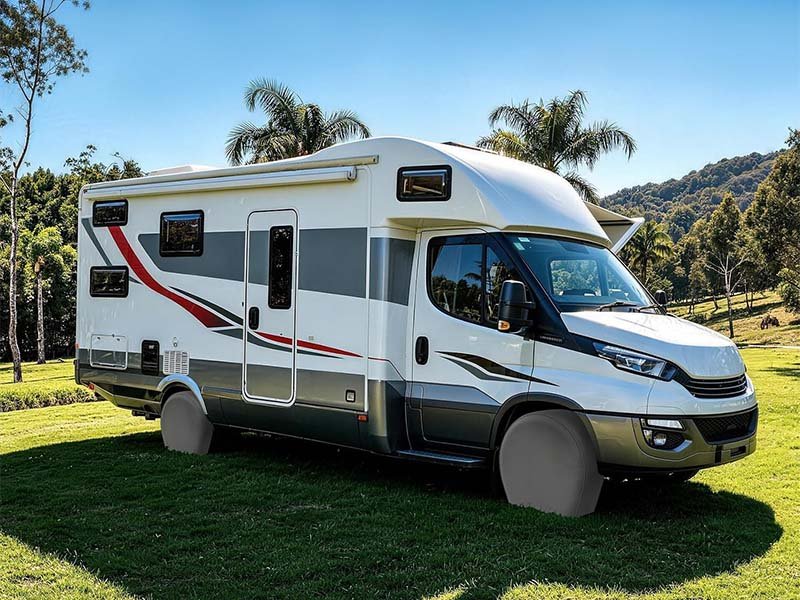
Choosing an RV tire cover looks simple until the vehicle stays parked outdoors for several weeks and the cover has to deal with intense sun, wind, rain, dust, temperature swings, repeated installation, and long periods of exposure without moving. That is when material differences become obvious. A fabric that feels thick in a showroom may become stiff in winter, while a lightweight cover that folds beautifully may not provide enough durability for seasonal storage. For that reason, choosing only by a label such as “heavy duty,” “waterproof,” or “900D” can lead to a product that sounds impressive but does not match the way the RV is actually used.
For most RV wheel-cover applications, 600D coated polyester Oxford provides the best overall balance of durability, manageable weight, flexibility, weather resistance, sewing performance, and cost. 420D is practical for standard or value-focused use, while 900D is more suitable for demanding long-term storage. Vinyl and PVC perform well where easy cleaning and a strong water-resistant surface matter, while reflective composites and solution-dyed acrylics serve more specialized heat or premium outdoor applications.
The key is that no material should be judged by one specification alone. Denier, finished fabric weight, coating chemistry, UV treatment, waterproof performance, seam construction, cold flexibility, color, fit, and retention all work together. A well-engineered 600D cover can outperform a poorly specified 900D product because the stronger fabric is only useful if its coating, seams, thread, elastic, buckles, and shape survive the same conditions. Once you start looking at the tire cover as a complete outdoor product rather than a piece of fabric, material selection becomes much easier to understand.
Which Material Is Best for RV Tire Covers?
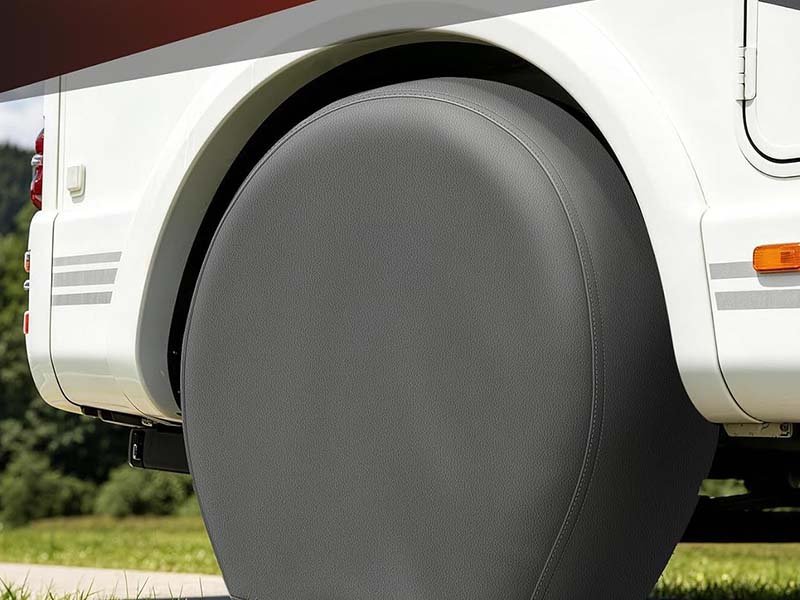
For most RV applications, 600D coated polyester Oxford is the most versatile choice because it provides a practical middle ground between lightweight 420D and heavier 900D. However, the best material still depends on climate, storage duration, wind exposure, water resistance, product weight, and price position. Specialized materials become more useful when heat, extreme weather, appearance, or prolonged outdoor storage becomes the dominant requirement.
What Makes a Good RV Tire Cover Material?
A good RV tire cover material needs to solve several problems at the same time. It must resist tearing and abrasion when users stretch it around the wheel, remain flexible enough for convenient installation, and maintain its shape without sagging after repeated use. It also has to withstand exposure to sunlight, moisture, road dust, dirt, temperature changes, and wind, which is a much broader requirement than simply being “thick.”
UV performance is particularly important because many RVs spend more time parked than moving. Long exposure can gradually affect surface color, coatings, synthetic fibers, and even the thread that holds the cover together. Water performance is equally dependent on more than the face material. Coating quality, seams, back openings, hems, and overall fit all influence how much rain or moisture can reach the covered tire.
The material platform used for Szoneier tire-cover development therefore evaluates more than denier or material trade name. Base fabric, weight, coating, waterproof performance, UV resistance, cold flexibility, tear strength, printing compatibility, and actual end-use conditions are considered before the material is approved for production.
A practical evaluation should normally consider the following points:
- UV stability for prolonged sunlight exposure.
- Tear and abrasion resistance for installation and wind movement.
- Water resistance or waterproof construction where required.
- Cold flexibility where winter storage is expected.
- Coating adhesion after folding and temperature changes.
- Seam strength around curved wheel-cover panels.
- Secure retention through elastic, bungee, buckles, or straps.
- Cleaning performance after exposure to road dust, mud, pollen, and outdoor debris.
These characteristics matter together. A strong fabric with weak seams can fail around the stitching, while an excellent waterproof coating may become inconvenient if the finished material is too stiff in cold conditions. Material selection therefore works best when the complete product is evaluated rather than when individual fabric properties are compared in isolation.
Is There One Best Material for Every RV?
There is no universal material that is ideal for every RV because the operating conditions differ too widely. A motorhome kept beneath a roof in a mild coastal climate has a different risk profile from a fifth wheel stored in direct desert sun for five months. Likewise, an RV owner who removes the covers every weekend has different needs from a storage facility where covers may remain installed for an entire season.
A 420D PU-coated Oxford construction can be very suitable for moderate conditions, standard retail products, and price-sensitive applications. It remains relatively light, compact, and easy to install. Moving to 600D adds a more substantial feel and greater abrasion and tear margin, making it a stronger option for premium RV 4-packs, dual-axle covers, trailers, and products intended for more regular outdoor use.
900D becomes easier to justify when the environment is more demanding. Long-term outdoor parking, commercial RV applications, strong wind, rough handling, or heavy-duty positioning may benefit from the added structural margin. Szoneier’s RV material framework follows this same progression: 420D PU Oxford for standard use, 600D PU Oxford as the primary premium material, and 900D Oxford for heavier-duty exposure.
Climate can change the recommendation again. High-sun regions may benefit from silver-coated Oxford or heat-reflective materials. Cold climates place more emphasis on low-temperature flexibility and cold-crack behavior. Premium long-term outdoor products can also move toward solution-dyed acrylic or selected marine-grade materials where appearance and UV stability are more important than achieving the lowest possible material cost.
Which Material Offers the Best Value?
The best value is rarely the cheapest fabric and rarely the heaviest option. Value comes from choosing enough material performance to meet the expected use without adding cost, weight, packaging volume, or stiffness that the customer will not actually benefit from. This is particularly important for RV accessories that are sold through retail, e-commerce, or international distribution, where a heavier material can affect much more than the manufacturing price.
For many mainstream products, 600D works well because it provides a noticeable performance upgrade from 420D while remaining easier to fold, sew, pack, ship, and install than heavier 900D constructions. A 900D material may provide greater abrasion and tear margin, but it also increases finished product weight, carton volume, and manufacturing difficulty. Those trade-offs are worthwhile only when the target use demands them.
Szoneier’s internal material guidance specifically avoids treating 900D as automatically superior. For some products, 600D offers better commercial balance because shipping weight and package size remain manageable while durability is already sufficient for the intended environment.
A practical product ladder can therefore be built around actual use:
- 420D: standard functional and value-focused products.
- 600D: premium mainstream and general outdoor use.
- 900D: extra-heavy-duty and prolonged exposed storage.
- Marine Vinyl: premium surface feel and vehicle-oriented appearance.
- Reflective Composite: high-heat and strong-sun applications.
- Solution-Dyed Acrylic: premium long-term UV exposure.
This gives each price point a clear reason to exist instead of relying on marketing words such as “premium,” “ultra,” or “professional” without a measurable change in material or construction.
How Do 420D, 600D, and 900D Oxford Compare?

420D, 600D, and 900D describe yarn denier rather than complete fabric performance. Higher denier generally provides a heavier and more substantial woven base, but coating, finished GSM, UV treatment, weave density, and construction remain equally important. In practical RV use, 420D favors lower weight, 600D provides the strongest overall balance, and 900D offers additional durability for demanding storage conditions.
What Does Denier Really Mean?
Denier measures yarn linear density. A larger number generally indicates heavier yarn, which can contribute to a stronger, thicker, and more structured woven fabric. The problem is that online product descriptions often use denier as if it were a complete quality grade. It is not. Two fabrics both sold as 600D can perform very differently once coating weight, weave density, UV additives, backing, surface treatment, and finished GSM are considered.
For example, a lightweight 600D PU-coated Oxford can remain relatively flexible and compact, while a 600D polyester fabric with a thick PVC backing can become much heavier, stiffer, and more water resistant. Both products can legitimately be called 600D, yet the customer experience, packaging size, cold-weather behavior, and waterproof performance may be noticeably different.
For this reason, Szoneier does not treat “600D” as a complete purchasing specification. A usable technical description should also identify polyester Oxford construction, weave density, finished GSM, PU or PVC coating, waterproof requirement, UV grade, color, and surface finish.
This distinction becomes especially important when comparing quotations from different manufacturers. A lower price may not represent the same finished construction even when the denier number matches. Comparing only “420D versus 600D” or “600D versus 900D” can hide significant differences in coating quality and actual fabric weight.
Is 600D the Best Balance?
For a large part of the RV tire-cover market, 600D is the most practical premium level. Szoneier’s material database positions 600D polyester Oxford as a core material for RV 4-packs, dual-axle covers, triple-axle covers, travel trailers, fifth wheels, outdoor storage products, private-label programs, fleets, and premium retail products. Depending on the coating system, finished weight generally falls around 250–380 g/m², while heavier PVC-backed versions can reach approximately 320–400 g/m².
PU-coated 600D can also be specified to different water-performance levels. Internal development targets include approximately 3,000 mm hydrostatic resistance for basic constructions, 5,000 mm for premium applications, and around 8,000 mm for selected higher-waterproof projects. These figures are controlled specification targets rather than universal ratings for every product sold as 600D.
| Oxford Grade | Typical Position | Useful Specification | Common RV Application | Main Trade-Off |
| 420D Oxford | Standard | Lower finished weight | Single, 2-pack, 4-pack | Less durability margin |
| 600D PU Oxford | Premium Core | About 260–300 g/m² in standard builds | RV 4-pack, dual axle, fifth wheel | Higher cost than 420D |
| 600D PVC Oxford | Waterproof Heavy Duty | About 320–420 g/m²; 5,000–10,000 mm internal targets | Wet storage, fleet, long exposure | Heavier and stiffer |
| 900D Oxford | Extra Heavy Duty | About 330–480 g/m² typical finished range | Seasonal storage, commercial RV | More weight and bulk |
| Silver 600D | Heat Focused | Silver reflective-type coating | High-sun RV storage | Less suitable for detailed graphics |
The reason 600D works so well is not that it dominates every laboratory test. It is because the material remains manageable throughout the entire product lifecycle. It can be cut efficiently, sewn around curved shapes, reinforced around hems, folded into reasonable packaging, and installed without making the user feel as though they are fighting with the cover.
When Is 900D Worth It?
900D is worth considering when the RV tire cover needs a larger margin against wear, abrasion, pulling, wind movement, and prolonged exposure. Szoneier’s material platform positions 900D for extreme outdoor storage, premium RV products, commercial trailers, fleets, long-term parking, and heavy-duty retail programs. Typical finished material weight is approximately 330–480 g/m², depending on coating and construction.
That additional material substance can make sense when the RV remains parked outdoors for months at a time. A storage facility, fleet operation, seasonal trailer, or premium heavy-duty product may benefit from the added structure because the cover experiences repeated wind movement and prolonged exposure without frequent removal.
The trade-off is that 900D generally creates a heavier and less compact finished product. Folding becomes less convenient, packaging occupies more volume, material consumption can increase, and sewing equipment must handle the thicker construction consistently. These factors can affect both production efficiency and shipping economics.
For that reason, 900D should be selected because the environment justifies it rather than because the specification number appears stronger in a comparison chart. A customer removing covers every few days may appreciate the flexibility of 600D far more than the additional structural margin of 900D. A customer leaving an RV outdoors for an entire winter or summer season may reach the opposite conclusion.
Is Vinyl or Oxford Better for RV Tire Covers?
Oxford is generally the stronger all-around choice for functional RV wheel-cover sets because its woven polyester structure provides good flexibility, tear resistance, and manageable weight. Vinyl and PVC-based materials perform particularly well where a smooth waterproof surface, easy cleaning, graphic printing, or premium appearance is important. The better material depends on climate, storage duration, product structure, and how the cover will be used.
Is Vinyl More Waterproof?
Vinyl and PVC-based materials have a natural advantage when the goal is a smooth surface that resists water and can be wiped clean easily. Rain, dirt, road dust, bird droppings, and mud can usually be removed from a vinyl surface with much less effort than from a textured woven fabric. That practical benefit is one reason vinyl remains common across outdoor automotive accessories.
However, a waterproof surface does not automatically mean the finished tire cover is completely waterproof. Sewing creates needle holes, and water can also enter through the back opening, hems, poorly controlled seams, or gaps created by incorrect fit. This is an important distinction because many product listings use the word “waterproof” based only on the face material.
Szoneier’s material guidance makes the same distinction. PVC can provide strong surface waterproofing, while overall cover performance still depends on sewing, seam construction, back structure, and openings. Oxford fabrics generally depend on PU or PVC coatings to increase water resistance or achieve stronger waterproof performance.
It is also useful to understand that the word “vinyl” is often used commercially for a broad family of PVC-based flexible materials rather than one standardized grade. Standard printable vinyl, premium synthetic leather, UV-stabilized vinyl, and marine-grade vinyl can vary greatly in backing, thickness, flexibility, UV performance, and surface quality.
A meaningful comparison therefore needs the actual material grade rather than simply “vinyl versus Oxford.”
Is Oxford More Tear-Resistant?
Oxford’s woven polyester structure makes it particularly useful for RV wheel covers that need to tolerate repeated stretching, folding, wind movement, and contact with rough outdoor surfaces. Instead of relying on a continuous synthetic surface alone, the woven yarn network distributes load across the fabric, giving properly specified Oxford useful tear and abrasion resistance.
The performance changes as the grade increases. Internal comparisons position 420D as lighter and more flexible, 600D as more structured with higher abrasion resistance, and 900D as stronger again with additional weight and bulk.
Still, a heavier base fabric does not guarantee a more durable finished cover. Many real-world failures occur around seams, thread, elastic, binding, buckles, or attachment points rather than through the middle of the panel. If the main fabric becomes stronger but every surrounding component remains unchanged, the weakest point simply moves elsewhere.
For long-term outdoor products, Szoneier’s development guidelines combine upgraded fabrics with reinforced stitching, stronger hems, bungee or buckle retention, UV-resistant thread, and appropriate binding.
That is the more useful way to think about durability. Oxford provides a strong platform, but the sewn construction determines whether that strength survives months of actual use.
Which Material Handles Cold Better?
Cold-weather performance is often overlooked because many material samples are evaluated in a warm showroom or office. A heavy PVC-coated fabric can feel rugged at room temperature but become significantly stiffer after prolonged exposure to low temperatures. Once the material is cold, repeated folding or pulling can place more stress on the coating, seams, and high-flex areas.
For winter applications, the important measurements include cold-crack resistance, fold performance, low-temperature flexibility, and coating adhesion. A material that provides excellent water resistance but becomes brittle or difficult to install in freezing conditions may not be the best choice for the final product.
Szoneier’s cold-climate material framework favors premium PU, cold-grade marine vinyl, and 600D PU-coated Oxford for relevant applications. It also avoids treating heavy PVC-backed fabric as an automatic first choice when verified cold-crack information is unavailable.
This matters particularly for products sold across large geographic markets. The same RV cover may be used in Texas, Colorado, Ontario, or northern Europe. If one specification is intended to serve all of those environments, the development team should examine how the actual finished coated fabric behaves after low-temperature conditioning rather than relying only on its thickness or waterproof number.
Which Material Works Best in Different Climates?

Different climates place different stresses on an RV tire cover. Moderate conditions usually work well with coated 420D or 600D Oxford, while strong sun favors UV-treated or reflective materials. Wet environments benefit from stronger water barriers, cold regions need greater flexibility, and prolonged outdoor parking demands stronger UV, tear, seam, and wind performance. Climate should therefore influence both the material and the finished construction.
Which Material Is Best for Strong Sun?
Sunlight is one of the main reasons people cover RV tires, but the cover itself must survive the same environment it is protecting the tire from. Prolonged UV exposure can contribute to fading, surface aging, coating deterioration, and gradual loss of flexibility. Because an RV may remain parked in the same position for months, exposure can accumulate continuously on the same side of the cover.
High-sun environments can therefore justify materials designed around UV stability or solar heat management rather than simply increasing denier. Silver-coated 600D, reflective composites, UV-stabilized PVC, and solution-dyed acrylics each solve the problem in different ways.
For selected premium 600D UV-treated programs, Szoneier’s internal development targets include approximately 500 hours of accelerated UV exposure, while some higher-level projects target approximately 800 hours. These are internal development and comparison targets rather than promises of a specific outdoor lifespan.
Color should also be considered. Silver, white, beige, and light gray surfaces generally make more sense when solar heat absorption is a major concern. Black remains popular because it looks clean and works with many RV designs, but a long-term black outdoor product should use an appropriately stabilized material rather than relying on an untreated basic fabric.
Which Material Is Best for Rain and Cold?
Wet and cold conditions create an interesting design conflict. Heavy coatings can improve water resistance, yet those same coatings may make the fabric stiffer in low temperatures. The best material therefore needs to balance the required water barrier with enough flexibility for installation, folding, and repeated use.
A 600D PVC-coated Oxford can provide a strong water barrier for wet storage. Internal constructions generally fall around 320–420 g/m², with hydrostatic targets of approximately 5,000–10,000 mm depending on the selected specification. This makes the material suitable for long-term storage, fleet applications, commercial trailers, and projects where water resistance is a high priority.
In colder markets, a PU-coated 600D construction may provide a more useful balance because it usually remains more flexible than a heavy PVC-backed version. The final decision should consider not only a laboratory water number but also how the cover behaves after exposure to cold, repeated folding, and installation around a full-size RV wheel.
Long-term storage raises the stakes further. Szoneier’s application database treats storage periods of 1–6 months or longer as one of the more demanding scenarios because the product may face UV, high heat, temperature cycling, dust, rain, snow, strong wind, and prolonged exposure without interruption.
That is exactly where climate-specific development becomes more valuable than choosing a single heavy material for every market.
Are Reflective Fabrics Better for Heat?
Reflective materials are useful when solar heating is one of the main problems. A silver or metallized surface is intended to manage solar radiation at the cover surface rather than simply relying on fabric thickness. This can make reflective constructions attractive for RVs parked in exposed storage lots, driveways, campgrounds, or hot-climate regions.
Szoneier’s reflective composite platform can include silver woven faces, metallized layers, polyester or PE bases, foam layers, and protective backing. Depending on construction, typical internal material weight ranges from approximately 150–350 g/m².
| Climate or Storage Condition | Practical Starting Material | Main Requirement | Useful Upgrade |
| Moderate climate | 420D–600D PU Oxford | Balanced protection and flexibility | UV-treated 600D |
| Strong sun / hot storage | Silver-coated 600D | UV stability and solar management | Reflective composite |
| Long-term outdoor parking | 600D UV-treated Oxford | UV, tear, seam and wind performance | 900D UV-treated Oxford |
| Heavy rain / wet storage | 600D PVC-coated Oxford | Stronger water barrier | 900D coated Oxford |
| Cold climate | 600D PU-coated Oxford | Low-temperature flexibility | Cold-grade marine vinyl |
| Premium outdoor | Solution-dyed acrylic | UV and color stability | Premium marine construction |
Reflective materials still have trade-offs. Metallic surfaces may show scratches more clearly, and some constructions are less suitable for large detailed graphics. They also should not automatically be marketed as traffic-safety reflective materials. Szoneier’s internal guidance distinguishes ordinary solar-reflective or heat-reflective constructions from certified retroreflective materials used for traffic safety.
For premium long-term outdoor products, solution-dyed acrylic offers another approach. Instead of focusing mainly on reflection, it is designed around long-term color and UV stability, making it attractive for high-end RV or outdoor applications where appearance matters alongside protection.
How Do UV, Waterproofing, and Durability Compare?
UV resistance, waterproofing, and durability describe different aspects of performance. A material may be waterproof but poorly stabilized against sunlight, highly abrasion-resistant but stiff in winter, or UV-stable yet weak around seams. A reliable RV tire cover combines the right base fabric, coating, thread, seams, retention system, and testing so that one strong property does not hide weaknesses elsewhere.
How Does UV Damage Tire Covers?
UV damage develops gradually. Fading may be the first visible sign, but longer exposure can also affect coatings, flexibility, tear performance, and the strength of components surrounding the main material. RV tire covers are particularly exposed because the vehicle can remain stationary for weeks or months, allowing one side of the product to receive continuous sun without interruption.
For long-term outdoor products, Szoneier’s material-selection guidelines consider UV performance alongside tear strength, water resistance, wind exposure, seam strength, and color stability.
The main fabric is only one part of this system. Sewing thread can weaken, elastic can lose recovery, printed graphics can fade, and some plastic components can become brittle. A premium UV-treated face fabric therefore should be matched with compatible thread, bindings, elastic, buckles, and other exposed parts.
This is one reason premium tire covers should not be developed by upgrading only the denier. If a 900D body is combined with ordinary thread and a weak elastic hem, the product may still fail at the seam or opening while the main panel remains intact.
A more realistic definition of outdoor durability is the ability of the entire assembled cover to continue performing after repeated exposure, not simply the ability of a square piece of material to pass one laboratory test.
Is Water-Resistant the Same as Waterproof?
Water-resistant and waterproof should not be treated as interchangeable terms. Water resistance generally means that a material or construction can resist penetration to a certain level, while waterproofing implies a more substantial barrier. The distinction becomes especially important for sewn outdoor products because the test result of a flat fabric does not automatically describe the behavior of the finished cover.
A premium Oxford construction can combine a face-side durable water-repellent treatment with a PU or PVC back coating. The face treatment encourages droplets to bead and reduces water absorption, while the back coating provides the main barrier. Szoneier uses this type of face DWR + back PU/PVC logic in selected premium RV material constructions.
The completed cover still contains seams, needle holes, openings, hems, and retention components. If those areas are not designed correctly, water can still enter even when the face material has a high hydrostatic rating.
Marine canvas provides another useful example. Premium canvas can be highly water-repellent and more breathable than PVC, but not every version should be marketed as fully waterproof. Additional PU, acrylic, or PVC backing and seam treatment may be required when stronger waterproof performance is needed.
Precise claims are better for both the user and the brand because they describe what the product can genuinely do instead of creating expectations based on a single material specification.
How Should Durability Be Tested?
Durability testing is most useful when every test corresponds to a real failure mode. There is no single number that tells you how long an RV tire cover will last because sunlight, abrasion, rain, cold, pulling, folding, and wind affect different parts of the product in different ways.
Szoneier’s internal tire-cover testing scope includes material thickness, GSM, tensile strength, tear strength, hydrostatic resistance, spray repellency, abrasion, colorfastness, print adhesion, scratch resistance, accelerated UV aging, temperature exposure, cold-crack behavior, pull force, and seam strength.
The test emphasis should change depending on the final product. A cover designed for desert storage deserves more attention to accelerated UV exposure and heat behavior. A winter product requires stronger evaluation of cold flexibility and coating adhesion. A fleet or commercial product should place more emphasis on seams, abrasion, retention, and repeated installation.
Production control is just as important as initial laboratory approval. Szoneier’s quality system classifies materials as Pending, Conditional, Approved, Premium Approved, or Rejected and combines this material control with traceability, first-piece approval, inline inspection, final inspection, corrective action, and golden-sample reference control.
That approach matters because a strong prototype is not enough. Consistent material lots, coating weight, sewing quality, shade, and finished dimensions have to remain stable during repeat orders if a product is expected to build reliable reviews and long-term customer confidence.
How Should Brands Specify RV Tire Cover Materials?

RV tire-cover materials should be specified through measurable construction and performance requirements rather than a short phrase such as “600D waterproof fabric.” A useful specification identifies the base fabric, denier, finished GSM, coating type, water-performance target, UV requirement, temperature range, color, construction method, retention system, intended climate, and testing plan before the first production sample is approved.
What Should Be Defined Before Sampling?
The most efficient time to solve material problems is before the first sample is cut. A manufacturer needs to understand not only what the cover should look like but also where it will be used, how long it will remain outdoors, how frequently customers will remove it, what retail position it needs to achieve, and what claims will appear on the packaging or product listing.
A useful project brief should define the RV or wheel-cover format, target tire-size range, geographic market, expected storage duration, primary climate risks, preferred color, required logo or printing, retention method, target price level, packaging method, and expected production volume.
Those details make it possible to choose a material logically rather than selecting fabric first and forcing the rest of the product around it. A mainstream RV 4-pack may begin with 420D or 600D PU-coated Oxford. A premium seasonal-storage version may use UV-treated 600D, while an extra-heavy-duty model can move to 900D. A high-heat version may introduce silver-coated Oxford or reflective composite, and a premium outdoor range may justify solution-dyed acrylic.
Szoneier’s material-selection workflow follows the same sequence by considering product type, market positioning, climate, printing requirement, quantity, fulfillment model, and expected use before defining a primary material, an alternative, and an upgrade.
This makes it much easier to build several products that genuinely serve different users instead of creating multiple SKUs that differ mainly in price and marketing language.
Which Tests Matter for Material Approval?
The test plan should match the claims being made about the product. A heavy-duty tire cover should have evidence around tear resistance, abrasion, seams, and retention. A long-term outdoor product needs stronger attention to UV aging, color stability, coating durability, water resistance, and temperature behavior. A winter-market product should include cold-crack and flexibility evaluation.
A practical development process normally moves from written specification to material screening, sample development, fit verification, functional testing, revision, material approval, golden-sample approval, and controlled bulk production. The goal is to identify problems while the cost of changing them is still low.
| Specification Area | What to Record | Practical Example |
| Base Fabric | Fiber and construction | 100% polyester Oxford |
| Denier | Yarn class | 420D / 600D / 900D |
| Finished Weight | GSM range | 600D PU around 260–300 g/m² |
| Coating | Backing chemistry | PU or PVC |
| Water Target | Defined hydrostatic level | 3,000 / 5,000 / 8,000 mm project levels |
| UV Requirement | Accelerated exposure target | 500 h standard premium; 800 h selected target |
| Cold Requirement | Flex / cold-crack testing | Required for winter programs |
| Construction | Seam and reinforcement | Reinforced hem, controlled seam allowance |
| Retention | Installation method | Elastic, bungee, buckle, strap |
| Quality Control | Production reference | Approved material + golden sample |
These figures should always remain linked to the actual project specification. A generic 600D material should never inherit the claims of a tested premium 600D construction simply because the same denier number appears in both descriptions. Szoneier’s 600D material system itself contains multiple coating weights and hydrostatic targets, which illustrates how widely one denier class can vary.
The most reliable approval system therefore records the material specification, supplier or source, approved lot characteristics, test results, color, coating, and golden sample so that later production can be checked against a known standard rather than against memory or appearance alone.
How Do You Balance Cost and Durability?
The most effective cost control comes from removing specifications that do not solve a customer problem while protecting the features that determine real outdoor performance. Simply making the material thinner to save money can shorten product life, while making it heavier simply to increase the denier number can create unnecessary shipping, packaging, and handling costs.
A practical product range can use 420D for standard functional products, 600D for premium mainstream use, and 900D for true heavy-duty storage. Reflective materials can then be added for hot climates, while solution-dyed acrylic or marine-grade constructions can serve premium outdoor applications.
Commercial quantities also influence what is realistic. For stock-colored Oxford, Szoneier’s current internal guidelines indicate that many projects can begin around 30–50 pieces, while custom-dyed Oxford can require approximately 300–500 pieces per color. Special waterproof coatings, UV treatments, flame-retardant finishes, or laminations may require material quantities corresponding to roughly 500–1,000 pieces, depending on the fabric supplier and treatment process.
Those figures explain why material selection has to consider both engineering and commercial reality. A technically impressive fabric may be the wrong choice if it creates excessive inventory, raises shipping weight substantially, or pushes the final retail price beyond what the market will support.
For custom RV tire-cover programs, Szoneier can work backward from the intended climate, storage duration, wheel format, target price, branding, packaging, and expected order scale before locking the material specification. This approach allows coating, construction, testing, and packaging to be evaluated as one product rather than as separate purchasing decisions.
Final Thoughts
There is no single RV tire-cover material that wins every comparison. 420D Oxford can be exactly right for a lightweight standard product, 600D is often the strongest overall balance for premium mainstream use, and 900D becomes valuable when prolonged exposure, wind, abrasion, or commercial storage demands a larger durability margin. Vinyl and PVC remain excellent choices where water resistance, easy cleaning, printing, or smooth appearance matters, while reflective composites and solution-dyed acrylics solve more specialized heat and long-term UV challenges.
The more useful question is not “Which material has the biggest number?” but “Which material, coating, construction, and retention system best match the environment where this RV will actually sit?” A well-designed cover connects material specification with climate, tire size, fit, seam strength, thread, coating, UV performance, packaging, and expected use. When all of those decisions support the same goal, the result is easier to install, easier to sell, and much more likely to perform the way the customer expects.
For brands developing custom RV tire covers, this same principle is especially important. A material specification should be chosen before bulk production based on real performance requirements rather than copied from a competing product title. That makes it possible to build a clear standard, premium, heavy-duty, or climate-specific product range while controlling cost and maintaining repeatable quality across future orders.
FAQ
What is the best material for RV tire covers?
For most RV applications, 600D PU-coated polyester Oxford is one of the best all-around choices because it provides a strong balance of durability, flexibility, weight, weather protection, and cost. 420D is suitable for standard or value-oriented products, while 900D is more appropriate for heavy-duty or long-term outdoor storage. The final choice should also consider UV exposure, rainfall, temperature, wind, and expected storage duration.
Is 600D or 900D better for RV tire covers?
900D is generally heavier and offers greater structural, abrasion, and tear margin, but it is not automatically better for every RV. 600D is lighter, easier to fold and install, and usually more economical to package and ship. For normal premium RV use, 600D is often the better balance, while 900D becomes more attractive for seasonal storage, exposed parking, commercial fleets, or other genuinely heavy-duty applications.
Are vinyl RV tire covers better than Oxford fabric covers?
Vinyl provides a smooth surface that is easy to clean and naturally suited to strong water resistance, while Oxford offers a woven textile structure with good tear resistance, flexibility, and practical weight. Oxford is commonly used for RV wheel-cover sets, especially in 420D, 600D, and 900D grades. Vinyl can be preferable for products emphasizing easy cleaning, printing, waterproof surface performance, or a more automotive-style appearance.
Are 600D Oxford RV tire covers waterproof?
600D Oxford itself is not automatically waterproof. Water performance depends largely on its PU or PVC coating, surface treatment, and finished construction. Szoneier’s PU-coated 600D material system includes internal hydrostatic targets around 3,000 mm for basic specifications, 5,000 mm for premium specifications, and up to approximately 8,000 mm for selected higher-waterproof projects. Finished-cover performance still depends on seams, hems, openings, and fit.
What material is best for RV tires stored in direct sunlight?
For prolonged direct sunlight, UV-treated 600D Oxford is a strong general-purpose option, while silver-coated Oxford and solar-reflective composites are useful when heat management becomes especially important. Premium long-term outdoor products may also use solution-dyed acrylic because it is designed around stronger UV and color stability. Material color, thread, coating, seam construction, and retention should also be selected for prolonged exposure rather than relying on the face fabric alone.
What material is best for RV tire covers in winter?
Cold climates require flexibility as much as waterproofing. PU-coated 600D Oxford is often a practical RV option because it can remain more flexible than heavy PVC-backed constructions. Premium PU and cold-grade marine vinyl may also be used in suitable products. Important evaluation points include cold-crack resistance, low-temperature flexibility, fold testing, and coating adhesion, particularly when covers will be installed or removed during freezing conditions.
How long should an RV tire cover last outdoors?
There is no responsible universal lifespan because outdoor durability depends on UV intensity, climate, fabric grade, coating, color, seams, wind exposure, installation frequency, storage duration, and maintenance. Instead of relying on a fixed number of years, compare measurable factors such as UV treatment, tear and abrasion performance, coating stability, cold flexibility, seam strength, and product construction. Long-term storage lasting several months places much greater demands on the cover than occasional weekend use.


