 Skip to content

Tire Cover Testing Capabilities | Custom OEM Quality Control
- 3 lab technicians support internal material and finished-product testing.
- 17 verification areas cover physical performance, print durability, environment, hardware and fitment.
- 3 testing levels separate routine QC, development verification and formal third-party testing.
- Actual tire, 1:1 tire fixture and vehicle-specific fitment verification are available for applicable projects.
Tire Covers Fail in More Than One Way
Material Failure
- Thickness and fabric weight establish a measurable baseline.
- Surface, coating, color and visible defects are checked before release.
- Tensile and tear testing support grade comparison when strength matters.
- Lot references keep test evidence connected to the material actually used.
Outdoor Failure
- UV aging supports material-to-material comparison.
- Cold-flex and cold-crack checks expose low-temperature brittleness.
- Hydrostatic and spray methods address different water-performance questions.
- Accelerated testing is not converted into unsupported promises of fixed outdoor life.
Manufacturing Failure
- Seam strength is checked separately from base-material strength.
- Load-bearing accessories are tested against the product specification.
- Camera reinforcement is treated as a functional construction area.
- Fitment verifies whether the finished cover can be installed and removed correctly.
Branding Failure
A printed tire cover must survive folding, packing, installation, handling and outdoor exposure without becoming a different product from the approved sample. Print durability depends on the material surface, ink system, print process and curing or adhesion conditions. Szoneier verifies new combinations before bulk production rather than assuming one successful print method works on every substrate.
- Adhesion checks whether the printed layer remains attached.
- Scratch and rub checks reveal surface vulnerability.
- Fold and flex evaluation matters on soft, repeatedly handled materials.
- Color and surface condition can be compared before and after environmental exposure.
Six Testing Capabilities That Support Product Decisions
Material Verification
- Thickness and GSM create a measurable baseline.
- Surface and coating condition affect printing and outdoor behavior.
- Incoming lots can be compared with approved specifications.
- Failed or uncertain material is held for review instead of moving directly into production.
Mechanical Strength
- Tensile measures resistance under increasing load.
- Tear testing evaluates propagation from a damaged edge or cut.
- Seam strength identifies whether construction fails before the base material.
- Pull-force targets are tied to the product specification rather than one universal number.
Water Performance
- Spray and hydrostatic tests answer different questions.
- Coated Oxford, PVC and vinyl constructions are not treated identically.
- Seam and opening design remain part of finished-product performance.
- Test wording distinguishes water repellency from waterproof resistance.
Environmental Durability
- UV aging compares color, surface and retained integrity.
- Temperature exposure can reveal softening, deformation or coating change.
- Cold-crack testing focuses on low-temperature flexibility.
- Premium and climate-specific projects can use more demanding internal targets where appropriate.
Print Performance
- Tape or adhesion checks support print-process approval.
- Scratch and abrasion show surface durability.
- Fold and flex checks are important for soft covers.
- UV or environmental exposure can be combined with visual print evaluation for outdoor projects.
Functional Validation
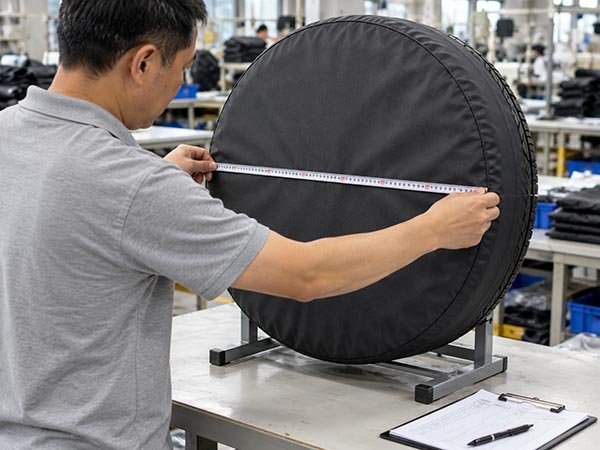
Functional testing verifies whether the tire cover works as a tire cover after materials, printing and sewing are complete. Szoneier uses actual tires, 1:1 tire fixtures, vehicle fixtures or actual vehicles where appropriate to verify diameter fit, side depth, tension, wrinkles, camera clearance, artwork position and removal. This product-specific validation cannot be replaced by fabric test data alone.
- Actual tire size is more important than vehicle name alone.
- Camera applications require functional clearance after installation.
- Exact-fit products should be snug without creating seam or material stress.
- Artwork position is checked in the installed condition, not only on a flat panel.
Three Testing Levels Match Different Project Risks
Level A - Incoming QC
- Used for routine material and production lots.
- Supports release, hold or quarantine decisions.
- Does not replace a development test when a new material has not been qualified.
- Keeps approved specifications connected to actual incoming production material.
Level B - Development Test
- Used before approving new material or product configurations.
- Supports side-by-side comparison between candidate constructions.
- Helps engineering identify weaknesses while changes are still economical.
- Results can feed material approval, sample revision and golden-sample decisions.
Level C - Third-Party Lab
Level C is used when the project requires independent evidence outside Szoneier’s internal laboratory. Typical triggers include customer specifications, retailer requirements, certification-related work or a formal external test report. The sample, scope, method and laboratory are defined before submission so the report corresponds to the actual product or component being reviewed.
- Customer-nominated laboratories can be supported.
- Formal reports remain separate from internal development records.
- Test scope is tied to a material, component or representative finished product.
- Existing reports are not treated as universal evidence for changed materials or future configurations.
Match the Product Risk to the Right Test
This matrix shows how Szoneier links a practical tire-cover risk to a measurable test and, most importantly, to the manufacturing decision that follows from the result.
| Product Risk | Typical Test | What It Measures | Manufacturing Decision |
|---|---|---|---|
| Material is lighter or thinner than approved | Thickness / GSM | Material construction and fabric mass | Release, hold or reject incoming material |
| Material may stretch, break or tear | Tensile / Tear | Mechanical resistance under defined loading | Select material grade or reinforce construction |
| Seam may fail before the material | Seam Strength | Strength of stitched construction | Adjust seam, thread, stitch or material pairing |
| Cover faces rain or storage exposure | Hydrostatic / Spray | Water-pressure resistance or surface repellency | Select coating, material grade or product claim |
| Surface may wear during use | Abrasion / Scratch | Resistance to rubbing and visible surface damage | Approve surface or select a different finish |
| Product faces strong sunlight | Accelerated UV | Comparative color and surface aging | Approve outdoor grade or move to premium material |
| Product is sold into cold climates | Temperature / Cold Crack | Low-temperature flexibility and cracking behavior | Select cold-suitable material grade |
| Printed graphic may peel or mark | Adhesion / Scratch / Fold | Print-to-substrate compatibility | Approve ink and printing process or revise it |
| Elastic or hardware may detach | Pull Force | Retention and load-point behavior | Approve accessory, reinforcement or safety margin |
| Metal hardware may corrode | Salt Spray Screening | Corrosion response under salt-fog exposure | Approve hardware finish or upgrade material/plating |
| Cover may not install correctly | Fitment Test | Diameter, depth, tension, camera and removal | Approve pattern, camera position and finished design |
From Test Requirement to a Controlled Decision
Define What the Test Must Prove
- Testing starts with the decision that needs evidence. A request such as “test the 600D” is incomplete because the customer may be concerned about fabric weight, tear strength, coating, water resistance, UV performance, print adhesion or finished-product strength. Szoneier first defines the risk, the material or finished-product configuration and the decision the result is expected to support.
- Requirement source: The trigger may come from a customer technical specification, an existing product benchmark, an outdoor use case, a new material proposal, a quality problem or an internal product-development target. The source matters because a comparison test and a formal acceptance test do not serve the same purpose.
- Sample definition: The team identifies whether the correct specimen is raw material, printed material, a sewn coupon, a complete tire cover, a hardware assembly or an installed product. A report on unprinted PVC is not automatically sufficient when the actual concern is print adhesion after folding, and a fabric-strength result does not prove a seam will hold under installation tension.
- Measurement context: A useful target includes the material identity, direction where relevant, method, unit, sample condition and acceptance or comparison basis. Szoneier avoids publishing isolated values without the information needed to understand what was measured.
Prepare a Representative Sample and Method
- The next step is to ensure the sample represents the product decision being made. New materials are identified by the relevant material reference and prepared in the condition required by the test. Printed samples use the intended substrate, ink system and process when print performance is being verified. Sewn and fitment samples use the actual construction intended for production as closely as the development stage allows.
- Condition control: Some tests are sensitive to orientation, coating side, print side, temperature history or previous environmental exposure. Szoneier records the specimen condition so a future comparison is meaningful. If the customer specifies a method or conditioning requirement, that requirement is incorporated before the test begins.
- Method selection: Internal development methods are selected to answer the engineering question efficiently. Where a customer requires a recognized external method or formal laboratory report, the scope is moved to Level C and prepared for third-party submission. Internal testing is not relabeled as independent certification.
- Reference control: For comparative development, an approved current material, previous golden sample or customer-supplied benchmark can be tested alongside a candidate. This often gives the sourcing team more useful information than a single standalone number because it shows whether the proposed change moves performance in the expected direction.
Record Data, Failure Mode and Observations
A test result is more useful when it records not only the final number but also how the specimen failed. Szoneier’s laboratory process includes sample preparation, test method awareness, data recording and test reporting. For mechanical tests, the failure may be a material break, tear propagation, seam opening or accessory detachment. For environmental tests, the important observations may include color shift, surface cracking, coating change, brittleness or print damage.
Measured result: Numerical data is recorded with the relevant unit and test context. Where multiple specimens are used, the individual results and comparison logic should remain available rather than being reduced to an unsupported marketing claim.
Failure location: A strong fabric with a weak seam requires a different engineering response from a weak fabric with an intact seam. Similarly, a pull-force failure in a buckle, stitching line or reinforcement patch points to different corrective actions. Recording the failure mode keeps the next decision technically useful.
Visual evidence: Before-and-after photographs are valuable for abrasion, scratch, UV, cold-crack, print and fitment work. They should be labeled against the sample or project reference so they remain evidence rather than generic laboratory photography.
Convert the Result Into Approval or Revision
The final purpose of the test is a controlled decision. A passing result can support material approval, print-process release, pattern approval or movement toward the golden sample. A weak result should lead to a documented action such as material replacement, coating change, reinforcement, seam revision, new print preparation or a revised sample followed by re-verification.
Material decision: Candidate material may be approved, rejected or restricted to a lower-demand application. A premium outdoor project may require a different grade from a promotional or short-term use program even when both products look similar when new.
Product decision:Fitment, seam and pull-force results can change pattern depth, elastic tension, reinforcement size, hardware selection or assembly method. Testing therefore becomes part of product engineering rather than a separate laboratory activity.
Production decision:Approved data is connected to the material, sample or project standard that production will follow. If a later lot, supplier or process changes, the team can determine whether quick verification is sufficient or whether a new development or third-party test is required.
Material Baseline Testing Starts Before Production

Thickness Control
- Measure representative points rather than one convenient edge.
- Compare with the approved material specification.
- Investigate unusual variation before printing or cutting.
- Record the material and lot reference with the result.

Fabric Weight
- Compare incoming material with the approved GSM range.
- Use the same sampling approach for repeat comparisons.
- Read the result together with coating, thickness and surface condition.
- Do not infer tear or UV performance from GSM alone.

Surface and Coating
- Inspect printable and reverse sides where relevant.
- Check coating consistency and visible damage.
- Hold questionable rolls before value-added processing.
- Link recurring surface defects back to supplier and lot information.

Color and Lot
- Record supplier and material lot.
- Compare against approved color or material reference.
- Separate significant shade variation before cutting.
- Preserve lot information for repeat-order review.

Fold and Handling
- Check face material and coating after folding.
- Combine with print evaluation when the surface is decorated.
- Review cold-fold behavior for climate-sensitive projects.
- Compare new materials with the approved reference.

Material Release
- Pass material moves to production.
- Uncertain material is held for engineering or quality review.
- Nonconforming material is quarantined.
- Repeat issues can trigger supplier corrective action or requalification.
Tensile, Tear and Seam Tests Measure Different Risks
Tensile Strength Shows How the Material Carries Load
- Material direction: Woven textiles can behave differently in warp and weft directions, while coated sheet materials may show their own directional or backing effects. Recording direction prevents misleading comparisons between specimens that were prepared differently.
- Development use: A higher tensile result does not automatically make a material the best commercial choice. Weight, flexibility, print compatibility, sewability, climate performance and cost still matter. Tensile data helps engineering understand the strength margin within that larger decision.
- Failure observation: The laboratory records whether the specimen ruptures cleanly, stretches excessively or fails around a coating or backing interface. Those observations may indicate a material-selection issue that a final numerical value alone would miss.
Tear Strength Shows How Damage Can Propagate
- Application relevance: PVC, PU, vinyl and coated textiles are evaluated according to the product construction and test method being used. Denier or thickness can influence performance, but neither is treated as a substitute for measured tear behavior when the project requires stronger evidence.
- Engineering response: If a candidate material tears too easily for the intended structure, the team may select a different grade, add reinforcement, increase the radius around a cut feature, modify the binding or change the way load is distributed across the panel.
- Camera projects: Camera openings deserve special attention because a cut opening, reinforcement layer and repeated installation load are concentrated in one area. Tear data supports the material decision, while the finished camera structure still requires separate functional verification.
Seam Strength Shows Whether Sewing Becomes the Weak Point
A tire cover is a sewn product, so the strength of the assembled seam can be more important than the strength of the base material. Seam verification evaluates the interaction between face material, backing, thread, stitch pattern, seam allowance and needle penetration. This is especially important with PVC and vinyl, where excessively dense stitching can create a line of needle holes that weakens the material rather than strengthening the seam.
- Construction variables: Thread type, stitch density, seam width, reinforcement and panel curvature can all change the final result. Szoneier therefore evaluates seam performance against the intended production construction, not only against a generic fabric coupon.
- Failure mode: The laboratory notes whether failure occurs in the thread, the seam opening, the base material beside the stitch line or another construction point. Each failure mode leads to a different corrective action.
- Production connection: Once a seam construction is approved, the released work instruction and golden sample preserve the intended method. Inline and final QC then confirm that bulk production follows the same sewing standard rather than recreating the seam from memory.
Water Testing Separates Repellency From Resistance
Water behavior must be described precisely. Szoneier uses different methods for surface repellency, material resistance and finished-product construction because one test cannot prove every type of water performance.

Spray Repellency
- Useful for comparing surface treatments and coatings.
- Shows wetting behavior after a defined exposure.
- Can be repeated after selected durability conditioning when required.
- Should be reported separately from hydrostatic resistance.

Hydrostatic Resistance
- Measures resistance under water pressure.
- Helps compare coating and material constructions.
- Does not automatically include seam leakage or openings.
- Supports material selection for higher-exposure storage applications.

Seam and Opening Risk
- Inspect seam construction together with material data.
- Review camera-hole reinforcement and opening geometry.
- Avoid unsupported whole-product waterproof claims from fabric data alone.
- Match the final wording to the product design and intended use.

Application Decision
- Use case defines the necessary performance level.
- Higher resistance may add weight, stiffness and cost.
- Premium storage applications can justify stronger barrier materials.
- Commercial decisions should compare performance with handling, printing and packaging needs.
Abrasion and Surface Tests Simulate Real Handling

Abrasion Resistance
- Compare candidate materials under consistent conditions.
- Inspect coating wear, fuzzing, surface loss or visible change.
- Combine with tensile or tear data when heavy-duty performance matters.
- Record the material side and finish being tested.

Scratch Resistance
- Suitable for premium PVC, PU, vinyl and printed surfaces.
- Observe visible marks, coating removal or print damage.
- Compare dark and light finishes where appearance sensitivity differs.
- Use together with adhesion testing for decorated products.

Fold and Pack Handling
- Inspect fold lines after conditioning.
- Check for coating or print transfer.
- Evaluate packaging pressure and crease sensitivity.
- Use the approved fold method for high-value graphic products.

Before-and-After Evidence
- Label specimen and project reference.
- Photograph consistent areas and lighting where practical.
- Record the test condition with the image set.
- Keep failed examples for engineering review when useful.
UV, Heat and Cold Tests Address Climate Risk
UV Aging Is a Comparison Tool, Not a Lifetime Calculator
High-Temperature Exposure Checks Coating and Surface Stability
Cold-Crack Testing Checks Flexibility After Low Temperature
Cold conditions can make some coated and synthetic materials stiff or brittle. Cold-crack or low-temperature flex testing evaluates whether the material can be bent or handled after conditioning without cracking, delaminating or suffering unacceptable surface damage. This is particularly relevant for tire covers that may be removed, folded or installed during winter conditions. Internal material examples: Szoneier’s internal material logic uses approximate low-temperature tiers such as Standard PVC around -10 to -15 C, Premium PVC around -15 to -20 C, Premium PU around -20 to -25 C, and selected cold-grade marine vinyl around -25 to -30 C or below. Final suitability always follows the actual material TDS, test result and customer requirement. Construction relevance: A material result should be considered together with seams, binding and reinforcement. A cold-flexible face material does not solve a brittle accessory or overly rigid camera reinforcement. Approval use: Low-temperature evidence can change material grade, coating, structure or market recommendation before bulk production, which is more valuable than discovering cracking after the product reaches a cold-climate customer.
Print Durability Testing Protects Brand Graphics
Adhesion Check
- Test the actual substrate and print process.
- Pay special attention to low-energy or heavily textured surfaces.
- Compare failure type, not only visible pass/fail appearance.
- Recheck after a material or coating supplier changes.
Scratch Check
- Observe ink removal, coating damage or visible marking.
- Compare printed and unprinted control areas where helpful.
- Use consistent force or internal method for meaningful comparison.
- Document before-and-after condition for premium programs.
Fold Check
- Use the approved material and intended print process.
- Inspect high-coverage graphic areas.
- Combine with cold conditioning for climate-sensitive projects when needed.
- Review packaging fold method if a product repeatedly marks at the same location.
Flex Check
- Evaluate printed areas under realistic bending.
- Observe cracking, edge lifting or color change.
- Compare with the approved golden sample.
- Adjust print method, coating or artwork coverage if necessary.
Abrasion and Rub
- Useful for screen, digital and transfer comparisons.
- Record substrate, ink and curing or process condition.
- Inspect color loss and exposed base material.
- Use the same method when comparing suppliers or repeat lots.
Environmental Print Review
Premium outdoor programs can combine print evaluation with UV or temperature exposure. The objective is to see whether the graphic retains acceptable color, adhesion and surface condition after the material has been aged. Szoneier does not convert accelerated exposure into a fixed “years without fading” promise; the result supports comparative material and print-process decisions.
- Evaluate color and surface after exposure.
- Recheck adhesion when aging may affect the interface.
- Compare with unexposed control material.
- Use the result to approve or revise the outdoor printing system.
Pull-Force and Hardware Tests Protect Load Points

Elastic and Bungee
- Test the assembly, not only the raw cord.
- Observe attachment-point failure as well as cord failure.
- Compare retention with installation effort.
- Increase safety margin for premium or high-load applications where specified.

Buckles and Webbing
- Confirm approved hardware supplier and specification.
- Test attachment stitching together with the component.
- Check slip, break and detachment behavior.
- Reverify when hardware or webbing is substituted.

Camera Reinforcement
- Review reinforcement material and geometry.
- Check stitch or bonding integrity around the opening.
- Combine with actual fitment and camera-view verification.
- Avoid overly rigid reinforcement that distorts the surrounding cover.

Metal Hardware Corrosion
- Inspect red rust, white corrosion, plating failure and staining.
- Confirm function after exposure.
- Match screening depth to actual hardware and environment.
- Use third-party testing when a formal external method or report is required.
Fitment Testing Verifies the Finished Tire Cover
Actual Tire and 1:1 Fixture Confirm Diameter and Side Depth
- Diameter fit: The opening and body must match the tire’s overall diameter closely enough to produce a controlled appearance while still allowing normal installation. An exact-fit cover that is too tight can increase seam stress and distort printed artwork; a cover that is too loose can wrinkle or move.
- Side depth: Tire width and cover depth affect how much of the sidewall and tread area is covered. This is especially important when aftermarket tires are wider than the original vehicle specification.
- Retention: Elastic, bungee, drawstring or other fastening systems are evaluated in the installed condition so pull-force data and real-world handling support the same product decision.
Vehicle and Carrier Fixtures Check Camera-Specific Geometry
- Camera clearance: The opening must avoid blocking the field of view, lens housing or required movement. A centered hole is not automatically correct because camera position changes by vehicle, generation, carrier and tire setup.
- Reinforcement behavior: The structure around the opening should remain stable after installation and repeated handling. Cracking, delamination, excessive stiffness or displacement can create both functional and appearance problems.
- Artwork relationship: Camera-aware artwork is reviewed in the installed condition so a logo, pet face or text is not visually damaged by the opening even if the flat production artwork looked correct.
Wrinkle, Tension and Artwork Position Are Functional Results
- Snug fit: Exact-fit projects target a controlled, close appearance without overloading seams or deforming the material. The correct tension depends on material stiffness, backing, side depth and closure design.
- Graphic position: A circular logo or camera-aware graphic is checked while installed because panel curvature and tension can shift the visible center. This is particularly important for dealer logos and premium branding where a few centimeters of visual shift may be obvious.
- Removal: The customer must be able to remove the product normally. A cover that technically fits but requires excessive force is not a successful fitment result.
Fitment Approval Connects Testing to the Pattern Library
When fitment is approved, the result should connect to the controlled pattern and project record rather than remain as an isolated sample. Szoneier links product data such as tire size, vehicle, pattern ID, camera version, artwork version and golden sample so a repeat order can return to the same approved construction.
- Pattern control: A revised fitment result creates a new controlled pattern revision instead of silently modifying the cutting file under the same reference.
- Golden sample: The approved physical sample preserves the relationship between material, sewing, tension, print and fitment. Bulk first-piece checks can compare against this reference before sustained production begins.
- Repeat orders: If the tire size, camera carrier, material stiffness or other key condition changes, Szoneier reviews whether the existing fitment approval remains representative. Same SKU should mean the same approved product, not a gradually changing pattern.
Test Data Must Change a Manufacturing Decision
New Material Approval
Sample and Golden-Sample Approval
Bulk Production Release
Repeat-Order Verification
The second and third production runs are where supplier discipline becomes visible. Szoneier reviews the material lot, approved pattern, artwork revision, print process, camera version, golden sample and QC standard before a repeat SKU is released. Quick verification confirms whether the new material still matches the approved baseline, while significant supplier or process changes can trigger deeper development or third-party testing. Same SKU principle: The purpose is to reproduce the approved product, not gradually change material, color, tension or print under the same item number. Evidence continuity: Test records, material references and fitment approvals provide a technical basis for investigating any difference between production lots. Corrective action: If a repeat problem occurs, evidence moves into root-cause analysis and CAPA so the next order incorporates the verified correction rather than relying on an informal instruction.
Internal and Third-Party Testing Serve Different Purposes
Szoneier uses internal testing for fast engineering feedback and process control, while independent laboratories are used when the customer or project needs formal external evidence.
| Project Need | Szoneier Internal Testing | Third-Party Laboratory | Typical Output |
|---|---|---|---|
| Routine incoming material | Fast Level A checks against approved specification | Normally not required for every lot unless specified | IQC / material release record |
| New material development | Level B comparison of relevant physical, print or environmental properties | Added when formal external verification is required | Development report / third-party report |
| New tire-cover construction | Seam, pull-force, print, fitment and function verification | Used when customer protocol requires independent testing | Engineering decision / formal report |
| Outdoor material selection | UV, temperature, cold-crack, water and abrasion comparison | Used for customer-specified methods or independent validation | Comparative data / laboratory report |
| Printing approval | Adhesion, scratch, fold, flex and environmental review | Used when a retailer or customer requires external print testing | Print approval / external report |
| Customer technical specification | Internal pre-screening can identify risk before submission | Customer-nominated or qualified lab tests the defined method | Formal report tied to the sample |
| Certification-related requirement | Internal testing may support development but is not presented as certification | Qualified external body performs the required formal work | Certificate or formal report where applicable |
| Pre-shipment product inspection | Internal QC verifies conformity to approved product | Independent inspection company may check the shipment | Final QC / inspection report |
Tire Cover Testing Frequently Asked Questions

Start a Tire Cover Testing Review
- Product type and tire size
- Vehicle and camera details, if applicable
- Material specification or physical sample
- Intended environment and use case
- Quantity and target schedule
- Required test method or target value
- Existing test report or benchmark
- Customer or retailer test protocol
- Required third-party laboratory, if specified
- Drawings, artwork or construction files

