 Skip to content

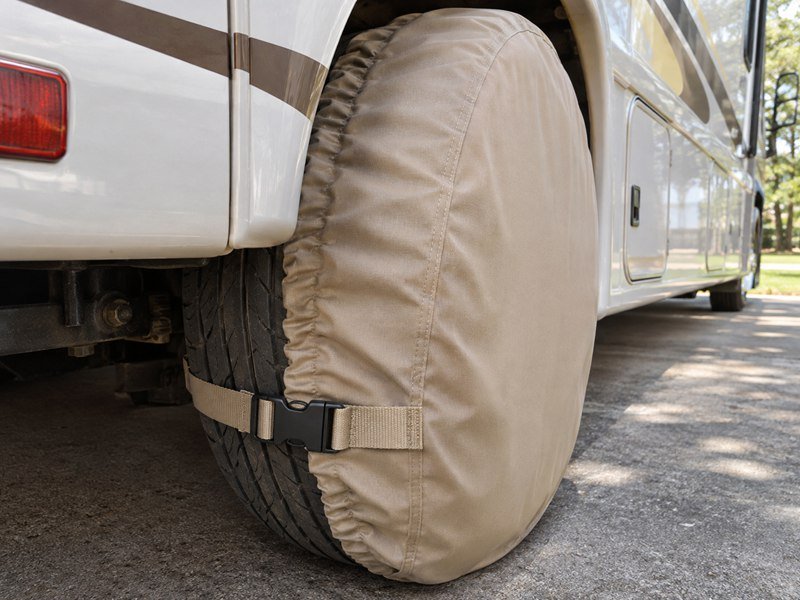
An RV tire cover looks simple until one actually refuses to fit correctly. A cover may be listed for the right tire diameter yet hang too low, wrinkle across the face, expose part of the sidewall, stretch the elastic almost to its limit, or flap every time a gust reaches the vehicle. These problems are rarely caused by one measurement alone. Overall diameter matters most, but tire width, cover depth, material flexibility, pattern shape, axle spacing, elastic tension, and the retention system all influence how the finished cover behaves after installation.
Most RV tire cover fit problems come from choosing a cover by rim diameter instead of overall tire diameter, placing a tire at the extreme end of a broad universal size range, ignoring tire width, or using a pattern and retention system that do not match the real installation conditions. A properly fitted cover should protect the intended sidewall area, install without excessive force, avoid large unsupported folds, and remain reasonably stable during normal outdoor storage.
This distinction matters because a cover can be technically compatible with a published size range and still look or perform poorly. A 27-inch tire and a 29-inch tire do not occupy the same amount of space inside one universal 27–29 inch cover, even though both are listed as compatible. For an RV owner, that difference can be frustrating. For a brand shipping hundreds or thousands of covers, it can become a return, review, replacement, and customer-service problem. Understanding the mechanics behind fit is therefore more useful than simply memorizing another size chart.
What RV Tire Cover Fit Problems Are Most Common?
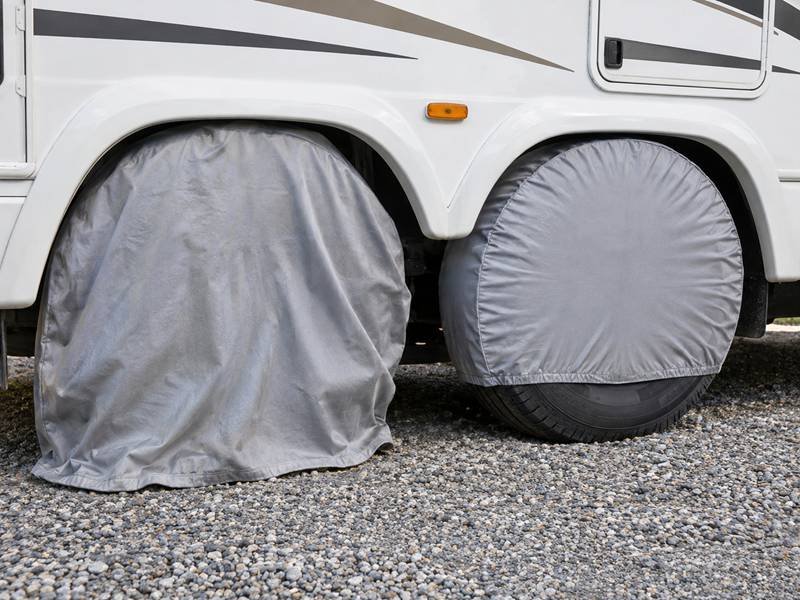
The most common RV tire cover fit problems are excessive looseness, excessive tightness, exposed sidewalls, poor bottom coverage, wind flapping, shifting, and incorrect alignment on dual-axle applications. Most are linked to inaccurate tire measurements, wide universal sizing ranges, unsuitable cover depth, material stiffness, or retention components that do not provide enough control for the actual tire and storage environment.
Loose, Tight, or Simply Different?
A tire cover does not need to fit like a rigid molded shell. Some installation allowance is necessary because the fabric has to move over the tread shoulder and still come off without a struggle. The useful distinction is whether that allowance remains controlled. When a cover contains large unsupported folds, hangs close to the ground, rotates around the tire, or moves substantially in light wind, the fit is probably looser than the product requires.
An undersized cover produces a different set of symptoms. Installation feels unusually difficult, the elastic reaches a high level of stretch before the cover is fully seated, seams begin to distort, and the bottom section may stop before reaching the intended sidewall coverage. Szoneier’s fit guidance treats excessive wrinkling, loose fit, and wind flapping as oversizing symptoms, while excessive elastic stretch, seam loading, deformation, and inability to install are associated with undersizing.
The practical challenge is that a tire can fall inside the advertised size range and still sit near one extreme of the pattern. A universal cover designed for several diameters must contain enough material to fit the largest tire in the group. The smallest tire therefore leaves more unused fabric. That does not automatically mean the product is defective, but it does mean universal fit and close fit should not be treated as the same design objective.
| Fit condition | What you usually see | Common cause | First thing to check |
| Too loose | Heavy wrinkles, sagging, movement | Cover diameter or depth too large | Actual tire diameter and width |
| Too tight | Hard installation, stretched hem | Cover too small or too shallow | Overall tire diameter |
| Sidewall exposed | Cover stops too high | Insufficient side depth | Tire width and cover depth |
| Cover rotates | Front panel shifts off-center | Excess depth or weak retention | Rear elastic or cord position |
| Wind flapping | Panel pulses or lifts | Loose material or poor retention | Base fit before adding straps |
| Tandem cover sags | Excess fabric between wheels | Incorrect wheel spacing | Center-to-center axle spacing |
Sidewall Coverage Matters More Than Appearance
A cover can appear acceptable from a distance while still failing at the area the owner is actually trying to protect. RV tires often spend long periods parked in the same orientation, so the exposed sidewall becomes an important part of the protection system. If the cover reaches only the upper portion of the tire or shifts upward after installation, the problem is no longer cosmetic. The intended coverage area has become smaller than the customer expected.
Good fit therefore involves at least three dimensions working together: front diameter, side depth, and retention position. Diameter determines whether the main panel fits the overall tire envelope. Side depth determines how far the cover wraps around the shoulder and toward the rear. Retention determines whether that coverage remains in the intended position after installation, wind exposure, temperature changes, and repeated removal.
Two tires with the same outside diameter can still require different cover depths because their section widths differ. A wider tire needs more material around the shoulder before the rear edge reaches its intended position. Szoneier’s exact-fit process therefore considers width or side depth in addition to front diameter rather than treating the product as a one-number sizing exercise.
A simple inspection at the 12, 3, 6, and 9 o’clock positions can reveal a great deal. The cover should not be heavily stretched at the top while hanging loosely at the sides, nor should one lower corner expose much more tire than the other. Uneven tension often indicates a mismatch in pattern proportions, not merely a problem with the nominal diameter category.
Multi-Wheel Fit Creates Different Problems
Single-wheel covers are comparatively forgiving because each piece can settle independently on its own tire. Dual-axle and triple-axle covers are more sensitive because one connected cover has to account for several tire diameters and the distance between adjacent wheels. A product can have the correct height yet still fit badly across the middle if the wheel spacing used during pattern development does not match the vehicle.
When the center-to-center spacing is too large for the pattern, the material between the tires is pulled into tension and may lift away from the intended lower coverage area. When the pattern includes too much distance, fabric can sag deeply between the wheels, collect dirt or water, and move more aggressively in the wind. The problem is geometric rather than simply a matter of choosing “large” or “small.”
For connected multi-wheel covers, actual tire diameter, maximum tire width, and center-to-center wheel spacing should all be recorded. Szoneier’s product platform includes single-wheel, multi-pack, dual-axle, and triple-axle configurations because these applications do not all use the same fit logic.
This distinction is useful when comparing a four-pack of independent wheel covers with one connected tandem cover. The four-pack mainly depends on reliable single-tire dimensions. The tandem product introduces an additional relationship between two tires, which means the space between the wheels becomes part of the pattern rather than empty background.
How Do You Measure RV Tires for the Right Fit?

Measure the complete outside diameter of the installed tire rather than using the rim diameter printed in the tire code. For closer-fitting covers, also record the tire width or required side depth. Connected dual-axle covers may require wheel spacing as well. Actual measurements are especially important when replacement tires, aftermarket sizes, or non-standard tire profiles are installed.
Measure the Tire That Is Actually Installed
Vehicle specifications are useful reference points, but the tire physically installed on the RV should normally control the cover decision. Owners replace tires, change brands, choose different load ranges, install alternative sizes, or modify wheel setups over time. A vehicle database can therefore be completely accurate while still describing a tire that is no longer on the vehicle.
Measure the outside diameter from the top outer tread edge to the bottom outer tread edge through the center of the wheel. The tape should capture the complete tire rather than the visible metal rim. For a closer or exact-fit product, measure the maximum section width as well, because that value influences how much material is required to wrap around the shoulder.
Szoneier’s non-standard fit process can use diameter, width or depth, a clear photo, and the intended installation structure when a standard size chart is not enough. A photo is more useful than many customers expect because it can reveal tread profile, limited rear clearance, nearby bodywork, mud flaps, unusual wheel geometry, or other installation details that a tire code cannot show.
| Measurement | Example | What it controls |
| Overall tire diameter | 28.3 in | Basic cover size |
| Tire section width | 225 mm nominal | Side-panel depth |
| Rim diameter | 15 in | Wheel size, not cover size |
| Tire code | 225/75R15 | Calculation and verification |
| Wheel spacing | Vehicle-specific | Tandem-cover geometry |
| Rear clearance | Physical measurement | Strap and cord accessibility |
Read Tire Codes Without Confusing Rim and Tire Size
A tire marked 225/75R15 contains useful dimensional information, but the last number is often misunderstood. The 225 represents nominal section width in millimeters. The 75 is the aspect ratio, meaning the sidewall height is approximately 75 percent of that width. The 15 represents the rim diameter in inches, not the overall outside diameter of the complete tire.
For a 225/75R15 tire, the estimated sidewall height is 225 × 0.75, or 168.75 millimeters. Dividing by 25.4 converts that value to approximately 6.64 inches. Because the tire has sidewall height above and below the rim, the estimated overall diameter is 15 + 6.64 + 6.64, which equals roughly 28.3 inches.
That simple calculation immediately explains why ordering a “15-inch tire cover” for a 225/75R15 would be a major sizing error. The cover has to surround a tire measuring roughly 28 inches from top to bottom, not the 15-inch wheel inside it. The same principle applies across common RV, camper, trailer, and motorhome tire sizes.
Calculated diameter remains an estimate rather than a perfect substitute for measurement. Tire model, tread depth, inflation, load, and manufacturer specifications can introduce small differences. The calculation is still valuable because it provides a quick reasonableness check. If a physical measurement differs from the tire-code estimate by a dramatic amount, the measurement method or recorded tire code should be checked again before ordering.
Width Becomes Critical as Fit Gets More Precise
Diameter dominates consumer size charts because it is simple and usually enough for broad universal sizing. Pattern development becomes more demanding when the goal changes from “fits the tire” to “fits the tire closely.” At that point, width becomes one of the major variables because the side panel has to travel around the tread shoulder before reaching the rear retaining position.
Imagine two tires that are both approximately 29 inches in overall diameter. One has a relatively narrow section, while the other is visibly wider. A cover deep enough for the wider tire may leave excess fabric on the narrow one. A shallow pattern developed around the narrow tire may become difficult to install on the wider tire even though the outside diameters are almost identical.
This is why a structured fitment system should keep tire code, overall diameter, tire width, and recommended cover size as separate data points. Szoneier’s fitment records follow that approach rather than assuming one dimension can describe the entire tire.
For an established product line, width data can also help determine where universal sizing should stop. High-volume tire dimensions may justify a dedicated pattern when customer expectations for appearance and installation are high, while uncommon dimensions can remain inside a broader universal range without creating unnecessary inventory complexity.
Why Is an RV Tire Cover Too Loose?

An RV tire cover is usually too loose because the tire is near the lower end of a broad size range, the side panel is deeper than the tire requires, the elastic system lacks sufficient working tension, or the pattern was intentionally designed to serve several tire sizes. Loose fit should be judged by stability, coverage, and usable tension rather than wrinkles alone.
The Bottom of a Size Range Can Look Very Different
Universal sizing simplifies manufacturing, stocking, and product selection because one cover can be sold for several nearby tire diameters. The tradeoff is that the smallest tire and largest tire do not occupy the same amount of material. A cover that looks relatively smooth on the largest tire in the stated range may show more folds and gathering on the smallest one.
Consider a 27–29 inch category. The difference in outside diameter is only two inches, but the circumference and amount of material required around the tire also change. Elastic can gather some of the extra fabric, yet it cannot make the entire front panel and side construction shrink in equal proportion. The smaller tire will therefore tend to leave more unused material.
That does not automatically make the product unacceptable. An economical storage cover may intentionally favor easy installation and broad compatibility over a tailored appearance. A premium product marketed around fit quality may need narrower size ranges because the customer expectation is different. The correct design decision depends on the product promise rather than a universal rule that every wrinkle is a defect.
For brands, repeated comments such as “too baggy on the smallest listed size” provide valuable fitment data. If complaints consistently cluster at one end of a range, separating that diameter into another pattern may improve satisfaction more effectively than increasing elastic tension or adding another rear strap.
Excess Side Depth Can Mimic Oversizing
Some covers appear oversized even though the front diameter is close to correct. The real problem is excessive side depth. A tire cover has to travel around the shoulder and extend toward the rear edge, so the side band contains a planned amount of material beyond the visible circular face. If that band is much deeper than the tire requires, the excess has to gather somewhere.
The user may notice folds behind the tire, a bottom edge that hangs unusually low, a front panel that rotates, or a printed graphic that no longer stays visually centered. Tightening the elastic can reduce movement, but it does not remove the unused material. In some cases it simply creates heavier gathering at the rear while leaving the front appearance almost unchanged.
This is another reason close-fit development needs width or depth information. Diameter answers the question of how tall the tire is. Width helps answer how far the cover must travel around it. Szoneier’s exact-fit workflow separates those dimensions rather than using one measurement to represent both.
The lesson is also useful when comparing competitor products. Two covers marketed for the same 28–30 inch tires can behave very differently if one has a deeper side construction or a different rear-retention position. Published diameter compatibility alone cannot describe that difference.
Wind Makes Small Fit Errors More Obvious
A loose cover may look acceptable in a garage and behave badly once the RV is stored outside. Wind creates pressure across unsupported areas of fabric, and once the panel starts moving, each movement transfers additional load to elastic, cords, grommets, seams, bindings, and contact points around the tire.
The correct diagnosis begins with fit rather than hardware. Adding a stronger bungee to an oversized cover can keep it attached, but the shell still contains unnecessary fabric that continues to move. Start by confirming actual tire diameter, then compare the tire with the cover’s range, inspect side depth, check whether the rear elastic is correctly engaged, and only then evaluate the supplemental retention system.
Storage conditions also matter. An RV parked beside a sheltered building does not face the same airflow as a trailer stored on an open lot or exposed campsite. Szoneier’s product requirements for long-term storage include secure fit alongside durability, UV performance, weather resistance, and installation convenience, reflecting the fact that retention is part of real-world product performance rather than an isolated accessory feature.
When movement begins only at the lower edge, a secondary strap or cord may solve the problem. When the entire panel balloons away from the tire, correcting the basic size or pattern depth usually deserves attention before adding more fastening components.
Why Is an RV Tire Cover Too Tight?

An RV tire cover becomes too tight when the pattern provides less diameter, depth, or installation allowance than the installed tire requires. Common causes include selecting by rim size, relying on outdated vehicle specifications, fitting wider aftermarket tires, using a stiffer production material than the original sample, or designing elastic that reaches excessive extension during normal installation.
Wrong Tire Data Is Often the Starting Point
Many severe fit problems begin before any material is cut. A customer reports the wheel diameter instead of the overall tire diameter, a seller relies on an original fitment chart even though replacement tires are installed, or an internal product code is mistaken for a real dimensional specification. Once incorrect information enters the process, every later step can be technically consistent and still produce the wrong cover.
Aftermarket tires deserve particular attention because vehicle identity does not guarantee tire identity. An RV that originally left the factory with one tire size may have been fitted with another size years later. Szoneier’s fitment guidance therefore calls for the actual installed tire information when aftermarket sizes are involved rather than depending only on original vehicle data.
A reliable check combines several sources. Record the complete sidewall code, calculate the approximate overall diameter, physically measure the tire, confirm its width where relevant, and compare those values with the cover range. If the calculated diameter is approximately 30.5 inches and the tape measure shows roughly the same result, the information is internally consistent.
If someone reports a “17-inch tire” while the actual tire code calculates to an outside diameter above 30 inches, the problem can be corrected before a sample or finished order exists. That small verification step is far less expensive than solving a fit dispute after inventory has already been produced and distributed.
Material Changes Can Make the Same Pattern Feel Smaller
Patterns cannot be evaluated separately from the material used to build them. A light polyester fabric, a PU-coated Oxford, a heavy PVC-coated Oxford, and a marine-vinyl construction do not bend around the tread shoulder with the same resistance. A pattern that feels comfortable in a soft prototype material can become noticeably harder to install when the final production fabric is thicker or stiffer.
Material weight gives some indication of the difference. Szoneier’s documented 600D Oxford constructions can fall around 250–380 g/m² depending on coating, while heavier PVC-backed versions may reach approximately 320–420 g/m². Heavier PVC constructions also require attention to low-temperature flexibility because stiffness can increase in colder conditions.
The numerical dimensions of the pattern have not changed, but the user experiences the cover through bending resistance, seam thickness, binding, and the way the material folds around the tire. These physical effects can make a nominally correct pattern feel smaller during installation.
For that reason, fit approval should use the intended production material whenever practical. If a brand changes coating, fabric weight, backing, or construction after sample approval, the fit should be reviewed again rather than assuming the existing pattern remains automatically valid.
Excessive Tension Shows Up at the Weakest Point
A cover that is too tight does not distribute load perfectly across the entire product. Stress tends to concentrate around elastic stitching, seam junctions, binding ends, grommets, bartacks, zipper corners, and other places where the fabric changes direction or attaches to another component.
The cover may survive the first installation and still be unsuitable for repeated use. RV owners commonly install covers for storage and remove them when traveling, which means the elastic and seams experience repeated extension cycles. Outdoor exposure then adds heat, cold, UV, and long periods under tension. A small sizing error can therefore become more important over time than it appears during the first fitting.
Szoneier’s fit guidance identifies excessive elastic stretch, seam loading, cover deformation, and inability to install as typical undersizing outcomes. A useful sample evaluation should therefore include repeated installation, observation of seam distortion, elastic recovery after removal, lower-sidewall coverage, and whether the cover can be removed without unreasonable effort.
A very tight appearance is not automatically a premium feature. If the customer has to fight the cover every time it is installed, the product has traded visual neatness for poor usability. Good fit leaves enough tolerance for practical installation while still controlling unnecessary movement.
Which Fit and Retention Design Works Best?
No single retention system is best for every RV tire cover. Elastic hems are simple and effective for many single-wheel products, while cords, straps, bungees, ring systems, and supplemental fastening can improve security in more exposed conditions. The best design depends on cover size range, fabric weight, tire geometry, available rear access, storage environment, expected installation frequency, and product positioning.
Elastic Is Simple, but It Still Needs Engineering
Elastic hems remain common because they combine low component count, compact packaging, simple installation, and tolerance for small dimensional variation. For many mainstream single-wheel covers, those advantages make elastic an appropriate base retention method. The mistake is assuming that the presence of elastic automatically corrects every sizing difference.
Elastic performance depends on its original length, extension rate, recovery after repeated stretching, sewing method, location around the rear edge, and interaction with the material. A very short elastic can create high installation force without correcting an unsuitable panel shape. A weak or overly long elastic can make a well-sized front panel feel loose because the rear edge never develops enough working tension.
When one SKU is expected to fit multiple diameters, sample testing should include both ends of the size range rather than only a convenient middle tire. The smallest tire reveals whether the elastic can gather enough material without allowing rotation or sagging. The largest tire reveals whether the extension becomes excessive and starts loading seams or making installation unreasonable.
That approach is more useful than approving a universal cover on one test tire and assuming every listed diameter will behave the same. Universal sizing works best when the complete working range of the retention system is validated together with the pattern.
Supplemental Retention Helps in Exposed Storage
Some RVs spend weeks or months parked outdoors, and their storage environments vary considerably. A sheltered driveway, an open desert lot, a coastal storage area, and an exposed campground can place very different wind loads on the same cover. Supplemental retention becomes more valuable as exposure increases or as the pattern contains more universal-fit allowance.
| Retention design | Installation effort | Adjustability | Relative wind control | Common application |
| Elastic hem | Low | Low to moderate | Moderate | Standard single-wheel covers |
| Draw cord | Low to moderate | High | Moderate to high | Universal size ranges |
| Grommet + bungee | Moderate | High | High | Exposed outdoor storage |
| Rear strap | Moderate | Moderate to high | High | Heavy-duty RV applications |
| Ring system | Low after setup | System-dependent | High | Premium quick-install designs |
| Hook-and-loop support | Low | High | Supplemental | Local fastening and access areas |
These comparisons describe normal design tendencies rather than absolute laboratory ratings. A badly positioned strap can perform worse than a properly engineered elastic edge, and a strong bungee cannot correct a shell that is significantly oversized. Fit and retention must work together rather than being treated as separate solutions.
Installation access should also influence the decision. A system that requires reaching deep behind closely spaced tandem tires may be secure but frustrating. A slightly simpler system that customers can install correctly every time may perform better in real ownership than a technically stronger design that is frequently left unused.
Universal and Exact Fit Solve Different Problems
Universal sizing is attractive because it reduces the number of SKUs a brand has to forecast, purchase, warehouse, photograph, label, and replenish. Exact-fit sizing is attractive because it improves visual consistency and reduces the amount of variation customers experience at the ends of broad size ranges.
Neither approach is automatically superior. A new product line may benefit from a limited number of universal sizes while real sales data is still being collected. Once demand becomes clearer, the highest-volume tire dimensions can be moved into narrower ranges or dedicated patterns if fit-related feedback justifies the additional inventory complexity.
Szoneier maintains both universal and exact-fit product approaches because the commercial goals are different. Universal structures can serve a defined range of tire sizes, while exact-fit development uses more specific dimensional information to control the installed shape more closely.
The decision should consider annual volume by size, customer return patterns, marketplace reviews, retail price, target appearance, warehouse cost, packaging complexity, and the environments in which the covers will be used. A broad universal range that repeatedly generates “too loose” complaints may save inventory cost while creating higher service and replacement costs elsewhere.
At the same time, creating a unique pattern for every rare tire dimension can make forecasting and stock management unnecessarily difficult. Strong product planning usually sits between those extremes, using tighter fit where commercial volume supports it and broader compatibility where flexibility matters more.
How Do Manufacturers Prevent RV Tire Cover Fit Problems?
Manufacturers prevent fit problems by controlling the complete fitment chain: verified tire dimensions, correct pattern selection, production-material sampling, separate records for each size, controlled elastic and component specifications, first-piece approval, inline checks, final verification, and clear packaging information. The strongest systems keep the size identity traceable from initial development through cutting, sewing, quality control, labeling, and customer use.
Fitment Control Starts Before Pattern Cutting
A custom project should not enter pattern cutting simply because the request says “RV tire cover, four sizes.” The technical meaning of those four sizes has to be established first. They may represent overall tire diameters, competitor product codes, retail categories, or internal descriptions that do not directly correspond to physical dimensions.
Useful project information normally includes the tire codes, actual overall diameters, widths or required cover depths, whether the product uses independent or connected wheel coverage, representative installation photos, retention method, proposed material, quantity by size, and the way sizing will appear on the retail package.
Szoneier’s non-standard fit process can require diameter, width or depth, a photo, and the intended installation structure before a reliable pattern decision is made. Once the fit is defined, multiple sizes are separated through dedicated pattern, SKU, cutting, and QC size records rather than depending on visual recognition alone.
That traceability becomes increasingly important when several products use the same fabric and color. A folded 28-inch black cover can look almost identical to a neighboring size on a packing table. The internal records need to carry the size identity more reliably than the appearance of the finished product.
Sampling Must Reproduce Real Production Conditions
Sampling is the point where mathematical dimensions meet material behavior. A CAD pattern can be dimensionally correct and still produce an unsatisfactory cover because sewing introduces seam allowances, binding thickness, elastic tension, coating stiffness, component placement, and manufacturing tolerances that do not exist in the drawing.
A useful sample process begins by confirming the target tire or validated fit dimensions, cutting the proposed production material, installing the actual retention components, and assembling the complete construction. The finished sample should then be installed on the target tire or an approved fixture so the team can inspect front contour, lower coverage, side depth, elastic tension, seam behavior, installation effort, and removal.
If the fit is not acceptable, the pattern is revised before bulk approval rather than trying to correct a structural problem through operator handling. Szoneier’s development process uses first samples, revised samples, and approved reference samples as part of fitment and production validation, while the broader testing system includes vehicle fitment among material and product checks.
The approved sample becomes especially valuable during mass production because it turns vague language such as “not too loose” into a physical standard. Production and QC teams can compare shape, depth, tension, print position, and finishing against something that has already been accepted.
Bulk Production Needs Size Traceability
A perfect development sample does not guarantee that the 500th or 5,000th production unit will fit the same way. Bulk fit quality depends on repeatability. Pattern revisions can be mixed, elastic lengths can drift, labels can be switched, side-band depths can be cut incorrectly, and similar-looking SKUs can be packed into the wrong bags if controls rely too heavily on visual judgment.
A controlled multi-size program links each product size to its pattern ID, SKU, cutting record, sewing specification, retention specification, QC size record, and packaging label. Szoneier’s quality framework combines pattern revision control, first-piece approval, inline inspection, final inspection, material traceability, and fitment verification rather than relying only on a finished-goods check at the end of the line.
This matters particularly for sewn products because flexible material can hide dimensional variation better than a rigid molded component. A slightly incorrect side panel may still fold neatly into a polybag, only revealing the problem when the customer attempts installation.
Inline dimensional checks help identify drift before large quantities are completed. Physical separation of finished sizes also reduces mix-ups, especially when several products share the same color, material, graphics, and packaging style.
Packaging and Product Pages Are Part of Fit Control
A manufacturer can produce the correct size and still create a fit problem if the package or product page leads the customer to choose the wrong one. Size communication should therefore be treated as part of the fitment system rather than as a marketing detail added after production.
Labels work best when they describe the measurement the customer actually needs. A generic designation such as “Size L” provides little guidance by itself. A statement such as “Fits 27–29 in Overall Tire Diameter” is more useful, especially when accompanied by a clear reminder that the measurement refers to the full outside tire rather than the rim.
Szoneier’s packaging system can carry tire size, product size, SKU, barcode, and fitment descriptions so that the information used during development can remain connected to the finished product. This consistency is particularly important for marketplace programs, where wrong-size orders and fitment-related returns can directly affect customer reviews, replacement costs, and listing performance.
A good fitment system is therefore not finished when sewing ends. The correct size information has to survive through warehousing, packaging, product listings, order selection, and final installation. When those stages use the same measurement logic, many preventable fit disputes disappear before they reach customer service.
A well-designed RV tire cover should not make the customer wonder whether an awkward installation, large wrinkles, exposed sidewall, or constant wind movement is simply “normal.” Good fit comes from matching real tire dimensions with an appropriate pattern, material, depth, and retention system, then keeping those specifications consistent throughout production and labeling. For Szoneier, that means treating fit as a repeatable engineering and quality-control process rather than a single size-chart decision. Whether the project involves a small custom run or a larger private-label program, accurate tire data and disciplined fit verification remain the most reliable starting points.
Frequently Asked Questions
How tight should an RV tire cover fit?
An RV tire cover should feel secure without requiring excessive force to install. The rear elastic, cord, or retention system should hold the cover in position, but seams should not distort and the elastic should not appear close to its maximum extension. Some small folds are normal in flexible universal products. A cover becomes suspiciously tight when installation is difficult, lower sidewall coverage is incomplete, or the fabric remains under obvious structural tension.
Should an RV tire cover touch the ground?
A correctly fitted cover may extend very close to the bottom of the tire because full sidewall coverage is desirable, but large amounts of fabric should not drag or bunch heavily on the ground. Persistent ground contact often suggests excessive diameter, excessive side depth, or a universal pattern being used near the lower end of its range. Ground contact can also increase exposure to dirt, standing water, abrasion, and debris during long-term storage.
How do I know what size RV tire cover I need?
Start with the complete outside diameter of the tire rather than the rim diameter. Measure from the outer tread edge at the top to the outer tread edge at the bottom through the center of the wheel. For a closer-fitting cover, also record tire width. If the product covers two connected wheels, center-to-center wheel spacing may also be needed. The complete tire code is useful for cross-checking the physical measurements.
Why does my RV tire cover fit loosely even though I ordered the correct size?
The tire may sit near the lower end of a universal size range. A cover designed for several diameters has to contain enough material to fit the largest tire in that category, so smaller tires can leave more unused fabric. Excess side depth can create a similar appearance. Before assuming the cover is defective, compare actual outside diameter, tire width, cover depth, and the position of the rear retention system.
Can an RV tire cover be too tight?
Yes. A very tight cover can be just as problematic as a loose one. Excessive tension can make installation difficult, prevent full sidewall coverage, overstretch the elastic, distort printed panels, and increase load around seams or other attachment points. A good fit should control movement while leaving enough working allowance for installation and removal. Material stiffness should also be considered because heavier coated fabrics may feel tighter than softer constructions using the same basic pattern dimensions.
Are universal or exact-fit RV tire covers better?
Universal covers are often better when broad compatibility, lower SKU count, simple inventory management, and flexible retail coverage are the priorities. Exact-fit covers are more suitable when appearance, consistent tension, precise side depth, or reduced fit variation is especially important. Neither approach is universally better. The right choice depends on sales volume by tire size, target price, storage environment, expected customer experience, and how much inventory complexity the product line can support.


