 Skip to content


A red logo that looks sharp and energetic on a monitor can become muddy, brownish, or strangely transparent when it is printed directly onto a black tire cover. That difference is not always caused by poor artwork or an inaccurate printer. In many cases, the real issue sits underneath the visible color. Dark PVC, PU, vinyl, and other colored substrates absorb light and influence partially transparent inks, which means the tire-cover material itself becomes part of the color a customer finally sees.
White ink matters in tire cover printing because it can create an opaque, neutral foundation between a dark substrate and the colored artwork. On black or dark tire covers, a correctly prepared white underbase helps preserve the brightness, contrast, and predictability of logos, gradients, photographs, and brand colors. White ink can also remain visible as white text, outlines, numbers, or logos when the design itself requires white.
The interesting part is that more white ink does not automatically create a better print. Material texture, ink chemistry, surface coating, white density, registration, curing, artwork preparation, and outdoor durability all affect the finished result. Two tire covers made from the same artwork can look surprisingly different when one uses a controlled white layer and the other treats color printing as if every substrate were the same.
What Does White Ink Do in Tire Cover Printing?
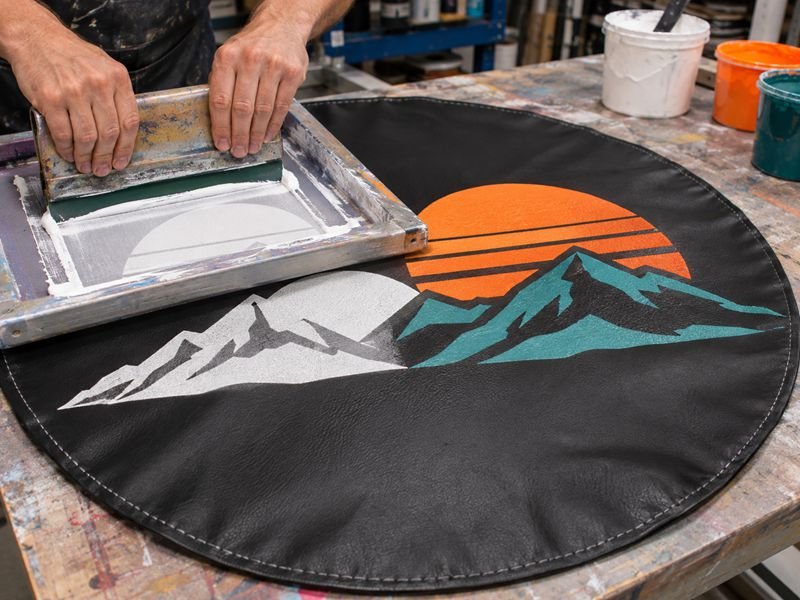
White ink either appears as part of the visible tire-cover design or works underneath colored ink as an opaque underbase. On black or dark PVC, PU, and vinyl, this white layer reduces the visual influence of the substrate, helping light colors, brand colors, gradients, photographs, and fine artwork retain better opacity, contrast, and color consistency.
Visible White vs. Underbase
White ink performs two different jobs, and confusing those jobs is one of the most common misunderstandings in custom tire-cover printing. The first use is straightforward: white ink can be part of the visible artwork. A white brand name, club logo, number, outline, or graphic placed on black material needs enough opacity to appear genuinely white. If the ink coverage is too weak, the black surface remains visually present and the white can look gray or dirty.
The second use is less obvious but often more important. White ink can be printed below colored artwork even when the finished design contains no visible white. This is the white underbase. Its function is to give the color layer a neutral foundation. A red, yellow, orange, pale blue, or photographic highlight printed on white material already benefits from the reflective white substrate. The same color printed directly on black material loses that support and can appear darker or less saturated.
The basic print structure is easy to understand. With a dark tire cover, a controlled process may be built as dark material → white ink → color ink, rather than dark material → color ink. Szoneier’s documented printing system specifically identifies black PVC, dark vinyl, colored materials, white underbase, and spot white as applications for white-ink Latex, while its UV printing configuration also supports white ink for dark PVC, PU, and vinyl.
This distinction is important for customers who believe white ink is only needed when their logo contains white. A design made entirely from red, blue, and yellow may still require a white underbase if it is printed on black or dark material. The visible color and the hidden foundation are separate parts of the production file, and both must be prepared correctly.
What Happens Without an Underbase?
Printing color directly onto a dark tire-cover surface does not produce one simple, predictable shift. Different colors are affected differently because each ink transmits and reflects light in a different way. Light yellow may lose brightness quickly, pale blue can become noticeably darker, red can move toward a deeper or browner appearance, and skin tones can lose their natural balance. Fine photographic highlights may disappear, while subtle gradients can collapse into the dark background earlier than intended.
The problem is easy to overlook during artwork approval because monitors generate light while printed tire covers reflect it. A bright image on a screen may therefore look more vivid than the same image produced on a flexible dark material. Surface gloss, texture, ink thickness, substrate color, and lighting conditions all influence the final appearance, which is why a digital mockup should not be treated as a perfect simulation of physical production.
The same CMYK values can also behave differently on white PVC, white polyester, matte PU, glossy vinyl, or textured synthetic leather. Szoneier’s documented color-control approach uses material-specific ICC profiles because identical digital color values do not automatically create identical physical colors across different substrates.
| Print Structure | Typical Visual Behavior |
| CMYK on white PVC | Bright, relatively predictable color reproduction |
| CMYK directly on black PVC | Darker, substrate-influenced color |
| CMYK over white underbase on black PVC | Higher opacity and stronger color separation |
| White ink directly on black PVC | Visible opaque white logo, text, or graphic |
That difference becomes particularly noticeable on tire covers because the printable face is large and visually simple. A logo often sits alone in the center of a circular surface, so inaccurate color, weak opacity, or a gray-looking white outline has nowhere to hide.
How Much White Is Enough?
The correct amount of white is the amount that provides sufficient opacity while maintaining adhesion, flexibility, clean registration, and an appropriate surface feel. Applying more white without a clear reason can increase ink consumption, slow production, create a heavier printed layer, and make alignment errors more visible. On flexible tire-cover materials, excessive ink build can also affect how the printed area behaves during folding, packing, installation, and long-term outdoor use.
This balance is especially important with UV printing because cured UV ink forms a more noticeable surface film than some other processes. On very soft materials that are repeatedly folded or flexed, the printed layer may need additional bend and flex testing. Szoneier’s documented UV process specifically calls for this evaluation where cracking, whitening, or adhesion failure could occur after repeated movement.
White-layer registration also matters. If the underbase extends beyond the colored artwork, a narrow white edge may appear around the design. If it sits too far inside, edge colors can lose opacity. Fine text, thin strokes, gradients, and photographic details therefore need more careful preparation than a large solid logo. Experienced prepress work treats the white layer as a production component with its own boundaries, density, and purpose rather than as an automatic setting applied to every dark material.
Which Tire Cover Materials Need White Ink?

Black and dark PVC, PU, vinyl, and other colored materials are the most common candidates for white ink because their surface color can influence the artwork printed above them. White and light printable substrates often need no underbase for standard full-color printing, although surface coating, texture, flexibility, and ink compatibility still need to be verified before production.
Black PVC and PU
Black PVC and PU remain popular choices for custom tire covers because they visually match tires, vehicle trim, off-road accessories, and many automotive design styles. They also tend to hide dust and road marks better than light-colored surfaces. From a printing standpoint, however, black material creates one of the most demanding backgrounds because it absorbs light and can show through colors that are not fully opaque.
The material name alone does not tell the whole story. PVC and PU can vary in coating chemistry, plasticizer content, gloss level, texture, backing fabric, thickness, flexibility, and surface treatment. Two materials both sold as “black PVC” can behave differently with the same ink. One may produce strong adhesion and a clean white underbase, while another may require a different ink profile, pretreatment, or process adjustment.
Szoneier’s material system includes printable white PVC, standard black PVC, premium black PVC, matte black PVC/PVC leather, printable white PU, standard black PU, and premium matte black PU for different product programs. Before PVC or PU is accepted into the approved tire-cover material library, the documented qualification process checks thickness, GSM, visual condition, tear performance, sewing behavior, folding, print adhesion, scratch resistance, water resistance, and cold-flex performance. Premium outdoor programs can add accelerated UV, color-change, coating-adhesion, and PU hydrolysis evaluations.
These checks are important because print quality is not only a visual question. A white underbase can look excellent when the material is flat and still fail later if the ink cracks, peels, or loses adhesion when the tire cover is folded, stretched over a spare tire, or exposed outdoors.
Vinyl and Textured Surfaces
Vinyl is another broad category rather than one single printing surface. Smooth printable vinyl, marine-style vinyl, automotive-grain vinyl, and heavily embossed synthetic leather do not reproduce the same level of detail. A smooth surface provides a more even plane for printing, while a deep grain creates microscopic high and low areas that can reduce the apparent sharpness of fine text, thin outlines, photographs, and soft gradients.
White ink can improve opacity on a textured material, but it cannot remove the physical texture itself. This becomes important when material selection is driven by appearance. A deeply embossed PU may feel more premium and automotive in the hand, but it may not be the best choice for a highly detailed pet photograph or a complex landscape. A smooth printable PVC may reproduce the image more precisely even if it looks less luxurious before printing.
Szoneier’s documented guidance for textured PU reflects this trade-off. It rates textured surfaces highly for logos and simple graphics while noting that deeper grain is less suitable for very fine photo reproduction. This is a practical reminder that a material should be chosen together with the artwork rather than before it.
A minimalist white club logo, a four-color dealer mark, and a full-resolution photographic image are three very different production jobs. They may all be called custom tire covers, yet the best material, white-ink strategy, and printing method can be completely different.
White and Light Materials
White material already provides the reflective foundation that colored ink needs, so a white underbase is often unnecessary for conventional full-color printing on a suitable white substrate. This can simplify production and make white printable PVC, PU, or polyester attractive for full-surface photographs, flags, illustrations, gradients, landscapes, and other artwork that contains a wide tonal range.
Standard dye sublimation is a good example of this principle because the process does not provide a conventional white-ink channel. Instead, the white polyester substrate supplies the white portion of the image. Szoneier’s documented sublimation process therefore specifies white polyester, printable polyester, sublimation polyester, and compatible polyester Oxford materials, while standard black polyester, PVC, PU, and marine vinyl are not treated as equivalent direct-sublimation substrates.
White material is not automatically better, however. A black tire cover may fit the vehicle’s visual style better, a matte PU may create a more premium look, and marine vinyl may be preferred for a particular outdoor program. Material, artwork, printing method, and expected use should therefore be considered as one system rather than as separate purchasing choices.
| Tire Cover Substrate | White Ink Need | Main Printing Consideration |
| Black PVC | Usually important for light or full-color artwork | Strong dark-background influence |
| Black PU | Usually important | Surface chemistry and flexibility must be tested |
| Dark vinyl | Usually important | Opacity and adhesion both matter |
| Colored PVC/PU | Artwork-dependent | Base color can contaminate visible ink |
| White printable PVC | Often unnecessary as an underbase | Material already provides a neutral white base |
| White printable PU | Often unnecessary | Surface coating still affects adhesion and color |
| White polyester | No conventional white ink in sublimation | Polyester itself provides white |
| Deep-textured PU/vinyl | Testing required | Texture can reduce fine-detail reproduction |
The useful question is therefore not simply whether a material accepts white ink. The better question is whether the selected material, ink system, artwork, and outdoor-use requirement can work together as one stable, repeatable tire-cover product.
How Does White Ink Affect Print Color?

White ink improves color mainly by separating the visible artwork from the dark surface underneath it. A consistent white foundation can increase opacity, preserve brightness, and make brand colors more predictable. Final appearance still depends on material texture, gloss, ink set, ICC profile, white density, curing, lighting, and the physical reference approved before production.
Opacity and Brightness
Opacity is the practical reason white ink matters so much when printing on black tire covers. If enough of the dark substrate remains visually present through the colored ink, the eye does not see the artwork color alone. It sees the combination of the artwork and the background, which is why a yellow, orange, pale blue, or light photographic area can look much darker on black PVC than it does on a computer screen.
A white underbase reduces that interaction by providing a light, opaque foundation. The principle is especially easy to see with bright colors. Clean yellow and orange shades depend strongly on reflected light, while pale photographic areas such as clouds, white fur, chrome highlights, snow, and skin highlights can lose visual separation quickly when the dark substrate shows through.
Opacity still needs to be balanced with flexibility and adhesion. A tire cover is not a rigid sign; it is folded, packed, stretched, handled, and exposed to outdoor conditions. Szoneier’s documented process therefore pairs premium white-ink UV work with adhesion, bend, fold, scratch, and UV checks rather than judging print quality only by brightness immediately after printing.
This is an important manufacturing distinction. A highly opaque print that cracks after folding is not a successful print, just as a flexible print that becomes dull on black material may not meet the visual standard. Good white-ink printing balances optical coverage and mechanical performance rather than maximizing one while ignoring the other.
Brand Color Control
Brand-color work is more demanding because a tire cover may need to fit into a larger visual system that includes packaging, dealer displays, vehicle graphics, retail products, online assets, and previously manufactured accessories. A Pantone reference can provide a useful target, but the same numeric reference does not automatically reproduce identically on matte PU, glossy PVC, textured vinyl, fabric, or paper.
Material gloss changes how light is reflected, while matte surfaces can make colors appear softer. Deep textures scatter light and can reduce the perceived sharpness of color boundaries. White-underbase density changes brightness, and different printer and ink combinations have different color gamuts. The color seen by the customer is therefore the result of several variables working together.
Szoneier’s documented artwork workflow checks Pantone references, background, color mode, print profile, and production artwork before printing. Repeat-order records can also include the material ID, ink, printer, ICC profile, RIP configuration, production date, color reference, and approved sample.
That traceability becomes particularly important when a project grows. Producing one approved sample is relatively simple; reproducing the same visual standard months later across hundreds or thousands of pieces requires a controlled record of how the original result was created. This is far more meaningful than a broad claim such as “high color accuracy” because it gives production teams a practical reference for repeat orders.
Texture and Gloss
White ink cannot be evaluated independently from the surface underneath it. Smooth white PVC, smooth black PVC, matte PU, glossy vinyl, and embossed automotive-grain material may all require different settings and can produce visibly different results even when the same artwork file is used.
Fine details are especially sensitive to texture. A thin logo stroke printed across a deep leather grain may not look as smooth as the same stroke printed on flat printable PVC. Tiny reversed text can lose edge definition, and subtle gradients may look less even because the raised and recessed parts of the material reflect light differently. White ink improves the background foundation, but it does not physically flatten the substrate.
Gloss introduces another variable because a glossy surface can produce strong directional reflections. The same printed red may look saturated from one viewing angle and lighter from another, especially in direct sunlight. Matte finishes generally scatter light more evenly but may appear less vivid. Neither effect necessarily means the color is incorrect; it means color has to be judged on the actual production material.
Szoneier’s use of material-specific ICC profiles reflects this physical reality. For important brand programs, the most useful approval is therefore made on the actual substrate under realistic viewing conditions rather than only on a calibrated monitor.
Which Printing Methods Use White Ink?

White-ink UV printing, white-ink Latex, and screen printing can all be appropriate for custom tire covers, while standard dye sublimation does not use a white-ink channel and instead depends on white or light polyester. Process selection should consider substrate, artwork complexity, order quantity, flexibility, outdoor exposure, and the visual finish required.
UV and Latex
UV digital printing is particularly useful when white ink is needed on dark synthetic surfaces or when artwork contains detailed graphics, gradients, spot white, or complex color. Szoneier’s documented UV process supports selected PVC, PU, vinyl, marine vinyl, films, synthetic materials, and coated Oxford fabrics, subject to material compatibility and adhesion testing. White ink is part of the supported configuration, which makes the process suitable for dark-material printing and premium branding.
The documented primary UV platform supports a maximum print width of approximately 1,610 mm, or 63.4 inches, and the process can technically support one-piece orders. That flexibility is useful for samples, personalized designs, small launches, and projects where artwork changes from order to order.
White-ink Latex provides another digital route. Szoneier’s documented Latex configuration is used for black PVC, dark vinyl, colored materials, white underbase, spot white, photographs, illustrations, gradients, complex logos, and personalized designs. The standard platform is approximately 64 inches, or 1.63 meters, wide and can also support one-piece customization on compatible materials.
Digital printing becomes especially useful when the design is too complex for economical spot-color production, when every tire cover contains different personalization, or when a sample needs to be made before a larger program begins. The important limitation is that every substrate still needs validation because a process that bonds well to one PVC coating may behave differently on another.
Screen Printing
Screen printing remains highly practical for repeated simple logos because it applies defined spot colors through separate screens rather than building a photographic image with digitally controlled droplets. When a dealer, RV brand, club, fleet program, retailer, or private-label project needs the same one-to-four-color design across a substantial quantity, screen printing can provide strong opacity and efficient unit economics.
White ink is fully relevant in this process. Szoneier’s documented screen-printing system can apply high-opacity white to black or dark materials and can also work with Pantone-matched spot colors on suitable PVC, PU, vinyl, polyester, canvas, and Oxford constructions.
The documented production ranges provide useful scale context. The technical MOQ is approximately 30 pieces, while the economic advantage becomes more obvious from around 100 pieces. Repeated simple-logo programs can run from roughly 100 to 10,000+ pieces, depending on design complexity and production conditions. Standard print areas are documented around 900 × 900 mm, with special large-frame applications reaching approximately 1,200 × 1,200 mm.
The limitation appears as the number of colors increases. Each additional spot color normally adds screen preparation, registration work, and production time. Once an artwork contains photographs, soft gradients, many colors, or frequent design changes, digital printing often becomes the more practical route.
Sublimation and Process Selection
Standard dye sublimation is fundamentally different because it does not use conventional white ink. The process depends on a white or light polyester substrate to supply the white part of the image, which is why it performs well for photographs, illustrations, landscapes, gradients, and other full-surface artwork on compatible polyester constructions.
Szoneier’s documented industrial sublimation platform supports approximately 64 inches, or 1.62 meters, of print width and can technically support one-piece production on suitable standard white materials. The same process should not be confused with printing a white underbase onto black PVC or PU, because those products require a different ink-and-substrate relationship.
| Printing Method | White Ink | Documented Scale / Width | Typical Strong Application |
| UV Digital | Yes | Up to 1,610 mm / 63.4 in; 1-pc capable | Dark PVC/PU/vinyl, detailed graphics, premium branding |
| White-Ink Latex | Yes | About 64 in / 1.63 m; 1-pc capable | Photos, gradients, personalized artwork, dark printable media |
| Screen Printing | Yes | About 900 × 900 mm standard; 1,200 × 1,200 mm special | Repeated logos, dealer, club, fleet, private-label programs |
| Dye Sublimation | No conventional white ink | About 64 in / 1.62 m; 1-pc capable on suitable stock | White polyester, full-surface graphics, photographs |
The most reliable decision is therefore made from the combination of artwork, substrate, quantity, and outdoor-use requirement. A newer or more expensive print technology is not automatically better if another process fits the material and order structure more naturally.
How Should Artwork Be Prepared for White Ink?

White-ink artwork should clearly define visible white areas, underbase areas, transparent regions, and zones where the original tire-cover material remains exposed. Production files also need correct dimensions, resolution, color settings, bleed, safe zones, camera-hole clearance, and print profiles so the physical result matches the approved design rather than only the digital preview.
White Layer Mapping
A customer artwork file and a production artwork file are not always the same thing. A customer may provide a transparent PNG, Illustrator logo, PDF, photograph, screenshot, or layered Photoshop file. The printing team still needs to determine which parts should receive visible white, which colored areas need a hidden white underbase, and which areas should remain transparent so the base tire-cover material stays visible.
Consider a red-and-white logo on black PVC. The visible white text clearly needs white ink. The red portion may also need white below it so that the black material does not darken the red. The transparent background should normally remain unprinted so the black PVC becomes part of the final appearance. Three areas inside one artwork therefore require three different production treatments.
Complex artwork creates additional decisions. Black artwork may be printed with black ink or may intentionally use the substrate itself. Gray shadows may need selective white support. A soft glow or translucent effect may need controlled opacity rather than the same solid white density used under a logo.
Szoneier’s documented prepress workflow checks file size, resolution, DPI, color mode, fonts, bleed, tire diameter, camera-hole placement, safe zones, Pantone references, background, and print profile before artwork enters production. These are not administrative details; they define what is physically printed.
Gradients and Fine Detail
Gradients are one of the easiest ways to reveal poor white-layer preparation because they may contain dozens or hundreds of tonal transitions between solid color, light color, and transparency. If a completely solid white layer sits underneath an entire gradient, the final design can become much brighter and more opaque than intended. If the underbase disappears too quickly, the dark substrate may make the gradient fade out abruptly.
Fine details create similar challenges. Small stars, narrow outlines, tiny text, hairlines, and negative spaces require accurate alignment between the white and color layers. A slight registration error that remains hidden inside a large solid logo may become obvious around a 1–2 mm stroke or a small letter.
For that reason, the white layer may be slightly reduced inside the colored boundary to prevent a visible white halo. The correct adjustment depends on printer accuracy, artwork scale, ink system, substrate behavior, and the actual size of the detail rather than on a universal fixed value.
Texture also matters. Szoneier’s material guidance notes that deeply textured PU becomes less suitable for high-detail photography as the surface grain becomes more pronounced. A technically high-resolution file therefore does not guarantee a high-resolution physical result unless the artwork has also been matched to the material.
Proofing and Camera Holes
A useful tire-cover proof should answer more than whether the artwork looks attractive on screen. It should confirm the actual material, substrate color, tire-cover diameter, graphic size, print position, visible-white areas, underbase behavior, camera-hole location when applicable, safe zones, and any important color references that must be carried into production.
Camera-compatible tire covers need particular attention because the printable face is not always an uninterrupted circle. On vehicles where a backup camera passes through or sits within the spare-tire area, important text, logos, faces, or graphic elements may need to move away from the opening and reinforcement zone. Szoneier’s documented artwork workflow checks camera-hole placement, circular layout, bleed, graphic positioning, and artwork avoidance around the camera region.
For important OEM, private-label, or repeat-order programs, a physical sample or golden sample provides a stronger production reference than a digital mockup. Digital approval is useful for confirming layout, spelling, size, and composition. A printed sample reveals material texture, actual color, opacity, white-layer behavior, edge quality, adhesion, and surface feel.
Once an approved physical standard exists, production and QC teams can compare bulk output against something tangible rather than relying on memory or vague instructions such as “make the red brighter” or “make the white stronger.”
How Is White Ink Quality Controlled?
White-ink quality control should evaluate the entire printed product rather than white density alone. Position, size, color, opacity, resolution, adhesion, scratch resistance, fold behavior, material compatibility, and approved artwork all matter. Repeat orders also benefit from traceable records of material, printer, ink, ICC profile, RIP settings, color reference, and approved samples.
Color Approval
Color approval begins by defining what “correct” means for the project. Depending on the application, the reference may be a Pantone value, printed swatch, existing product, signed physical sample, previously approved production batch, or brand standard. A screen image alone is a weak production reference because monitors vary and emit light rather than reflecting it.
The physical substrate must also be considered. Matte PU, glossy PVC, textured vinyl, and fabric can make the same numeric color appear different. White-underbase density, ink set, gloss level, and lighting conditions further influence perception. This is why color evaluation should happen on the actual production material whenever the brand color is commercially important.
Szoneier’s documented quality process compares print color with an approved proof or golden sample rather than relying only on the artwork file. For repeat orders, records can retain the material ID, ink, printer, ICC profile, RIP configuration, production date, color reference, and approved sample.
This traceability reduces the risk of treating each repeat run as a new project. Instead of saying that a new batch “looks a little different,” the production team can compare it with a known reference produced under documented conditions.
Adhesion and Flexing
Good-looking white ink that does not remain bonded to the tire cover is not good printing. Adhesion is particularly important on PVC, PU, vinyl, and coated fabrics because plasticizers, surface treatments, release agents, coatings, and texture can all affect how an ink bonds.
Szoneier’s documented UV process therefore requires substrate adhesion testing before production on selected materials. The finished product is then evaluated as a flexible product rather than as a flat printed panel.
Tire covers are folded during packing, unfolded during installation, pulled over the spare tire, handled by users, rubbed against packaging, and exposed to temperature changes. The printing system must tolerate those movements without abnormal cracking, whitening, peeling, or delamination.
The documented scratch test simulates friction from handling, packing, installation, and cleaning, with large-area ink loss, delamination, and surface peeling treated as unacceptable outcomes. On highly flexible materials, fold and bend testing is equally important because defects may appear only after repeated movement.
This approach changes the question from “Does the print look good when it leaves the machine?” to “Does the printed layer behave like a durable part of the tire cover?”
Production Control
Bulk production should be compared against the standard that was actually approved. Szoneier’s documented inspection system checks graphic position, printed dimensions, color, resolution, adhesion, scratch behavior, fold performance, and camera-artwork safe zones rather than relying on a general visual glance.
| QC Check | Practical Production Question |
| Print Position | Is the artwork located where the approved sample shows it? |
| Print Size | Does the graphic match the approved production dimension? |
| Color | Does production remain close to the approved proof or golden sample? |
| White Coverage | Is opacity sufficient without unwanted white edges? |
| Resolution | Are details free from obvious pixelation or lost definition? |
| Adhesion | Does ink remain bonded to the selected substrate? |
| Scratch | Can normal handling occur without abnormal ink loss? |
| Fold / Flex | Does the printed layer remain stable during folding and movement? |
| Camera Safe Zone | Is artwork clear of the approved camera opening and reinforcement area? |
Outdoor durability also needs careful interpretation. Accelerated UV testing is useful for comparing materials and print systems, but laboratory exposure hours should not be converted directly into guaranteed years outdoors. Szoneier’s documented internal framework uses accelerated UV categories ranging from approximately 200–300 hours for basic screening to 800–1,000+ hours for extreme-outdoor evaluation, while explicitly noting that these laboratory hours do not equal a direct real-world service-life claim.
Actual outdoor performance changes with climate, sunlight intensity, temperature, orientation, cleaning practices, storage, substrate formulation, and ink system. A credible printing program therefore avoids promising durability from one phrase such as “UV ink” or “high-opacity white.” It controls the complete chain of material, artwork, white layer, color profile, printing, adhesion, flexing, inspection, and approved reference.
Conclusion
White ink is easy to describe as another printing color, but in custom tire-cover production it often performs a much more important job. On black and dark PVC, PU, and vinyl, it can create the optical foundation that allows colors, photographs, gradients, and logos to appear as intended. The quality of that result depends on far more than whether a printer has a white-ink channel.
The strongest tire-cover printing programs treat white ink as part of a controlled manufacturing system. Material selection determines surface behavior, artwork preparation defines where the white layer belongs, color management controls reproduction, printing parameters affect opacity and flexibility, and QC verifies that the approved result survives handling and production. When those elements work together, the finished cover looks like a designed automotive product rather than simply a graphic placed on dark material.
For brands developing custom printed tire covers, this also creates a practical way to compare manufacturing partners. Ask how the supplier selects the print process, how dark substrates are handled, what happens before bulk production, how color is approved, and how repeat orders are controlled. A supplier that can answer those questions with clear process logic is far more useful than one that simply promises “high-quality printing.”
Frequently Asked Questions
1. Do all black tire covers need a white underbase?
Not every black tire-cover design requires the same white-underbase treatment, but light colors, photographs, gradients, and most multicolor logos generally benefit from one because the black substrate can darken partially transparent inks. A design made mostly from black or very dark elements may need less white support, while visible white logos obviously require opaque white ink. The final decision should be made from the actual artwork, substrate, and printing process rather than from material color alone.
2. Is white ink only used when the logo contains white?
No. White ink can remain visible as part of a white logo, but it can also sit underneath colored artwork where the customer never sees it directly. This hidden white underbase is often more important than visible white because it separates red, yellow, blue, orange, photographic highlights, and other colors from the dark tire-cover material. A logo with no visible white can therefore still depend heavily on white ink for correct color reproduction.
3. Which printing method is best for a full-color design on a black tire cover?
White-ink UV or Latex printing is often a strong candidate for full-color artwork on compatible black PVC, PU, or vinyl because these processes can place white below complex color layers. The correct choice still depends on material compatibility, required flexibility, artwork detail, order quantity, and outdoor-use expectations. Screen printing can be more economical for repeated simple spot-color logos, while sublimation normally requires white or light polyester instead of black PVC or PU.
4. Can white ink guarantee an exact Pantone color match?
White ink improves the foundation for color reproduction, but it cannot guarantee an exact Pantone appearance by itself. Surface gloss, texture, material color, ink set, printer profile, white density, lighting, and finishing all affect perceived color. For important brand programs, the more reliable approach is to combine Pantone references with material-specific color management and an approved physical sample or golden sample that production can use as the practical visual reference.
5. Why can the same artwork look different on PVC and PU tire covers?
PVC and PU can differ in surface coating, gloss, texture, flexibility, backing construction, and ink interaction. Even two materials within the same category can print differently because their formulations are not identical. A smooth PVC may reproduce fine detail differently from a matte or textured PU, while adhesion and white-ink coverage can also vary. For that reason, professional production should validate the actual material rather than assuming that one print setting works for every PVC or PU.
6. Does more white ink always make a tire-cover print better?
No. More white can increase opacity, but excessive ink build can also increase curing requirements, create a heavier surface film, reduce flexibility, and make registration defects easier to see. The correct white density is the level that produces the required visual coverage while still meeting adhesion, folding, scratch, and surface-quality expectations. Solid logos, fine text, gradients, and photographic artwork may all require different white-layer strategies.
7. What should be approved before a bulk custom tire-cover order begins?
A reliable approval should cover the final material, tire-cover size, artwork version, graphic dimensions, print position, visible-white areas, underbase behavior, color reference, camera-hole location when applicable, printing method, and physical sample or approved proof. For repeatable production, it is also useful to retain the material ID, printer, ink, ICC profile, RIP configuration, and approved sample so future batches can be compared against the same manufacturing reference.


