 Skip to content


A PU tire cover looks simple until something goes wrong. A finished cover may consist of little more than a circular front panel, a sidewall, an elastic or drawstring system, and perhaps a printed logo or backup-camera opening. Yet every one of those features depends on material chemistry, pattern dimensions, printing compatibility, sewing tension, fitment accuracy, and production control. A supplier can make one attractive sample and still struggle when the order expands to several hundred pieces, multiple sizes, several artwork versions, or different vehicle configurations.
A reliable PU tire cover manufacturer should be evaluated through six areas: manufacturing control, PU material specifications, printing and fitment capability, product testing, bulk quality management, and pre-production verification. The best supplier is not simply the one offering the lowest price or fastest quotation. It is the manufacturer that can explain how materials, dimensions, artwork, samples, inspections, and production records are controlled from development through repeat orders.
Imagine approving a smooth matte-black tire cover in March, placing a 3,000-piece order in April, and receiving products in June that feel slightly harder, print a little differently, and wrinkle more around the tire shoulder. Nothing may look dramatically wrong in a carton, yet customer complaints begin after installation. Problems like this usually start long before final inspection. They begin when material grades are loosely defined, pattern revisions are poorly controlled, or a factory substitutes a similar-looking PU without repeating the original validation. A good supplier evaluation is designed to uncover those risks before they become inventory.
What Makes a Reliable PU Tire Cover Manufacturer?
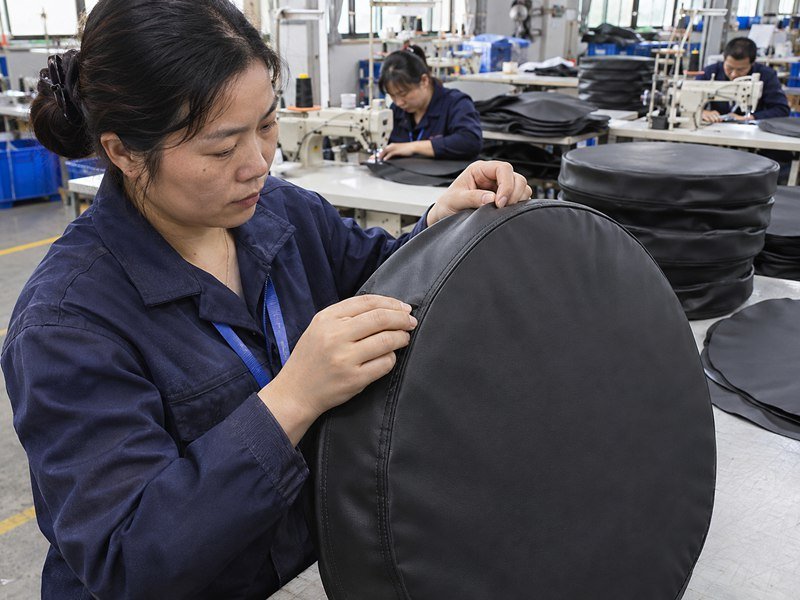
A reliable PU tire cover manufacturer controls the processes that directly affect material performance, fitment, appearance, and repeatability. It should understand PU selection, pattern development, printing, sampling, sewing, inspection, and production planning. More importantly, the factory should be able to show how every approved requirement is translated into specifications, controlled versions, production instructions, inspection criteria, and repeat-order records.
Manufacturing Control
The first question should not simply be whether the supplier calls itself a factory. A much more useful question is who controls the operations that determine the finished tire cover. A commercial PU tire cover can involve material sourcing, incoming inspection, printing, cutting, curved sewing, elastic installation, reinforcement, camera-hole processing, labeling, packing, and several quality checkpoints. Some processes may be specialized, but the supplier needs to maintain clear ownership of the complete manufacturing sequence.
A capable manufacturer should be able to explain where PU is inspected, who approves the print process, who creates or adjusts the pattern, who makes the prototype, who releases bulk production, and who is responsible if a defect appears after shipment. Szoneier manages tire cover manufacturing as one coordinated system covering material, artwork, printing, cutting, sewing, camera-hole work, quality control, packaging, and global delivery rather than expecting customers to coordinate separate process suppliers themselves.
This becomes especially important when semi-finished components move between different production processes. Printed panels, cut pieces, reinforcement components, and finished covers should remain traceable to the correct project, SKU, material batch, artwork revision, and production status. A factory that cannot explain this chain clearly may still produce good samples, but repeatability becomes much harder once order complexity increases.
Engineering Capability
Real manufacturing experience becomes visible when the supplier can explain how tire dimensions, material behavior, and construction influence one another. A PU cover that fits correctly is not created simply by cutting a circle equal to the nominal tire diameter. Tire width, shoulder shape, side depth, seam allowance, material flexibility, elastic recovery, and installation tension all affect how the finished cover sits on the spare tire.
A tire such as 285/70R17 has an approximate theoretical overall diameter of 32.7 inches, but actual dimensions can vary slightly by manufacturer and tread design. That difference matters more when the product is positioned as an exact-fit premium cover rather than a loose universal fit. A supplier should therefore understand when nominal tire data is sufficient and when actual measurements, fixtures, or physical installation tests are necessary.
Material changes also affect patterns. A flexible knitted-back PU may stretch differently from a heavier textured synthetic leather with a denser backing. If a factory changes from one substrate to another but continues using exactly the same allowance, wrinkles, seam stress, or poor sidewall depth can appear. Strong engineering teams treat pattern development as part of material development rather than as an isolated cutting task.
Project Management
Many sourcing problems that eventually appear as “quality problems” actually begin as project-control problems. A customer approves one artwork, changes a camera opening later, selects another PU surface, and adjusts packaging shortly before production. If those changes are managed only through scattered messages, someone eventually uses the wrong file. A professional manufacturer converts those decisions into a single controlled project record.
A structured tire cover project can include customer identification, project number, SKU, tire size, vehicle information, material ID, pattern version, artwork revision, printing method, camera configuration, golden sample, QC standard, packaging specification, and shipment instruction. Szoneier’s tire cover project system uses this type of linked production information so that important requirements remain connected rather than living only in emails or chat messages.
Version control becomes increasingly important as the program grows. Ten sizes combined with five graphics already create 50 possible product combinations before packaging or camera options are considered. The supplier should have a defined process for approving revisions, withdrawing obsolete files, and making sure production, printing, QC, and packing teams are all working from the same current specification.
Production Scalability
Production capacity should be evaluated according to the exact order rather than a headline monthly number. A supplier may operate many sewing machines, but sewing is only one part of the production chain. Printing output, material availability, cutting efficiency, number of SKUs, inspection requirements, packaging complexity, and changeover time can all become the true bottleneck.
A 5,000-piece order containing one black PU material, three sizes, and one repeated logo is far easier to scale than 5,000 covers divided among 25 sizes, 50 graphics, several camera-hole versions, and individually labeled retail cartons. A realistic manufacturer should be able to explain how order complexity changes effective output rather than quoting the same production capacity for every program.
Scalability also involves backup planning. Machinery can break down, a material supplier can delay a shipment, and another major order can occupy a key production cell. Szoneier’s integrated production model is designed so approved processes can be reassigned when capacity, equipment, or timing problems occur instead of depending entirely on one critical machine or one production point.
For long-term programs, this type of resilience is often more valuable than a very high theoretical maximum capacity that only applies to simple, uninterrupted production.
Which PU Material Specifications Should You Check?

PU should never be approved using “PU leather” as the complete material description. A useful purchasing specification should identify material grade, thickness, total weight, backing, surface finish, tear performance, UV requirement, low-temperature flexibility, hydrolysis resistance, water performance, and print compatibility. Two materials can look almost identical while performing very differently during sewing, installation, outdoor exposure, and long-term production.
PU Grade
The first step is understanding which type of PU the manufacturer is proposing and what that grade is designed to achieve. Standard PU may be suitable for basic customized covers, while printable PU prioritizes a stable surface for graphic reproduction. Matte and textured grades focus more heavily on premium automotive appearance, and higher outdoor grades require stronger control of environmental durability.
A deep-grain PU can create an attractive leather-like finish for a black Jeep or Bronco cover, but strong embossing may reduce the clarity of fine photographic details. A smoother printable surface can support more detailed artwork while looking slightly less like traditional automotive leather. Neither is inherently better; the correct choice depends on product positioning.
Szoneier separates its PU material platform into several functional categories rather than treating all synthetic leather as one product. Material approval considers characteristics such as thickness, weight, backing, UV performance, cold flexibility, tear strength, surface type, and printing compatibility.
This is the level of discussion a supplier should be able to have before a quotation is finalized. If every project receives exactly the same PU recommendation regardless of climate, artwork, vehicle, or price level, the supplier may be selling a convenient stock material rather than selecting an appropriate one.
Thickness, Weight, and Backing
Thickness is important, but it is only one part of the PU structure. A thicker surface layer can provide more body and a richer hand feel, yet a weak backing can still create poor dimensional stability or low seam strength. The textile backing is responsible for much of the tensile support, tear resistance, and sewing stability of synthetic leather.
Total GSM helps clarify the overall material construction. When comparing quotations, make sure each supplier is describing the same measurement. One factory may quote the thickness of the complete PU composite, while another may refer only to the coated face. Similar confusion can occur when one GSM figure includes the backing and another does not.
| PU specification | Printable PU example | Premium PU example | Practical impact |
| Thickness | 0.45–0.60 mm | 0.60–0.80 mm | Structure, feel, sewing behavior |
| Total weight | 380–520 g/m² | 500–650 g/m² | Body and dimensional stability |
| Typical backing | Polyester knit | Dense knit / woven polyester | Tear and seam support |
| Internal tear target | 35–45 N | 45–55 N | Resistance to tear propagation |
| Low-temperature target | About -20°C to -25°C | Around -25°C | Flexibility in cold conditions |
| Typical surface | Smooth / fine matte | Matte / fine grain / soft touch | Print detail and appearance |
These figures are examples from Szoneier’s tire cover material-development system rather than universal industry standards. They are useful because they demonstrate how a vague material description can be converted into measurable purchasing requirements.
Outdoor Performance
A material being waterproof does not automatically make it suitable for long-term outdoor use. A spare tire cover may remain exposed to sunlight for months, become hot during summer parking, cool rapidly at night, get wet repeatedly, collect dust and road dirt, and be folded or stretched every time the customer removes it. These stresses interact rather than occurring separately.
For warmer markets, UV stability, color change, coating hardness, and print fading deserve particular attention. In colder regions, flexibility and cold-crack performance become more important. Hot and humid climates add another risk for PU because some polyurethane systems are more vulnerable to hydrolysis if their formulation is not appropriate for sustained heat and moisture.
Manufacturers should therefore avoid giving simple promises such as “five years outdoors” unless the claim is tied to a clearly defined material, ink system, climate, and test basis. Szoneier uses accelerated UV exposure as a development tool and distinguishes different internal screening levels, but the exposure hours are not treated as a direct mathematical conversion into outdoor years.
That distinction is important because 500 hours of laboratory exposure cannot automatically mean five years in every real-world environment.
PU vs. PVC
PU is often attractive for products that emphasize softness, flexibility, leather-like appearance, premium texture, or a more refined automotive look. PVC or vinyl often performs well when cost efficiency, easy cleaning, abrasion resistance, strong water impermeability, and large-volume outdoor use are more important.
The correct decision depends on the target customer and market. A premium vehicle-specific cover with a low-gloss black finish may justify a higher-grade PU. A commercial outdoor cover that will be cleaned frequently and sold at an aggressive retail price may perform better economically with an appropriate PVC construction.
Szoneier’s internal material comparison gives PU an advantage in softness, low-temperature flexibility, and premium tactile quality, while PVC generally has stronger advantages in highly impermeable applications, abrasion resistance, and bulk cost. It also makes an important point: actual performance depends on coating formulation and backing, so material names alone cannot determine quality.
A trustworthy manufacturer should therefore be willing to tell a customer when PU is not the best choice. A supplier that always recommends the more expensive option without discussing the application is not necessarily providing better engineering.
How Do You Evaluate Printing and Fitment?

Printing and fitment should be evaluated as technical processes rather than decorative finishing. The factory should demonstrate that its chosen print method is compatible with the exact PU surface and that the completed cover fits the actual tire without excessive wrinkles, distortion, or seam stress. Vehicle-specific camera applications also require controlled hole position, reinforcement, clearance, and artwork placement.
Print Process Selection
There is no single printing process that is ideal for every PU tire cover. The correct method depends on surface chemistry, artwork complexity, base color, quantity, outdoor requirement, and the desired branding effect. Digital UV can be useful for detailed graphics, gradients, dark materials, and white-ink applications, while compatible latex systems can perform well for flexible full-color outdoor graphics.
Screen printing remains useful for repeated simple logos when the volume justifies the setup. Heat transfer, hot stamping, embroidery, TPU patches, and silicone patches can also make sense when the branding requirement is more important than full photographic reproduction. The important point is that the factory should match the process to the material instead of forcing every design through the machine that happens to be available.
Szoneier uses a material-and-process matching approach across its tire cover production, selecting different printing technologies according to substrate, artwork, quantity, and intended outdoor performance.
When comparing factories, provide the same artwork and ask each supplier to explain its recommended production method. Experienced technicians usually discuss surface compatibility, opacity, white underbase, adhesion, curing, flexibility, expected quantity, and durability rather than simply saying that the graphic can be printed.
Adhesion and Color
Printing quality should be evaluated after mechanical stress, not only when the image is fresh. A newly printed surface can look perfect before it has been folded, scratched, rubbed, heated, cooled, or stretched during installation. Poor compatibility between PU and ink may only become visible after those stresses are introduced.
Printable PU deserves special attention because surface coatings vary from one formulation and supplier to another. Release agents, contamination, coating chemistry, and surface energy can all change adhesion even when two materials look similar to the eye.
Szoneier’s printable-PU validation includes ink-adhesion, bending, scratch, and color checks before a material is accepted for ongoing production. That type of batch validation is particularly useful for long-term OEM programs because a later material lot can be compared against the original approved substrate rather than being accepted based only on color and grain.
Color also needs a controlled reference. A file displayed on a computer monitor should not become the only standard for bulk printing. Physical sample approval, Pantone references where relevant, and controlled print settings provide a more reliable baseline for repeat orders.
Tire Fitment
Tire fitment should start with the tire specification rather than relying only on the vehicle name. Jeep, Bronco, Defender, and other off-road vehicles frequently use aftermarket tires, which means two vehicles of the same model and year can require different cover dimensions.
A professional fitment process should consider tire size, actual diameter when necessary, tire width, sidewall depth, material stretch, seam allowance, and elastic or drawstring tension. Exact-fit products require tighter control than universal covers because the objective is a clean, close appearance without creating excessive strain during installation.
Szoneier’s fitment process can use actual tires, 1:1 tire fixtures, vehicle fixtures, and selected vehicle testing. Evaluation covers diameter fit, side depth, retention tension, wrinkling, artwork position, installation, removal, and camera clearance.
Sample approval should therefore include installation rather than only flat inspection. A cover may look excellent on a worktable but reveal excessive tension, loose sidewalls, distorted graphics, or awkward installation when stretched over the actual tire. Front, side, and rear photographs taken during fitting usually reveal more than a studio image of an uninstalled sample.
Camera Compatibility
A backup-camera opening is one of the clearest tests of a manufacturer’s vehicle-specific capability. A camera-compatible cover requires more than simply cutting a hole. The supplier needs to control the center position, opening size, surrounding reinforcement, allowable tolerance, carrier geometry, installation stretch, and the relationship between the camera and printed artwork.
Artwork often needs to be adapted after camera positioning is known. A logo that is visually centered on a flat circular panel may appear unbalanced once an opening removes part of the graphic. Production artwork should therefore include a camera safe zone rather than being treated independently from product engineering.
Szoneier’s camera-cover development process includes position control, reinforcement, artwork avoidance, prototype development, and fitment verification for relevant vehicle configurations. Its broader fitment inspection also confirms that the camera remains unobstructed and that artwork is positioned correctly after installation.
For commercial vehicle-specific programs, ask to see an installed sample or installation video. A flat cover with a neatly cut opening proves very little about whether the camera will actually work correctly on the vehicle.
What Tests Should a PU Tire Cover Pass?

A PU tire cover should be tested according to its real use rather than through one generic “quality test.” Important checks can include thickness, GSM, tear strength, sewing performance, print adhesion, scratch resistance, water resistance, UV aging, low-temperature flexibility, hydrolysis, pull force, and physical fitment. Premium, retailer, or regulated programs may require additional laboratory documentation.
Material Tests
Material testing should begin before bulk cutting because once a questionable PU has already been printed and sewn, the cost of rejection rises quickly. Routine incoming inspection can confirm thickness, weight, appearance, backing, contamination, color, and batch consistency. Development testing then evaluates characteristics that influence actual performance.
PU deserves extra attention for hydrolysis because heat and humidity can affect some polyurethane structures over time. Depending on the formulation, degradation can appear as surface weakening, tackiness, peeling, cracking, or loss of physical strength. This is especially relevant when products are sold into hot and humid regions.
| Test | Main risk being checked | When it matters most |
| Thickness / GSM | Material variation or substitution | Every important incoming lot |
| Tear strength | Propagation around cuts and seams | All sewn products |
| Sewing test | Needle damage and seam behavior | Every new PU grade |
| Print adhesion | Peeling, cracking, or ink loss | Printed PU |
| Scratch / abrasion | Installation and cleaning damage | Outdoor retail products |
| Water resistance | Moisture penetration | Outdoor programs |
| UV aging | Fading, hardening, cracking | High-sun markets |
| Cold-flex / cold crack | Winter brittleness | Cold markets |
| Hydrolysis | PU coating degradation | Hot and humid regions |
| Fitment | Size, tension, camera clearance | Every new pattern |
Szoneier’s PU approval system includes thickness, GSM, visual inspection, tear, sewing, folding, print adhesion, scratch, water resistance, and cold-flex checks, with enhanced outdoor programs adding UV exposure, color-change, coating-adhesion, and hydrolysis evaluation.
UV and Temperature
UV performance needs to be evaluated with a defined method rather than vague descriptions such as “sun-proof” or “never fades.” Useful accelerated testing looks for changes in coating color, print appearance, hardness, yellowing, cracking, and surface integrity after controlled exposure. ASTM G154 is one commonly referenced framework for accelerated fluorescent UV weathering, although the exact cycle and acceptance requirement still need to match the project.
Temperature should be considered separately because different materials respond differently to cold and heat. A cover sold mainly in a desert climate faces a different failure pattern from one used through a Scandinavian winter.
Szoneier’s internal screening separates material grades according to temperature-related performance. Its reference ranges include standard PVC around -10°C to -15°C, premium PVC around -15°C to -20°C, premium PU around -20°C to -25°C, and selected cold-grade marine vinyl around -25°C to -30°C or lower, subject to actual material data and validation.
These values are useful for material selection, but the correct purchasing requirement should always reflect the intended climate and product position rather than copying the highest available number.
Tear and Seam Strength
Tear strength and seam strength answer different questions. Tear strength shows how resistant the material is to propagation after a cut or defect begins, while seam strength reflects the interaction between PU, backing, thread, needle, stitch density, seam allowance, and actual sewing construction.
Thicker material does not automatically produce a stronger finished cover. Very dense stitching can perforate some coated materials, while an unsuitable needle can damage the face layer or backing. A strong substrate can also fail at the seam if the construction places too much concentrated load on one line of stitching.
Useful validation should therefore use the real production configuration: the approved PU, planned thread, needle, stitch length, machine, seam allowance, and reinforcement method. Szoneier uses internal tear targets of approximately 35–45 N for some printable PU constructions and around 45–55 N for selected premium PU developments.
The failure mode is just as useful as the final number. A substrate tear, thread break, seam opening, or backing separation points toward different corrective actions.
Third-Party Verification
Third-party testing is most useful when there is a clear commercial or compliance reason for independent evidence. Small development orders often do not need extensive external laboratory work because internal screening is faster and can eliminate weak materials before formal testing becomes necessary.
External reports become more valuable when a retailer, importer, contract, certification program, customer quality system, or regulatory requirement calls for independent documentation. They can also provide useful evidence during disputes or large product launches where material performance needs a formally recorded baseline.
Szoneier separates routine incoming checks, internal development testing, and third-party laboratory verification. External testing can be arranged when customer requirements, retailer programs, certification, formal reports, regulatory documentation, or disputes justify the additional step.
Before ordering a laboratory report, define the test method, sample construction, conditioning, target value, and pass criteria. A report is only useful if it answers the actual sourcing question. Also confirm that the tested sample represents the intended production material rather than an older development substrate.
How Does the Factory Control Bulk Quality?

Bulk quality is created through controlled production, not inspected into the product at the end. A dependable factory should manage material lots, artwork versions, pattern revisions, first-piece approval, inline checks, final inspection, AQL where appropriate, corrective action, and golden-sample references. These controls help the factory reproduce an approved development sample across hundreds or thousands of pieces with less uncontrolled variation.
Material and Version Control
Many repeat-order failures begin with a quiet substitution. A supplier purchases another PU with similar color and grain, changes a backing, adjusts an ink, opens an older artwork file, or uses a previous pattern revision. Each difference may appear small on its own, but several small changes can produce a noticeably different finished cover.
Important production inputs therefore need identifiable versions. Material lot, artwork file, pattern revision, camera configuration, color reference, and packaging standard should all remain connected to the project.
Szoneier’s tire cover quality system combines material traceability, artwork-version control, pattern-revision control, first-piece approval, inline QC, final AQL, corrective action, and repeat-order golden-sample management.
This type of control is valuable even when no complaint occurs. A brand may reorder the same matte-black cover nine months later and expect essentially the same feel, fit, print appearance, and packaging. Without historical material and production records, the factory has to rely too heavily on memory or visual comparison.
Supplier changes should be handled the same way. If the original PU producer can no longer supply the approved grade, a visually similar replacement should be revalidated before becoming the new production standard.
Golden Sample and First Piece
A golden sample provides a physical reference for the approved product. It can show hand feel, surface texture, color, graphic placement, stitching appearance, sidewall depth, camera position, attachment details, labeling, and packaging in a way that a written specification cannot completely replace.
The physical sample, however, should work together with controlled measurements and files. Samples can age, colors can look different under different lighting, and one physical piece cannot communicate every acceptable tolerance. The strongest system combines a golden sample with specifications, measurements, artwork files, material identity, production instructions, and inspection criteria.
Before bulk production reaches full speed, first-piece approval should confirm that the production line has correctly transferred the approved standard. Material, size, printing, seam construction, elastic tension, camera details, labels, and packaging should all be checked before a long run continues.
This becomes even more important in multi-SKU orders. Twenty sizes combined with five artwork versions create 100 possible combinations. Perfect sewing cannot save an order if the wrong artwork is paired with the wrong size.
Inline and Final QC
Inline inspection is designed to detect process drift while corrections are still economical. Final inspection checks whether finished goods meet the agreed requirements before shipment. These two stages have different purposes and should not be treated as interchangeable.
Inline QC can identify print-position changes, inaccurate cutting, incorrect seam allowance, weak stitching, poor elastic installation, camera reinforcement mistakes, or recurring workmanship problems before large quantities accumulate. Final inspection then reviews finished appearance, measurements, function, assortment, labels, packaging, and shipment preparation.
Statistical AQL inspection is useful for many standardized bulk orders when defect classifications and inspection levels have been agreed. Personalized products require another approach because each item may contain a different artwork, customer name, tire size, or shipping label.
Szoneier checks quality across material, printing, cutting, sewing, camera processing, inline production, final inspection, and packing. Personalized and direct-fulfillment orders can receive 100% order-by-order verification instead of relying only on statistical sampling.
For larger programs, buyers should also confirm that quality staff have authority to stop production or delay shipment when major problems appear.
CAPA and Repeat Orders
Every manufacturing system eventually encounters defects. A strong supplier distinguishes itself by how accurately it contains the problem, identifies the root cause, verifies the correction, and prevents recurrence.
Suppose a printed PU panel begins losing ink during a scratch test. Stopping production and isolating the affected batch is only containment. Root-cause analysis may need to examine surface contamination, substrate chemistry, pretreatment, ink compatibility, curing conditions, storage, or an unapproved material change.
The resulting corrective action should address the actual cause. Telling operators to “pay more attention” will not solve a chemistry or material-control problem.
A useful CAPA record normally identifies the defect, affected quantity, material lot, production date, process, immediate containment, root cause, corrective action, responsible person, completion date, and verification result. Szoneier links CAPA with traceability, version control, first-piece approval, inline checks, final inspection, and golden-sample management.
Previous production history should also be reviewed before repeat orders begin. If one size showed excessive wrinkling or one PU lot had weaker print adhesion, the next order should include that information in its production plan rather than treating the new PO as a completely fresh start.
What Should You Verify Before a Bulk Order?
Before releasing bulk production, verify the final sample, exact PU specification, print method, fitment, artwork revision, quality criteria, production plan, realistic capacity, MOQ, lead time, packaging, testing requirements, and change-control procedure. The goal is to confirm that the supplier is pricing and manufacturing the exact approved product rather than a simplified interpretation of the original request.
Sample and Specification Approval
Production samples are particularly important when the project uses a new PU grade, new vehicle, camera-hole construction, unusual branding method, custom color, or significant order quantity. They provide the final opportunity to identify problems before correction becomes expensive.
Approval should include more than the visible front panel. Check installed fit, sidewall depth, elastic tension, stitching, print position, camera clearance, backing, labels, and packaging. If the program covers a broad size range, test sizes where geometry changes most significantly rather than assuming the middle size represents everything.
New materials should also complete validation before becoming routine production substrates. Szoneier’s new-material workflow includes printing, cutting, sewing, folding, scratch, fitment, and sample verification before approval.
The final approval should identify a specific sample or version. Avoid phrases such as “same as the last one” when several revisions exist. If the material, artwork, camera position, color, packaging, or construction changes after approval, the project should create a controlled revision instead of relying on informal messages.
Capacity and Lead Time
Capacity is meaningful only when discussed in the context of the actual purchase order. A factory’s headline monthly output cannot tell you how quickly it can produce 4,000 covers divided among eight sizes, 25 graphics, two camera configurations, custom retail packaging, and strict outgoing inspection.
A realistic production discussion should cover material readiness, printing throughput, cutting, sewing operations, SKU changeovers, inspection workload, packing, and required shipment date. Different projects create different bottlenecks. Artwork management may slow a highly customized order, while sewing capacity may dominate a simple high-volume OEM program.
MOQ should also be connected to specification. Standard stocked PU can support very small orders because the supplier does not need a new material production run. Custom color, grain, thickness, or coating can introduce an upstream material minimum.
For example, Szoneier’s current PU platform can support one-piece production for selected standard stocked PU configurations, while special color, texture, thickness, or grain may move the practical material requirement into approximately 100–300 pieces per color depending on the upstream supplier.
That is a more useful answer than claiming one universal MOQ for every possible PU tire cover.
Documents and Commercial Evidence
Documentation should become more detailed as project risk increases. A straightforward custom order may only need a clear quotation, product specification, approved artwork, sample confirmation, packaging instructions, and order documents. Larger OEM programs often require more structured evidence.
Useful documents can include material specifications or TDS, measurement sheets, color references, test records, inspection criteria, golden-sample references, production schedules, packaging drawings, labeling requirements, and corrective-action procedures. If a retailer or destination market requires specific chemical, packaging, safety, or import documentation, those responsibilities should be discussed before production begins.
Confidential artwork also deserves formal control. Szoneier’s policy supports customer-owned or properly licensed artwork and allows confidential projects to be managed under NDA arrangements.
For longer supplier relationships, ask how long the factory retains material records, artwork revisions, inspection reports, production history, and golden samples. Repeat-order quality depends heavily on the ability to retrieve the approved history rather than reconstructing it from old conversations.
Final Supplier Comparison
The final choice should consider total sourcing risk rather than unit price alone. A cheaper quotation can represent genuine manufacturing efficiency, but it can also hide a lighter PU, weaker backing, simpler printing process, reduced testing, less inspection, or cheaper packaging.
A weighted scorecard creates a more balanced comparison between factories:
| Evaluation area | Suggested weight | Evidence to review |
| PU material control | 20 | Specifications, lot records, material tests |
| Printing capability | 15 | Process selection, adhesion validation |
| Fitment engineering | 15 | Tire data, patterns, installed samples |
| Sampling and golden sample | 15 | Approval and revision records |
| QC and traceability | 15 | Incoming, inline, final QC, CAPA |
| Production and delivery | 10 | Order-specific capacity plan |
| Documentation and service | 10 | Specifications, reports, project control |
| Total | 100 | Compare evidence, not promises |
The exact weighting can change according to the project. A vehicle-specific camera cover may place more weight on fitment engineering, while a large dealer logo program may emphasize material consistency, printing, and delivery reliability. The important point is to compare evidence rather than choosing a supplier because one sample looks good or one quotation is several percentage points lower.
A manufacturer that costs slightly more but consistently controls material, fitment, artwork, production, and corrective action can create a lower total landed risk than a cheaper supplier with weak process control.
Choosing a PU tire cover manufacturer is ultimately a decision about repeatability. The real question is not whether a factory can make one good cover. Many factories can. The more important question is whether it can manufacture the same approved product again and again while controlling PU grade, print quality, dimensions, fitment, camera position, packaging, and shipment accuracy as quantities and SKU complexity increase. A supplier that can explain those controls clearly before the order begins is usually much easier to manage after production starts.
For brands developing a new PU tire cover collection, the most productive first discussion usually includes target vehicles or tire sizes, expected quantity, artwork type, target market, desired material appearance, outdoor environment, branding method, and packaging requirements. Once those details are available, an experienced manufacturer such as Szoneier can evaluate the project as a complete product system rather than reducing the discussion to a unit price. That approach makes sampling more useful, quotations easier to compare, and bulk-production decisions considerably more predictable.
Frequently Asked Questions
How do I know if a PU tire cover manufacturer is reliable?
A reliable manufacturer should be able to show how it controls PU specifications, printing compatibility, pattern revisions, fitment, sampling, bulk production, inspection, and repeat orders. Look for measurable specifications and documented approval steps rather than broad claims about quality. The strongest evidence is usually a combination of material records, installed samples, test results, first-piece controls, traceability, and a clear corrective-action process.
What PU thickness is suitable for a tire cover?
There is no single thickness that is correct for every tire cover. Printable PU may commonly fall around 0.45–0.60 mm in some product platforms, while heavier premium constructions can be around 0.60–0.80 mm. Thickness should always be considered together with GSM, backing construction, flexibility, tear strength, and the target fit because a thicker material does not automatically produce a stronger or better product.
Is PU better than PVC for spare tire covers?
PU is often preferred when the product needs a softer hand feel, leather-like surface, premium appearance, or better low-temperature flexibility. PVC can be more attractive for aggressive outdoor use, easier cleaning, strong water resistance, abrasion performance, and lower bulk cost. The right choice depends on the climate, price point, appearance, printing method, and expected use rather than a simple assumption that one material is universally superior.
What tests should I request for a PU tire cover?
Useful tests can include thickness, GSM, tear strength, sewing performance, print adhesion, scratch resistance, water resistance, UV aging, cold-flex or cold-crack performance, hydrolysis, and fitment verification. Not every project needs every laboratory test, but higher-value outdoor or OEM programs should use a test plan connected to the real market conditions and should define methods and acceptance criteria before bulk production.
How should a manufacturer verify tire cover fitment?
The manufacturer should begin with the actual tire specification and confirm diameter, width, material stretch, side depth, seam allowance, and retention tension. Exact-fit products may need actual tire measurements or fixtures, while camera-equipped vehicles require additional checks for camera position and clearance. The final sample should be physically installed because a flat sample cannot reveal wrinkles, excessive tension, loose sidewalls, or camera displacement.
Should I approve a sample before placing a bulk order?
Yes, especially when the project uses a new PU grade, new vehicle fitment, custom camera opening, unusual printing method, special color, or significant order quantity. The approved sample should be tied to a written specification and controlled version. Review installation, dimensions, print position, stitching, elastic tension, camera clearance, labeling, and packaging rather than approving the product only from a front-facing photograph.
What should I compare when choosing between two PU tire cover factories?
Compare material control, printing capability, fitment engineering, sample management, QC, traceability, production planning, delivery reliability, documentation, and corrective-action capability. Unit price should remain part of the decision, but it should not dominate it. A slightly cheaper product can become far more expensive if poor fit, peeling graphics, mixed SKUs, delayed shipment, or inconsistent repeat orders create returns and replacement costs.


