 Skip to content


A spare tire cover looks like a simple accessory until you put one on a Jeep Wrangler JL. The rear camera sits in the center area of the spare tire, so the cover has to do several things at once: fit the actual tire, stay centered under tension, clear the camera housing, avoid blocking the field of view, and still look clean around the opening. A cover can be the right nominal diameter and still perform poorly if one of those details is ignored.
A properly fitted Jeep Wrangler JL backup camera tire cover should match the actual spare tire diameter and width, provide enough clearance around the full camera housing rather than only the lens, stay stable after installation, and preserve an unobstructed camera image. Factory JL and JLU setups usually use a center-mounted rear camera, while modified tires, carriers, extensions, and relocation hardware require extra fitment checks before the cover is selected or produced.
The difference often becomes obvious only after installation. A Jeep owner can order a good-looking 35-inch cover, pull it over the spare, and discover that the center opening sits slightly low or that a fold appears in the lower corner of the camera image. The cover technically fits the tire, yet the complete tire-camera-cover system does not fit correctly. Understanding that distinction is the key to choosing or developing a better product.
What Makes a Jeep Wrangler JL Tire Cover Camera-Compatible?
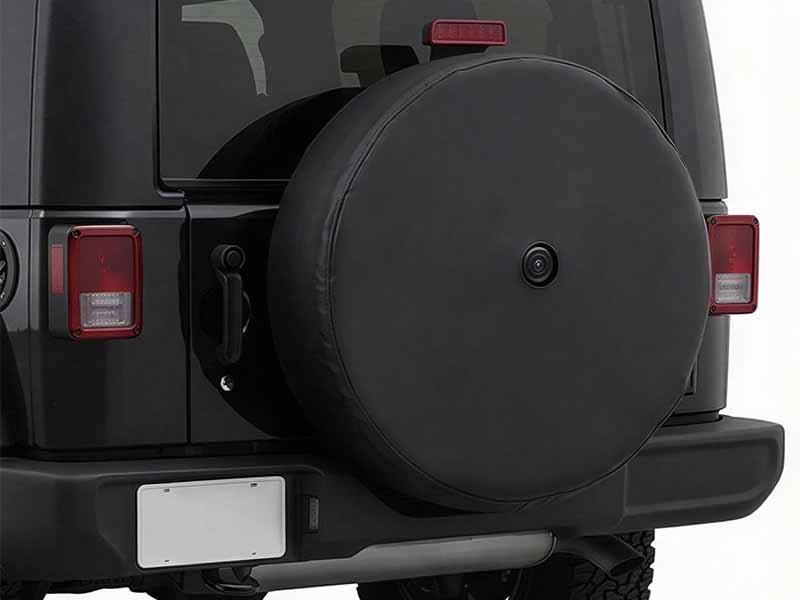
A Jeep Wrangler JL tire cover is truly camera-compatible only when it fits the spare tire while maintaining stable clearance around the rear camera and its surrounding housing. Correct compatibility depends on tire diameter, tire width, camera position, housing dimensions, cover tension, opening reinforcement, artwork placement, and any aftermarket carrier or extension. A hole in the middle of a universal cover does not automatically make it JL-compatible.
Camera Position Matters
The JL/JLU platform places the rear camera in the center area of the rear-mounted spare tire, which creates a different product structure from older solid-face spare tire covers. The front panel can no longer run continuously across the wheel center because the camera and its supporting structure have to pass through or remain exposed within a controlled opening. That opening needs to stay in the right place after the fabric or vinyl has been stretched over the tire.
A tire cover is manufactured flat but used as a three-dimensional product. During installation, the front face is pulled across the tire while the side section wraps around the tread and sidewall. The rear retention system then creates additional tension around the circumference. If the pattern is too large, the face can sag or rotate. If it is too small, the material may pull heavily around the opening and distort its shape. That is why the camera location has to be considered during pattern development rather than added at the end.
Szoneier’s fitment system treats vehicle, model year, tire size, camera position, camera housing, cover size, pattern ID, camera-hole dimensions, reinforcement and verification status as separate engineering variables. That approach reflects a practical reality: camera compatibility is a combined fitment problem, not one isolated dimension.
JL and JK Are Not the Same
Jeep Wrangler JK and JL accessories are sometimes grouped together in online listings, but they should not be treated as the same tire-cover platform. The JK/JKU generation generally does not use the JL-style factory rear camera projecting through the center of the spare tire. JL/JLU models do, which means the front-panel pattern, center opening and graphic layout need to be developed differently even when the two vehicles use similar tire diameters.
This distinction becomes especially important with printed covers. A JK design can place a logo, flag, illustration or text directly in the visual center. On a JL cover, the same layout may put the camera opening through the most important part of the graphic. The artwork therefore needs a defined safe zone, and the designer needs to see the camera position before approving production. Moving a logo several centimeters or enlarging a circular graphic can make the finished product look intentionally designed rather than cut apart.
Szoneier maintains separate JK and JL pattern families because the camera system changes the product itself. Its JL/JLU fitment records identify the center-mounted camera as a critical feature and maintain dedicated camera patterns across common spare-tire sizes.
More Than the Lens Must Stay Clear
One of the most common mistakes is measuring only the visible camera lens. The optical lens may be fairly small, but the tire cover usually has to clear a larger housing, protector, stalk, bracket or extension. In other words, the dimension that matters for the cover is often the physical envelope around the camera rather than the glass element that captures the image.
For certain verified JL configurations, internal engineering references used in production distinguish a visible camera module of roughly 32–36 mm from a broader housing envelope around approximately 68–72 mm. These figures are engineering references rather than universal Jeep specifications because aftermarket protectors, carriers and extension systems can change the shape and size around the camera.
A well-designed camera-compatible cover therefore checks several areas together. The opening should be large enough to install without catching on the housing, small enough to keep the front panel supported, and reinforced enough to stay stable under tension. Once installed, the surrounding material should sit flat and remain outside the useful camera view.
| Fitment Area | What to Confirm | Risk if Ignored |
| Tire diameter | Actual installed spare size | Cover may be loose or overstretched |
| Tire width | Section width and side depth | Side panel may not wrap correctly |
| Camera center | Installed camera position | Opening may shift away from camera |
| Housing envelope | Maximum outside clearance | Cover may catch on the housing |
| Opening diameter | Finished clear diameter | Too tight or unnecessarily large |
| Reinforcement | Binding, stitching or ring | Stretching and tearing may increase |
| Artwork safe zone | Graphic clearance | Logo or text may be cut |
| Installed camera view | Live rear-camera image | Fabric may enter the field of view |
Which Tire Cover Size Fits a Jeep Wrangler JL?

The correct Wrangler JL tire cover size should be chosen from the actual spare tire mounted on the vehicle, not from wheel diameter or trim name alone. Common JL applications fall around 32, 33 and 35 inches in overall tire diameter, but exact fit also depends on tire width, cover material, side depth and any modifications to the spare-tire carrier or camera system.
Read the Tire Sidewall First
The tire sidewall is the most useful starting point because it tells you what is actually installed on the Jeep. A code such as 285/70R17 contains the section width, aspect ratio and wheel diameter. The 17-inch number describes the wheel, not the complete tire. Once the sidewall height above and below the wheel is included, the overall diameter becomes approximately 32.7 inches, which is why that tire normally belongs in a 33-inch cover platform.
This matters because a 17-inch wheel can carry very different tire diameters. Depending on the tire specification, the same wheel diameter may support a roughly 32-inch, 33-inch or 35-inch tire. Ordering a cover based only on the rim size is therefore one of the easiest ways to get the wrong product. The complete sidewall code should always be recorded, and exact-fit programs should also consider the actual tire model when dimensional tolerance is important.
The following sizes illustrate several common JL-related platforms. These figures are nominal calculated values, so small differences between tire brands and tread designs are normal.
| Tire Size | Approx. Overall Diameter | Nominal Section Width | Common Cover Platform |
| 245/75R17 | 31.5 in | 245 mm | 32 in |
| 255/75R17 | 32.1 in | 255 mm | 32 in |
| 255/70R18 | 32.1 in | 255 mm | 32 in |
| 285/70R17 | 32.7 in | 285 mm | 33 in |
| 315/70R17 | 34.4 in | 315 mm | 35 in |
32, 33 and 35 Inches Are Core Platforms
For many Wrangler JL and JLU projects, the most useful commercial size groups are approximately 32, 33 and 35 inches. These categories provide practical starting points for pattern selection, but they should not be interpreted as three universal patterns that fit every tire in those ranges equally well. A 33-inch all-terrain tire and another tire sold in the same nominal class can have different actual width, tread shoulder shape and measured outside diameter.
Szoneier’s JL/JLU fitment records likewise use 32-, 33- and 35-inch camera-compatible patterns as core platforms, with additional development for larger aftermarket configurations. The advantage of dedicated size families is not only appearance. A more controlled pattern helps stabilize the camera opening, reduces excess material around the front panel, improves artwork position and makes repeat production easier to inspect.
Material choice can change the practical fit range as well. Flexible vinyl constructions may tolerate dimensional variation differently from heavier Oxford fabrics with less face stretch. For a premium printed product, reducing unnecessary looseness usually produces a cleaner front surface and a more predictable relationship between the graphic and the camera opening.
Tire Width Is Easy to Miss
Overall diameter controls the size of the visible circular face, but width determines how far the cover must travel around the side of the tire. Two tires can have similar overall diameter while one is significantly wider. If a pattern only increases front diameter without adding enough side depth, the cover can pull forward and create unnecessary tension around the camera opening or retention area.
The opposite problem occurs when the side panel is too deep. Extra material can gather behind the tire, reduce tension across the front face and allow the printed area to rotate. This is particularly noticeable on camera-equipped covers because even a relatively small shift can move the opening away from the housing center or introduce a wrinkle close to the lens.
For exact-fit programs, Szoneier therefore treats tire width or side depth as an additional fitment variable instead of relying only on the front diameter. Internal sizing standards also note that oversized covers may create wrinkles, loose fit and wind movement, while undersized covers can overstretch retention components, load the seams and deform the front panel.
Do Not Order by Trim Name Alone
Labels such as Sport, Sahara, Rubicon and Willys are useful for identifying the Wrangler configuration, but they are not enough to determine a tire-cover pattern. Tire packages vary by market, model year and option package, and many Jeep owners replace the factory tires long before they replace the vehicle. A Rubicon that left the factory on one tire size may now carry a wider or taller aftermarket spare.
The practical rule is straightforward: the tire currently mounted on the rear carrier matters more than the original catalog specification. A useful fitment record should include the JL or JLU generation, model year, full tire code, approximate overall diameter, section width, wheel type, spare carrier and camera configuration. If the Jeep has been modified, photos of the rear and side are often more useful than a trim name because they show what is really installed.
This simple verification step prevents many avoidable problems. It also becomes increasingly important when a brand sells several Jeep tire-cover sizes and needs customers to select a configuration online without assistance.
How Should the Backup Camera Hole Be Designed?

A Wrangler JL camera opening should be developed around the complete housing and the way the cover behaves after installation. The finished hole must stay centered, provide enough clearance, resist stretching, and leave a clean area for graphics. Hole diameter, reinforcement size, pattern location, cover tension and final camera visibility should be controlled as one connected design instead of separate production steps.
Size the Housing, Not Just the Lens
The camera lens is the first component most people see, but it is not usually the best reference for the tire-cover opening. The cover may need to pass around or rest beside a protector or housing that is much larger than the visible optical module. If production is based only on the lens size, the finished opening can be too small even when its center is technically correct.
For some standard JL projects, Szoneier’s engineering reference distinguishes a visible camera module around 32–36 mm from a larger housing envelope around 68–72 mm. The difference illustrates how misleading it can be to copy a lens measurement directly into a cutting file.
At the same time, making the opening much larger than necessary is not a good solution. An oversized hole removes support from the center area, exposes more of the wheel and can make the product look unfinished. A better process measures the largest physical section that the cover needs to clear, adds appropriate installation tolerance and then verifies the result on an actual or replicated fitment.
The Hole Must Be Correct After Stretching
A camera opening can look perfectly circular on a flat pattern and still become oval once the cover is pulled over the tire. The front face, side section and retention system all create tension in different directions. If those forces are unbalanced, the opening can migrate several millimeters or distort enough to create visible differences around the housing.
That is why inspection should take place after the cover has been installed on a sample tire, fitment jig or actual vehicle configuration. Measuring the panel on the cutting table is useful for process control, but it does not show how the product behaves once it is under working tension.
Camera-cover production can use digital patterning, CNC cutting, reinforcement cutting, pattern sewing, cylinder-bed sewing and camera-jig inspection. Szoneier’s camera-specific process controls hole diameter, hole center, housing clearance, reinforcement and cover diameter more closely than an ordinary solid-face tire cover.
For repeat orders, any meaningful change to the camera opening should be linked to a pattern revision. This prevents a new dimension from silently replacing a previously approved specification.
Reinforcement Controls Long-Term Shape
A camera cutout interrupts the front panel, so the edge around the opening becomes a natural stress point. The material is repeatedly pulled during installation and removal, and outdoor use adds wind movement, temperature cycles, moisture and vibration. Without adequate edge control, the opening can gradually stretch, fray, curl or lose its intended shape.
The reinforcement method should match the material rather than follow one universal solution. Options can include binding, stitched reinforcement, structured rings or layered patches. Szoneier’s manufacturing records include binding, reinforcement and stitching as available camera-hole treatments.
The goal is not simply to make the edge thicker. Reinforcement should distribute tension without creating a stiff area that puckers the surrounding panel. For commercial production, it is helpful to control the finished clear opening diameter and reinforcement outer diameter separately. That gives both the sewing team and the artwork team a clear definition of how much center space will be occupied after assembly.
Protect the Artwork Before Printing
On a custom Jeep JL tire cover, the camera is part of the graphic layout whether the designer planned for it or not. A centered dealership logo, circular badge, portrait or piece of text can be damaged if artwork is approved without showing the final camera opening and reinforcement area.
A practical production file should show three related zones: the finished camera opening, the reinforcement or stitching area, and a larger artwork safe zone. Important text, faces, QR codes and detailed graphic elements should remain comfortably outside that region.
If a logo conflicts with the opening, the artwork can often be improved by moving the logo slightly upward, enlarging the circular composition, dividing text into upper and lower sections or intentionally incorporating the camera into the design. Szoneier’s artwork workflow includes camera-hole avoidance and graphic repositioning during prepress preparation rather than leaving the issue until after printing.
That approach usually creates a cleaner product because the camera opening looks like part of the design instead of damage caused by production.
Do Aftermarket Tires Change Camera Fitment?
Aftermarket tires can change camera fitment even when the original rear camera remains near its factory position. Increasing tire diameter or width changes the cover pattern and tension, while larger tire upgrades can introduce new spare carriers, camera extensions and relocation hardware. Dedicated patterns are generally more predictable for common 33- and 35-inch setups, while 37-inch and larger builds deserve individual verification.
33- and 35-Inch Setups
Moving from a stock-sized tire to a 33- or 35-inch tire changes more than the circumference of the cover. The front face becomes larger, and the tire often becomes wider as well. That additional width requires more side-panel depth, otherwise the cover may sit too shallow and pull the face toward the camera opening.
When the pattern becomes larger, the camera opening should be verified as part of the new geometry rather than simply copied from a smaller size. Even if the camera itself remains in the same physical location relative to the spare carrier, the way the cover stretches across the tire has changed.
Szoneier maintains camera-compatible JL/JLU pattern groups around 32-, 33- and 35-inch applications for this reason. Separate size control helps improve camera centering, graphic scale, sidewall coverage and repeat-order consistency.
For a retail brand, those improvements can reduce the number of fitment complaints that appear after customers install the product themselves. A cover that looks clean in a product photo but shifts on different tire widths can quickly create support problems.
Large Tires Introduce New Hardware
When Wrangler owners move into roughly 37-inch, 38-inch or 40-inch tires, the fitment question becomes more complicated because the spare-tire system itself may have changed. Larger tires can require stronger carriers, different wheel positions, camera extensions or relocated third brake lights. The rear assembly may no longer match the factory arrangement even though the vehicle is still a Wrangler JL.
Szoneier’s JL database flags 37-inch and larger applications for additional confirmation of spare carrier type, camera extension, third brake light position and tire width. That means a request such as “I need a 37-inch JL cover” is not always enough for an exact camera-compatible product.
For heavily modified builds, useful information includes the complete tire code, tire brand, measured outside diameter, maximum width, wheel offset where relevant, carrier type, camera extension length, rear-view photograph and side-view photograph. These details cost very little to collect compared with producing a batch of covers with the wrong opening position.
Camera Extensions Can Change the Opening
A camera extension is designed to preserve rear visibility when larger tires or aftermarket hardware move the spare outward. The extension can change how far the camera projects through the wheel center, alter the size of the surrounding hardware or place the camera within a different protector.
Once that happens, the standard factory housing assumption may no longer apply. Even if the cover fits the tire correctly, the center opening may need a different diameter or reinforcement shape to accommodate the new assembly.
Szoneier’s modified-Jeep fitment process specifically asks for tire diameter, tire width, camera position and camera extension. If photographs show a configuration that is not already verified, treating it as a new fitment variation and producing a sample is usually more reliable than assuming it matches a stock JL.
Camera relocation kits create an even bigger difference. Once the camera has moved away from its original relationship with the spare tire center, a normal JL camera pattern may no longer be suitable even when the tire itself has not changed.
Fit and Camera View Are Separate Checks
A tire cover can install without touching the camera and still reduce the quality of the rear image. A loose fold may appear along the bottom of the screen, a wide reinforcement ring may sit near the lens, or the surrounding material may gradually move toward the viewing area after the cover settles.
That means final verification should answer two separate questions. First, does the cover physically clear the camera housing? Second, does the installed camera image remain usable and unobstructed? Both conditions need to be satisfied.
This distinction matters because customers experience the product from the driver’s seat as well as from outside the vehicle. A cover that appears technically correct from the rear but consistently puts fabric into the camera image will still be considered a poor fit. Live camera-view verification should therefore be part of sample approval whenever a new tire, carrier or camera configuration is introduced.
How Do You Install a Tire Cover Without Blocking the Camera?

Install a Wrangler JL camera tire cover by positioning the camera opening before fully stretching the cover around the spare. Work gradually and evenly down both sides so the front panel does not rotate, then recheck the opening and tension after the cover is seated. Before driving, activate the rear camera and confirm that the fabric, reinforcement and wrinkles remain outside the useful image.
Align the Camera First
A conventional tire cover can often be placed over the top of the spare and pulled downward without much concern about front-panel orientation. A camera-compatible JL cover should be handled more carefully because the face has a fixed relationship with the camera opening and, in many cases, with printed artwork.
Begin by identifying the top of the cover and positioning the opening around the camera housing. Once the center area sits naturally, place the upper section over the tire and work gradually down the left and right sides. Alternating between both sides helps distribute tension evenly and reduces the chance that the face rotates around the tire.
After seating the bottom edge, step back and look directly at the spare. The graphic should appear level and the camera opening should remain centered around the housing. If the cover repeatedly twists back out of position, the problem may be related to pattern dimensions rather than installation technique.
Exact-fit constructions generally reduce excess face material and improve graphic and camera-hole stability compared with broad universal-fit structures. Szoneier’s internal product records note the same practical advantage.
Check Tension Around the Opening
Once the cover is installed, inspect the material immediately around the camera. A circular opening should remain reasonably round rather than becoming strongly oval, and the spacing around the housing should appear balanced. Flexible sewn products do not need laboratory-level symmetry, but the housing should not press heavily against one side while leaving excessive space on the other.
Strong diagonal wrinkles running away from the camera area can indicate uneven tension. Check the top, bottom, left and right sides of the opening, then inspect the reinforcement to make sure it lies flat and does not curl inward toward the lens.
It is also useful to check the cover again after it has been installed for a short period. A product that was folded for packaging can relax slightly as the material redistributes around the tire. If the center opening remains stable after the material settles, that is a stronger indication of correct pattern fit than the first few seconds after installation.
Avoid Unnecessary Camera Disassembly
Different camera-compatible tire covers use different opening structures, so there is no universal rule that every Wrangler JL installation requires removing a bezel, protector or camera component. Some covers are designed to stretch around the existing housing, while others use a collar or finishing system that has its own installation method.
Before taking anything apart, confirm whether the opening is intended to pass over the existing housing, whether a trim component is designed to separate, whether the cover includes a separate ring, and whether the vehicle already has a camera extension or relocation kit.
This consideration matters for product development as well as installation. A tire cover that fits perfectly after an experienced technician disassembles several camera components may not be ideal for a retail customer. Ease of installation should be reviewed during sampling, particularly when a product will be sold in multiple sizes to Jeep owners who expect to install it at home.
A good product should make the intended assembly method obvious and avoid unnecessary interference with the vehicle’s original camera hardware.
Verify the Camera Before Driving
The last step is not visual inspection of the cover. It is checking the actual rear-camera image.
Activate the backup camera and look at the full display. Check whether fabric appears at the top or bottom of the image, whether the reinforcement is visible near one corner, whether a fold is drifting toward the lens or whether the housing seems to be pulled sideways by cover tension.
If material enters the image, first confirm that the cover is completely seated and centered. Avoid immediately cutting the opening larger because removing material is irreversible and may not solve a pattern or tension problem.
For controlled production, camera-compatible products can use digital patterns, CNC cutting and jig inspection so the opening is positioned consistently from one unit to the next. A properly developed cover should not require the end user to reshape the camera opening with scissors after purchase.
What Should You Check Before Ordering a Camera Tire Cover?
Before ordering a Jeep Wrangler JL camera tire cover, confirm the vehicle generation, model year, actual spare-tire size, tire width, camera configuration and spare carrier. Modified vehicles should also provide photographs and extension information. Custom artwork needs a camera safe zone, and new or uncertain fitments are best verified with a physical sample before they are approved for repeat or bulk production.
Build a Complete Fitment Record
Accurate tire-cover development starts with a small set of reliable vehicle details. “Jeep Wrangler JL” identifies the general platform, but it does not reveal the actual tire, the width, the spare carrier or any modifications that have been made since the vehicle left the factory.
A practical fitment record should include the vehicle generation, model year, complete tire code, approximate outside diameter, section width, tire brand where exact fit is important, spare carrier type, camera configuration, extension details, cover material and artwork type. Rear and side photographs are particularly helpful for modified Jeeps because they reveal hardware that may not be obvious from a written description.
| Item | Example | Why It Matters |
| Vehicle generation | Wrangler JL/JLU | Identifies camera platform |
| Model year | 2024 | Helps confirm configuration |
| Tire size | 285/70R17 | Establishes base tire geometry |
| Approx. OD | 32.7 in | Helps select pattern family |
| Nominal width | 285 mm | Helps determine side depth |
| Tire brand/model | Specified if known | Improves exact-fit accuracy |
| Spare carrier | Factory / aftermarket | Can change camera relationship |
| Camera | Factory / modified | Determines opening geometry |
| Extension | None / measured | Changes camera projection |
| Cover material | Vinyl / Oxford / polyester | Influences fit tolerance |
| Artwork | Logo / photo / graphic | Requires a camera safe zone |
| Reference photos | Rear and side views | Reveals vehicle modifications |
Szoneier’s vehicle database records vehicle, tire, camera, pattern and sample-result information, and new configurations can be developed from measurements, photographs, vehicle data or an existing product.
Universal and Exact Fit Solve Different Problems
A universal cover is designed to accommodate a wider size range, which can simplify inventory and reduce the number of SKUs a seller needs to manage. That approach is useful for basic protective applications, but the extra tolerance can also create more wrinkles, greater variation in graphic position and more movement around a camera opening.
An exact-fit product narrows the dimensional range and usually produces a cleaner face, more predictable sidewall wrap and more stable camera alignment. A vehicle-specific camera cover goes further by linking the tire dimensions to the vehicle’s camera structure.
None of these approaches is automatically right for every project. A broad universal product can make sense where simple protection and easy inventory management are the priorities. A premium custom-printed accessory may benefit from dedicated sizes because appearance and camera alignment are more important. A private-label Jeep accessory program may choose separate 32-, 33- and 35-inch camera patterns so each SKU has a controlled fit.
The important point is to match the construction strategy to the way the product will actually be sold and used.
Approve Artwork With the Camera Included
Artwork approval should show the real camera opening instead of presenting a perfect uninterrupted circle and leaving the production team to solve the cutout afterward. This is especially important for circular logos, dealership branding, large text, QR codes, flags, portraits and character artwork.
The mockup should indicate the finished hole and the area occupied by reinforcement. Important visual elements can then be moved before printing. A centered logo might be shifted upward, circular text can be enlarged, or a graphic can intentionally use the camera as part of the composition.
Szoneier’s prepress workflow includes graphic positioning and camera-hole avoidance so these decisions are made before production rather than after a printed panel has already been cut.
For repeat programs, the approved artwork should also be linked to the correct tire-cover pattern. A 32-inch and 35-inch cover may use the same design concept, but identical print coordinates do not always create the same installed appearance because the face diameter and camera relationship are different.
Verify Before Scaling Production
A reliable camera-compatible program follows a simple order: collect vehicle data, confirm tire dimensions, identify the camera structure, develop the pattern, define the opening, prepare the artwork safe zone, produce a sample, check the physical fit, check the camera view, approve the sample and then move into production.
This sequence works because the variables are connected. Changing material can change stretch. Changing stretch can affect front-panel tension. Tire width changes the side depth. Side depth influences how the face sits. Face tension affects the camera opening, and the opening influences where artwork can be placed.
For important private-label or OEM programs, Szoneier can maintain first samples, revised samples and an approved reference sample before repeat production. Its camera-fitment system also records pattern revision and verification status alongside the dimensional information.
That level of verification is more useful than a general statement that a product “fits Jeep Wrangler JL.” The objective is repeatability: the same approved size should install in the same way, place the artwork consistently and keep the rear camera clear from one production run to the next.
Choosing a backup-camera tire cover for a Wrangler JL becomes much easier once the problem is reduced to the right variables. Start with the actual tire rather than the trim badge, identify whether the camera and spare carrier are factory or modified, and treat the camera opening as part of the pattern rather than an afterthought. For a single owner, those checks help prevent a frustrating purchase. For brands developing custom Jeep accessories, they provide the foundation for a more repeatable and professional product.
Szoneier approaches camera-compatible tire covers as fitment products rather than generic circular covers. That means tire dimensions, camera geometry, material behavior, artwork, reinforcement and sample verification are considered together. The practical result is simple: the cover should look intentional on the spare, install without unnecessary modification and allow the backup camera to continue working as expected.
FAQ: What size tire cover fits a Jeep Wrangler JL?
The correct size depends on the tire actually mounted on the rear spare. Many Wrangler JL applications fall around 32-, 33- or 35-inch overall diameter, but the full sidewall code should be checked before ordering. A 285/70R17 tire, for example, has a calculated overall diameter of about 32.7 inches and is commonly treated as a 33-inch cover platform. Tire width should also be considered for exact-fit products.
FAQ: Can you put a tire cover over the backup camera on a Jeep Wrangler JL?
Yes, but the cover needs a properly positioned opening that clears the camera housing and remains stable when the cover is stretched over the tire. The opening should not press against the housing or allow fabric to drift into the camera image. A vehicle-specific camera-compatible pattern is generally more reliable than cutting a hole into a generic cover after purchase.
FAQ: Does a Jeep Wrangler JL tire cover need a center camera hole?
A factory JL/JLU rear-camera setup normally requires a center-area opening because the camera is positioned through the center region of the spare tire. Modified Jeeps may use camera extensions or relocation kits, so the actual location should still be confirmed. If the camera has been moved from the factory position, a standard JL center-hole pattern may no longer fit correctly.
FAQ: Will a 35-inch tire affect the Jeep JL backup camera?
A 35-inch tire does not automatically prevent the backup camera from working, but the larger diameter and greater width change the tire-cover geometry. The cover should use a pattern developed for the larger tire so the camera opening remains correctly positioned. If the upgrade also includes a new carrier, camera extension or wheel offset change, those components should be checked separately before choosing the cover.
FAQ: Can I cut a backup camera hole into an existing tire cover?
It is physically possible with many flexible materials, but the result can be difficult to control. The hole may become oversized, off-center, oval under tension or prone to tearing if the edge is not reinforced. Cutting may also damage printed artwork. For a long-term or retail-quality product, a factory-developed camera opening with controlled positioning and reinforcement is generally more predictable.
FAQ: How do I know whether my Jeep tire cover is blocking the camera?
After installation, activate the backup camera and inspect the full display. Fabric, reinforcement or folds should not interfere with the useful image. If part of the cover appears on screen, first make sure the cover is fully seated and centered before changing the opening. A cover can physically clear the lens while still entering the camera’s viewing area, so the live image is the final fitment check.
FAQ: What information is needed for a custom Jeep Wrangler JL camera tire cover?
The most useful information includes the JL or JLU generation, model year, complete tire size, tire width, spare carrier type, camera configuration and whether an extension or relocation kit is installed. Rear and side photographs are helpful for modified vehicles. For custom printed products, the artwork should also be reviewed with the camera opening and reinforcement area shown before production begins.


