 Skip to content


A polished website, a competitive quotation, and a collection of attractive product photos can make almost any supplier look capable. The real differences usually appear later, when the artwork changes after sampling, a material behaves differently in production, a camera opening no longer aligns with the approved vehicle, or thousands of covers must match the same specification. At that point, the important question is no longer who sent the lowest quotation. It is who actually controls the decisions behind the product.
A tire cover factory is generally the stronger choice when a project requires direct production control, repeatable OEM manufacturing, technical customization, transparent quality management, or meaningful recurring volume. A trading company can still be valuable when a company needs mixed product sourcing, supplier consolidation, smaller purchases, or additional commercial coordination. Neither model is automatically superior; the right choice depends on product complexity, purchasing scale, technical risk, and how much visibility you need over manufacturing.
The distinction matters more with tire covers than many purchasers initially expect. A custom spare tire cover may involve material grade, exact tire dimensions, artwork resolution, printing compatibility, seam construction, elastic tension, packaging requirements, and sometimes a vehicle-specific backup-camera opening. One poorly controlled detail can turn a visually attractive product into something that does not fit, fades prematurely, blocks a camera, or cannot be reproduced reliably on the next purchase order.
The most useful way to compare suppliers is therefore not to ask whether they call themselves a manufacturer. Ask whether they can show how an approved product moves from specification to material, pattern, artwork, production, inspection, packaging, and repeat manufacturing. Once you look at the relationship from that angle, the difference between genuine manufacturing control and commercial coordination becomes much easier to see.
What Is a Tire Cover Factory vs Trading Company?
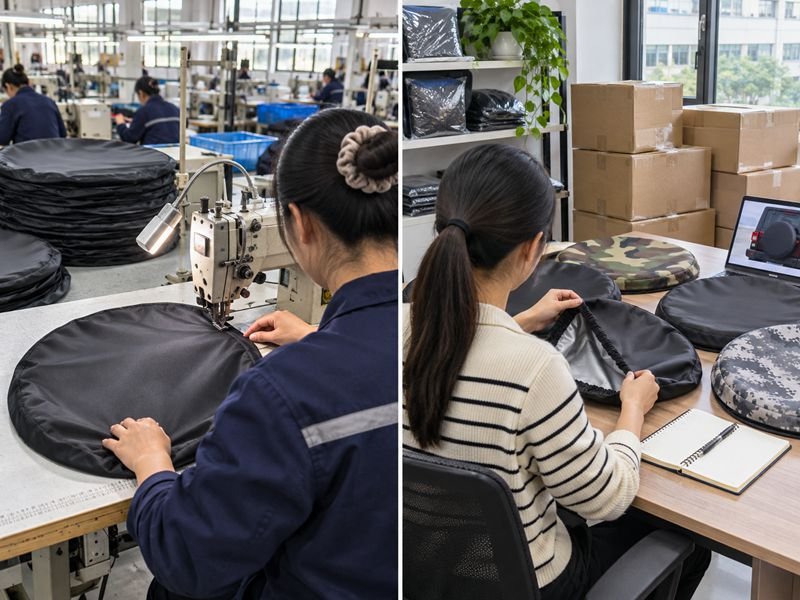
A tire cover factory directly manufactures or controls the processes that determine the finished product, including materials, patterns, printing, cutting, sewing, quality inspection, and packaging. A trading company mainly coordinates purchasing between customers and one or more manufacturers. The practical difference is therefore not the company label alone, but who has authority over technical decisions, production changes, quality standards, and corrective action.
What Does a Factory Actually Control?
A genuine tire cover manufacturer should control far more than the final sewing operation. Custom production normally begins with understanding the product specification and then connecting tire size, material, construction, artwork, printing method, fastening system, packaging, and inspection criteria to one production project. If the product is vehicle-specific or camera-compatible, fitment data and pattern revisions become part of that same control chain.
A useful way to test manufacturing depth is to change one specification during development. Ask what happens if a 600D Oxford construction is changed to vinyl, a full-color graphic becomes a one-color logo, or a backup-camera opening needs to move after fitting the first sample. A manufacturer should be able to explain which materials, pattern files, printing processes, cost assumptions, production operations, and inspection points must be reviewed rather than simply responding that the change is possible.
Within Szoneier’s tire cover manufacturing system, controlled projects can be associated with information such as tire size, vehicle, material identification, pattern identification, artwork version, printing process, camera configuration, golden sample, quality standard, packaging standard, and shipping instruction. This type of specification control is more meaningful when evaluating manufacturing capability than the word “factory” printed on a marketplace profile or website footer.
How Does a Trading Company Work?
A trading company normally serves as the commercial layer between the purchaser and the manufacturing plant. Its team may locate suppliers, negotiate prices, organize samples, consolidate products, arrange inspections, handle export documentation, and coordinate logistics. When a company needs several unrelated automotive or outdoor products from multiple factories, that service can reduce administrative workload and simplify communication significantly.
The limitation becomes more visible when the product requires technical changes. A trading company generally cannot revise a CAD pattern, change sewing construction, adjust a printing profile, approve a new material, or determine how a camera reinforcement should be engineered without communicating with the actual factory. Every technical decision therefore passes through another organization, and each handoff creates another opportunity for instructions to be delayed, simplified, or misunderstood.
This does not mean that trading companies produce poor results. Many experienced traders maintain strong factory relationships and capable inspection teams. The issue is simply one of control. The more complex and repeat-sensitive the tire cover becomes, the more important it is to understand whether the company answering your emails can also influence what happens on the production floor.
How Do Their Supply Chains Differ?
A direct manufacturing relationship generally creates a shorter technical path between the approved specification and the people executing it. Customer requirements can move through project management, engineering, material preparation, production, quality control, and shipment within one coordinated manufacturing system. When a specification changes, the revision can be linked directly to the responsible process and production documents.
A trading-company model adds another commercial layer. Customer instructions normally travel through the trader before reaching factory sales, merchandising, engineering, or production personnel. The same information then moves back through the trader for confirmation. This structure may be entirely workable for standard products, but additional handoffs matter when an order contains many sizes, multiple artworks, several packaging versions, custom colors, or different vehicle-camera configurations.
It is also important not to confuse corporate structure with trading activity. A manufacturing business may operate an international brand, specialized division, or separate legal operating entity while still controlling manufacturing. Szoneier, for example, operates Tire Cover Factory as a dedicated tire-cover manufacturing and fulfillment division rather than representing it as a separate legal corporation. The important question is whether the relationship between the contracting entity, manufacturing operation, and production facilities can be clearly explained and verified.
Which Offers Better Pricing and MOQ?

Factories usually become more cost-efficient as order volume increases because material purchasing, printing, cutting, sewing, packaging, and production planning are calculated directly around the order. Trading companies may offer greater flexibility for small or mixed purchases. MOQ should never be treated as one universal number because material, printing, accessories, packaging, color development, and production setup can each create a different minimum quantity.
How Does Factory-Direct Pricing Work?
Factory-direct pricing is built around the resources required to manufacture a defined specification. Material consumption is an obvious factor, but it is only one part of the calculation. Print coverage, number of colors, cutting yield, sewing time, binding, elastic or drawstring components, camera reinforcement, packaging, inspection requirements, and the number of different SKUs can all affect the finished unit price.
Consider two orders containing 1,000 tire covers. One order uses a single size, one material, one logo, and one packaging configuration. The other contains 20 sizes, dozens of artworks, several camera openings, and multiple retail labels. Although the total quantity is identical, the second program requires more pattern control, artwork processing, production changeovers, sorting, quality verification, and packaging management. A serious quotation should reflect those operational differences.
For that reason, experienced purchasing teams often request volume breaks using the same approved specification. Comparing prices at 100, 500, 1,000, and several thousand pieces helps reveal where material purchasing, production efficiency, cutting utilization, printing setup, and packaging scale begin to create meaningful savings. The lowest initial quotation matters less than understanding how the supplier calculates cost and whether the same logic can be reproduced on repeat orders.
Which Offers More Flexible MOQ?
There is no technically meaningful single MOQ for every custom tire cover. A manufacturer may genuinely produce one digitally printed cover using an existing material and standard construction while requiring hundreds of units for a custom-dyed fabric, special coating, molded accessory, or printed retail box. MOQ therefore needs to be understood as a group of manufacturing constraints rather than a marketing number.
Szoneier’s tire cover manufacturing framework separates artwork, production, material, printing, accessories, packaging, and commercial minimums instead of applying one blanket MOQ to every project. Documented examples range from one piece for selected standard PVC or vinyl configurations to higher thresholds when custom colors, heavier fabrics, special finishes, or supplier-specific material runs are required.
| Customization Scenario | Documented Typical MOQ | Main Production Constraint |
| Standard PVC/Vinyl custom cover | 1 pc | Stock material and digital customization |
| Stock 420D or 600D polyester | 30 pcs | Production setup and material usage |
| Stock 900D polyester | 50 pcs | Material and production efficiency |
| Custom PU color or texture | 100–300 pcs/color | Material supplier minimum |
| Custom-dyed Oxford | 300–500 pcs/color | Fabric dye lot |
| Special functional fabric | 500–1,000 pcs equivalent | Coating, lamination, or finishing run |
These figures represent documented manufacturing parameters rather than universal tire cover industry standards. The more useful purchasing question is therefore not simply “What is your MOQ?” but “Which part of my specification creates the MOQ?” A supplier that can explain that answer clearly gives you much more useful information for future product planning.
When Does Order Volume Change the Choice?
Small quantities reward flexibility, while large repeat orders increasingly reward manufacturing efficiency and process stability. A difference of $0.25 per unit means only $25 across 100 pieces, but it becomes $2,500 across 10,000 pieces. At higher volumes, seemingly small improvements in material yield, printing efficiency, sewing time, packaging, and production planning can materially influence the economics of the program.
Quality risk scales in exactly the same way. Saving a few cents per cover offers little benefit if a misaligned camera opening, incorrect size, broken elastic, wrong barcode, or unstable print affects hundreds or thousands of pieces. The real sourcing calculation should therefore include sampling, testing, material minimums, packaging setup, inspection, freight, rework exposure, replacement costs, launch timing, and repeat-order consistency.
For companies planning ongoing wholesale, OEM, or private-label programs, factory-direct sourcing often becomes more attractive as the product becomes standardized and volume grows. A trading company may still offer commercial convenience, but direct manufacturing access gives the purchaser more opportunities to understand where costs originate and how process changes can improve them over time.
How Does Tire Cover Customization Differ?
Customization is easier to control when the supplier has direct access to material, pattern, fitment, artwork, printing, sewing, sampling, and quality teams. Trading companies can coordinate customized products successfully, but technical decisions usually pass through another organization. For vehicle-specific, camera-compatible, private-label, printed, or OEM tire covers, direct engineering access reduces interpretation errors and makes revisions easier to document before mass production begins.
Who Controls Materials and Construction?
Material choice changes more than the appearance of a tire cover. PVC, PU, marine vinyl, printable polyester, and 420D, 600D, or 900D Oxford can differ in thickness, stiffness, stretch, coating behavior, print compatibility, abrasion resistance, folding performance, and sewing requirements. The fastening method also matters because elastic, drawstring, bungee, partial-back, and other structures create different fit and tension characteristics.
Changing material after sampling may therefore require more than replacing one fabric with another. Pattern dimensions may need adjustment because different substrates behave differently around the tire circumference and sidewall. Needle selection, seam allowance, stitch construction, binding, reinforcement, and handling methods can also change. A cover that fits correctly in flexible vinyl may not behave identically when produced in a heavier woven material using the same dimensions.
A disciplined development process evaluates new material before mass production. Szoneier’s documented tire cover workflow includes printing, cutting, sewing, folding, scratch, fitment, and sample validation when introducing new PVC, PU, vinyl, polyester, Oxford, or specialty materials. This is a useful standard when questioning any supplier: ask what else must be reconsidered when the material changes. Experienced manufacturers rarely answer that nothing changes.
Who Handles Printing and Artwork?
Custom printing begins long before the artwork reaches a printer. A circular tire cover creates visual constraints that rectangular promotional products do not have. Important graphics can disappear into seam allowance, curved edges, elastic zones, or a camera opening. Text and logos therefore need to be positioned according to the finished product rather than simply centered inside the original artwork file.
Customers may supply AI, EPS, SVG, PDF, PSD, PNG, JPG, screenshots, phone photos, or sketches. Each input requires a different level of prepress work. Szoneier’s documented workflow checks file type, resolution, pixel dimensions, vector status, fonts, spelling, color, background, aspect ratio, bleed, and camera-safe zones. For raster artwork, at least 150 DPI at finished size is recommended, while 200–300 DPI is preferred for photographic or premium output.
Printing technology should then be matched to the material, graphic complexity, quantity, and outdoor expectations. Full-color graphics, photographs, simple dealer logos, polyester artwork, and premium branding may require different processes. A technically capable supplier should explain why a process suits the substrate and order rather than offering a long menu of printing methods without discussing adhesion, curing, color repeatability, production speed, or cost.
How Are Tire Sizes and Camera Fitment Developed?
A vehicle model is not enough information to manufacture an exact-fit tire cover reliably. The same vehicle may use different original tires, aftermarket wheels, upgraded spare tires, or changes between model years. For that reason, the tire sidewall specification and actual dimensions are more useful manufacturing inputs than the vehicle name alone.
A 285/70R17 tire, for example, has a nominal section width of 285 mm. Its calculated sidewall height is approximately 199.5 mm because 285 × 0.70 equals 199.5 mm. After accounting for two sidewalls and the 17-inch wheel, the theoretical outside diameter is approximately 32.7 inches. Actual mounted measurements can still vary slightly by tire brand, model, inflation, construction, and wear.
Szoneier’s documented fitment rule therefore prioritizes actual tire information over the vehicle name and records factors including make, model, year, relevant trim, tire sidewall size, outside diameter where available, tire width, spare location, and camera details. Camera-compatible products add another engineering layer because the opening, reinforcement, graphic positioning, and usable field of view must work together rather than being treated as separate cosmetic decisions.
How Do Quality and Lead Time Compare?

Direct manufacturing can shorten the path between a defect and the people capable of correcting it, but factory status alone does not guarantee strong quality. Reliable production depends on incoming checks, process inspection, approved samples, defect standards, traceability, and corrective action. Lead time should similarly be supported by realistic material availability, capacity planning, and backup processes rather than a delivery promise made before production requirements are fully reviewed.
Who Controls Production Quality?
Effective quality control begins while the product is being manufactured, not when cartons are already waiting for shipment. Tire cover inspection can include material appearance, print position, color, cutting dimensions, stitching, seam integrity, fastening components, camera opening, cleanliness, labeling, packaging, and finished size. Detecting a systematic issue early can prevent the same defect from being repeated across a large production lot.
Within Szoneier’s documented production system, inline inspection is performed at least once every two hours under normal conditions, with increased frequency for important new products. When a recurring problem is identified, the process calls for production to stop, correction to be made, and the affected operation to be rechecked instead of waiting for final inspection to discover the same failure.
Personalized products require a different inspection approach because a product can be perfectly sewn yet still be unusable if it contains the wrong customer name, photograph, size, vehicle configuration, or shipping label. Personalized and dropshipping orders are therefore documented as receiving 100% individual verification against the relevant order, artwork, product, packaging, and shipment information.
How Should AQL Be Used?
AQL sampling is commonly useful for standardized bulk production when inspecting every characteristic of every unit would be inefficient. It should not be interpreted as permission to manufacture defects or as a substitute for process control. The value of an AQL system depends heavily on how defects are classified and whether the inspection level reflects the commercial and functional risks of the product.
Szoneier’s documented bulk inspection framework uses ISO 2859-1 sampling logic and General Inspection Level II as the internal default when a project does not specify another inspection plan. Its internal targets are Critical 0, Major 1.5, and Minor 2.5, while customer-defined inspection requirements can replace those internal defaults when agreed for the project.
| Defect Class | Internal Default AQL | Practical Tire Cover Examples |
| Critical | 0 | Safety hazard, unusable camera, wrong personalized customer data |
| Major | 1.5 | Wrong size, open seam, broken elastic, major print defect |
| Minor | 2.5 | Small thread, slight alignment difference, minor cosmetic mark |
The most important part of the system is not simply the number. A small cosmetic thread does not carry the same commercial consequence as a wrong tire size or a camera opening that blocks rear visibility. A useful inspection plan separates those risks instead of treating every defect as equally important.
How Is the Golden Sample Controlled?
A golden sample should be treated as the physical manufacturing reference for bulk production, not merely as a nice sample sent to the purchasing office. Once approved, it can confirm the intended material, dimensions, construction, stitching, graphic appearance, logo placement, camera details, fastening method, accessories, and workmanship. The associated digital records should identify exactly which pattern and artwork revisions belong to the approved product.
For important OEM and ODM projects, Szoneier’s tire cover development process documents first samples, revised samples, and golden samples as controlled stages within engineering and sampling. This becomes especially valuable when several rounds of comments have been exchanged because production teams should not rely on memory or whichever file happens to appear latest in an email chain.
Repeat production provides an even better test of supplier control. Ask what the factory retrieves when the same SKU is reordered six months later. A disciplined answer should reference the approved pattern, artwork revision, material record, golden sample or equivalent reference, inspection requirements, and packaging specification. If the supplier must recreate the specification from photographs, messages, or a visually similar old product, repeat-order consistency becomes much harder to protect.
How Does Manufacturing Control Affect Lead Time?
Lead time is a sequence of dependent processes rather than one number printed on a quotation. Material availability, artwork approval, printing, curing, cutting, sewing, camera work, inspection, packaging, and freight scheduling can all affect the final delivery date. A supplier can therefore promise an attractive lead time while still having little ability to recover when one critical process becomes delayed.
A more useful measure is production resilience. Szoneier’s documented manufacturing model separates product development, sampling, personalized production, large-scale cutting and sewing, materials, printing, and specialty processes within one coordinated network rather than expecting a single production point to handle every task in exactly the same way. The system also maintains backup routes for several important operations and avoids depending entirely on one source for critical materials.
No manufacturer can guarantee that every urgent order will avoid disruption. Equipment can fail, materials can be delayed, and capacity can tighten during peak periods. The better question is whether the supplier has already considered what happens next. A credible production team should be able to explain which operations are critical, which have alternatives, and how priorities are managed when the original schedule becomes unrealistic.
How Can You Verify a Real Tire Cover Factory?

Verify a tire cover factory by connecting several layers of evidence: legal identity, manufacturing relationship, production access, technical personnel, active work-in-process, specification records, quality documentation, and willingness to accept independent inspection. A business license proves that a company exists, but it does not prove that the company controls tire cover manufacturing. Strong verification combines legal, physical, technical, and operational evidence rather than relying on one certificate or website claim.
What Should You Check First?
Start with the legal entity responsible for the commercial transaction and understand how that entity relates to the manufacturing operation. Compare the legal company name with contracts, invoices, relevant business documentation, and manufacturing information. Differences between a legal company name, international brand, and specialized manufacturing division are not automatically suspicious, but those relationships should be explainable without vague or contradictory answers.
Szoneier provides a clear example of this type of structure. Tire Cover Factory is documented as a dedicated tire-cover manufacturing and fulfillment division rather than a separate incorporated company, while Shenzhen Oneier Technology Co., Ltd. is identified as the legal operating entity behind the business. Manufacturing roots are documented separately from the legal incorporation date, avoiding the common mistake of presenting operational history and company-registration history as though they were the same fact.
The same standard should be applied to any supplier. If company names differ, ask for the relationship. If manufacturing occurs through an affiliated facility, ask who controls it. If production is subcontracted, ask whether the same factory will remain responsible for repeat orders. Transparency is more useful than insisting that every business must have an identical brand, factory, and legal name.
Can the Team Answer Technical Questions?
Technical questions often reveal manufacturing depth faster than a factory photo. Instead of asking whether a supplier can manufacture custom tire covers, provide a realistic project: a 285/70R17 tire, 600D material, full-color graphic, elastic retention, backup-camera opening, branded packaging, barcode requirements, and a 1,000-piece production quantity. Then ask how the project would move from specification to approval and production.
The salesperson does not need to answer every engineering question personally. In many cases, the stronger sign is that the company can involve product engineering, pattern, artwork, prepress, printing, production, or quality personnel when the discussion moves outside normal commercial questions. A salesperson who immediately says yes to every technical request without checking anything is not necessarily demonstrating capability; sometimes the opposite is true.
Szoneier’s documented tire cover organization includes functions covering product engineering, vehicle fitment, pattern development, graphics and prepress, printing, sampling, industrial engineering, production, quality management, warehousing, and fulfillment. Manufacturing expertise is demonstrated by the questions a team asks about your specification and by its ability to explain the consequences of each decision, not simply by the speed of a quotation.
What Should You See During a Factory Review?
A useful factory review should follow the manufacturing process rather than remain in a meeting room or sample showroom. During a live video review or physical visit, ask to see raw materials, current printing or artwork preparation, cutting, sewing, in-process products, inspection stations, packaging, and finished goods. Where customer confidentiality permits, look for production records tied to actual work rather than prepared demonstration samples.
| Verification Area | Strong Evidence | Warning Sign |
| Legal identity | Entity relationship is clearly documented | Company names cannot be explained |
| Production | Active manufacturing processes can be shown | Only finished samples are displayed |
| Engineering | Technical staff can join the discussion | All technical questions stay with sales |
| Revision control | Artwork and pattern versions are recorded | Files are managed informally |
| Quality | Inline and final inspection records exist | Quality depends only on final visual checks |
| Sampling | Approved sample links to bulk specification | No controlled approval reference exists |
| Traceability | Project, SKU, material, or batch records exist | Production cannot be traced |
| Inspection access | Independent inspection can be arranged | External inspection is discouraged |
No single piece of evidence proves everything. Factory photos can be borrowed, machinery can belong to another company, and certificates may cover only part of a business. Verification becomes more reliable when the legal structure, technical answers, live production, controlled records, and quality procedures all support the same manufacturing story.
What Production Records Matter Most?
Manufacturing records protect the product after the original conversation has been forgotten. Staff can change, customers can reorder months later, materials can receive new batches, and artwork may go through several revisions. A strong system therefore needs a reliable way to connect the finished product to the specification that was actually approved.
Useful records include project identification, tire specification, vehicle data where relevant, material reference, approved pattern, artwork revision, printing method, camera configuration, sample approval, inspection criteria, packaging requirements, and shipment instructions. The exact software used matters less than whether the information can be retrieved accurately when production begins again.
Corrective-action documentation is equally important because every manufacturer eventually encounters problems. Szoneier’s documented quality process uses a CAPA structure for significant issues, covering containment, root-cause investigation, corrective action, preventive action, verification, and closure. This is a far more useful indicator of manufacturing maturity than a claim that defects never occur. The important question is whether the company can identify an affected lot, control the immediate problem, determine what caused it, and prevent the same issue from returning on the next order.
Which Supplier Should You Choose?
Choose a direct factory when tire covers require technical development, stable repeat production, custom materials, vehicle fitment, camera compatibility, controlled artwork, stringent quality management, or recurring wholesale volume. Choose a trading company when sourcing convenience, supplier consolidation, and broad product coverage matter more than direct process access. A capable trader can outperform a poorly managed factory, so the final decision should be based on evidence and project risk rather than labels alone.
When Is a Direct Factory Better?
Direct manufacturing becomes increasingly valuable as product complexity rises. A standard universal cover with one simple logo may require relatively little engineering. A program containing 20 SKUs, several tire sizes, custom graphics, vehicle-specific fitment, camera openings, material variants, private-label packaging, and scheduled repeat orders is very different. Every additional variable creates another specification that must remain controlled from sampling through bulk production.
Factory relationships are particularly useful for OEM and private-label programs because the knowledge developed during the first order can be reused. Once a pattern, material, artwork file, construction, packaging setup, and quality requirement have been properly approved, future production should begin from those controlled references instead of starting development again from photographs or sales notes.
That continuity becomes commercially valuable over several seasons. A manufacturer that understands the history of a product can often help improve material utilization, reduce unnecessary process steps, develop additional sizes, or introduce new graphics without losing the original construction standard. For a company building a long-term tire cover category, that accumulated manufacturing knowledge can become more important than a small difference in the first quotation.
When Is a Trading Company Better?
A trading company becomes attractive when the purchasing challenge involves many suppliers rather than deep development of one product category. A distributor may need tire covers together with recovery bags, camping organizers, seat accessories, promotional items, storage products, and unrelated automotive accessories. Managing a separate factory for each product may require more procurement time and staff than the program economically justifies.
A capable trading company can consolidate communication, supplier selection, inspections, documentation, and freight while allowing the purchasing company to work through one commercial relationship. It may also provide access to smaller manufacturers that have strong production ability but limited international sales or export-management resources.
The key is to define responsibility before ordering. Ask whether the trader will disclose the manufacturing plant, whether production can move to another factory without approval, who owns the technical specification, who controls the approved sample, who performs inspection, and who is responsible if the factory fails to meet the agreed requirements. Commercial convenience can be valuable, but only when responsibility remains clear.
How Should You Make the Final Decision?
The final choice should be based on the risk profile of the project rather than a preference for one business model. For a technically customized tire-cover program, an internal evaluation can assign the greatest weight to technical capability and quality management, followed by commercial fit, delivery resilience, and communication. The percentages can be adapted to your own purchasing priorities instead of being treated as an industry standard.
A practical scoring approach might allocate roughly 30% to technical capability, 25% to quality management, 20% to commercial fit and MOQ, 15% to delivery resilience, and 10% to communication and documentation. A supplier with the lowest price may still rank poorly if it cannot explain material control, fitment, artwork revision, inspection, or repeat-order production. Conversely, a slightly higher quotation can represent better total value when the supplier removes significant quality and schedule risk.
Before approving the order, ask who actually manufactures the product, which operations are performed under the supplier’s control, how tire size is confirmed, who develops the pattern, how artwork versions are locked, how the golden sample is used, what inspection criteria apply, and what happens when production deviates from the plan. Those answers reveal considerably more about supplier suitability than whether the company introduces itself as a factory or trading company.
For custom tire covers, the safest sourcing relationship is usually the one that keeps you closest to the people controlling fit, material, artwork, manufacturing, and quality. Szoneier’s role in such projects is not simply to accept a drawing and arrange production, but to connect product development, customization, manufacturing, inspection, packaging, and fulfillment through one coordinated system. The objective is straightforward: the approved product should be manufacturable, measurable, traceable, and repeatable when the next order arrives.
A strong supplier should therefore be comfortable moving the conversation beyond “Can you make it?” The more useful discussion is how the product will be engineered, which specifications will be locked before bulk production, where quality will be checked, how deviations will be corrected, and how the same approved result will be reproduced months later. When a supplier can answer those questions with evidence rather than promises, the factory-versus-trading-company decision becomes much easier.
Frequently Asked Questions
Is buying directly from a tire cover factory always cheaper?
Not always. A direct manufacturer removes one potential commercial layer, but the final cost still depends on material, printing, construction, quantity, packaging, inspection, and logistics. Trading companies may also receive favorable factory pricing through consolidated purchasing. Direct sourcing generally becomes more economically attractive when specifications are stable and order volume grows, because production efficiency and repeat-order planning begin to matter more than sourcing convenience.
How can I tell whether a tire cover supplier is a real manufacturer?
Do not rely on one piece of evidence. Check the legal company relationship, request live access to production processes, ask technical questions about materials and fitment, review pattern or artwork controls, examine inspection records, and confirm whether independent inspections are accepted. A genuine manufacturing operation should be able to connect its sales organization with engineering, production, quality, and traceable project records rather than providing only factory photos and certificates.
What is a normal MOQ for custom tire covers?
There is no single industry-wide MOQ because the minimum depends on the product and customization. Standard digitally customized PVC or vinyl products can sometimes be made in very small quantities, while custom-dyed fabrics, special coatings, unique colors, printed packaging, and specialized accessories may require hundreds of pieces. The most useful approach is to ask which material, printing, packaging, or production process is setting the MOQ for your specific project.
Is a trading company suitable for OEM tire cover orders?
A trading company can manage OEM orders successfully when it maintains a stable manufacturing partner, understands the specification, controls revisions, and has a reliable inspection system. However, technically complex programs involving new patterns, vehicle-specific sizing, camera compatibility, material development, or frequent revisions often benefit from more direct communication with the manufacturing team because fewer technical instructions have to pass through an additional commercial organization.
What information should I send a tire cover manufacturer for an accurate quote?
For a useful quotation, provide the tire size or intended size range, vehicle information when fitment matters, expected quantity, preferred material, artwork or logo, printing requirements, camera configuration if applicable, fastening structure, packaging needs, destination, and target schedule. If some details are not yet decided, a capable manufacturer should identify which specifications affect cost and help you compare practical alternatives before finalizing the production version.
What should be approved before mass production begins?
At minimum, the purchasing team should approve the product dimensions, material, construction, artwork, printing appearance, color reference where necessary, fastening method, camera details, accessories, labels, packaging, and inspection requirements. For customized OEM projects, these approvals should be linked to controlled pattern and artwork revisions and preferably to an approved physical sample so that production teams are not relying on informal messages or outdated files.
Is a factory audit necessary before placing a large tire cover order?
A formal audit is not required for every order, but verification becomes increasingly important as commercial exposure grows. For a large OEM, retail, or private-label program, a live factory assessment, production review, quality-system check, or independent inspection can provide valuable evidence before significant funds are committed. The level of verification should match the value, technical complexity, repeat potential, and reputational risk of the purchasing program.


