 Skip to content


A PU tire cover can look excellent when it leaves the printing machine and still become a disappointing product after a few months outdoors. The reason is simple: tire-cover printing is not only a graphic process. The printed surface must survive folding during packing, rubbing during handling, stretching during installation, vibration on the vehicle, cleaning, sunlight, heat, cold, and repeated outdoor exposure. A printing method that produces beautiful color on a flat sample is therefore not automatically the method that gives the most reliable finished product. In practice, the material surface, ink chemistry, artwork, color structure, quantity, intended climate, and production controls all work together. This is especially important with PU because two materials sold under the same broad name can have different surface coatings and react very differently to the same ink. Experienced tire-cover development therefore starts by matching material and print system rather than choosing a printer first.
The best printing method for a PU tire cover depends on the PU surface, artwork, order quantity, color requirements, and outdoor exposure. UV printing is strong for dark PU, white ink, and fine detail; flexible digital printing suits photos and changing artwork; screen printing is often more economical for repeated 1–4 color logos. Every PU-and-ink combination should be validated before bulk production.
A common development problem illustrates this clearly. A brand approves a bright, detailed logo on a sample made from one black PU, then changes to another visually similar PU to reduce cost before production. The finished print still looks good on day one, but the new coating has lower ink compatibility and small areas begin to lift after repeated folding. Nothing was wrong with the artwork or the printer; the problem was that the material-and-ink combination changed without being revalidated. That is why a dependable tire-cover printing program is built around the complete product, not around a single machine specification.
What Makes PU Tire Covers Hard to Print?
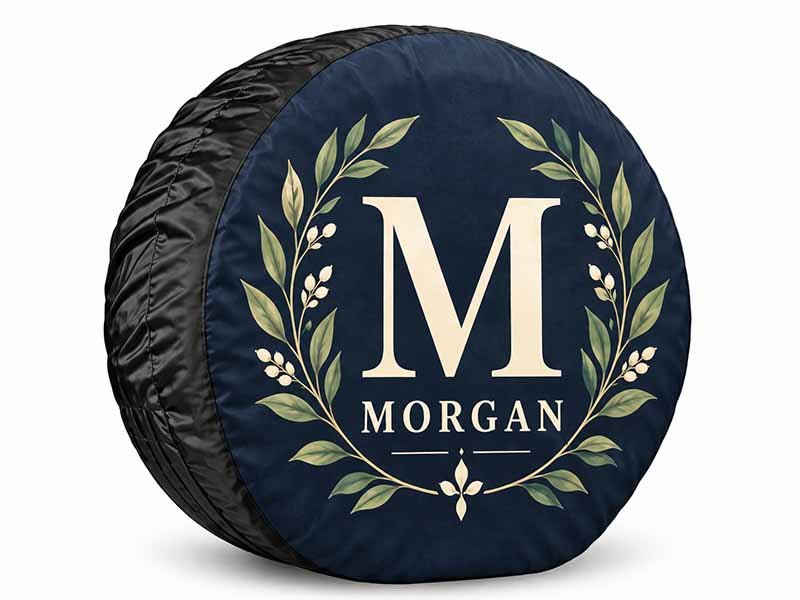
PU tire covers are harder to print than ordinary absorbent fabrics because the ink must bond to a flexible coated surface that is repeatedly folded, stretched, scratched, heated, cooled, and exposed outdoors. Surface chemistry, texture, coating formulation, ink system, curing, and environmental exposure all affect performance, so print quality cannot be judged only by the appearance immediately after production.
What Is Different About a PU Surface?
A PU tire-cover panel is usually constructed with a polyurethane surface layer supported by a woven or knitted textile backing. The visible face may be smooth, matte, semi-gloss, leather-grained, automotive-grained, pebble-grained, or otherwise embossed. Because most printing takes place on this coated face, the chemistry and physical structure of that top layer determine how well the ink wets the surface, how securely it bonds, how much detail can be reproduced, and how the finished print behaves when the material is bent.
This is very different from printing on an absorbent textile where ink can penetrate more deeply into the fiber structure. On PU, much of the graphic remains associated with the surface coating. A small difference in formulation can therefore create a large difference in adhesion. Two black PU sheets may appear identical to the eye while using different resins, additives, surface finishes, backing structures, or manufacturing treatments. One can accept ink easily while the other needs different pretreatment, curing conditions, or an entirely different ink system.
Surface construction also affects visual quality. Smoother PU generally makes it easier to reproduce thin lines, small lettering, gradients, and photographic detail. Matte PU reduces reflections and often suits premium black or charcoal automotive styling. Textured PU can create a more convincing leather-like appearance, but deeper grain makes extremely fine detail more difficult to reproduce consistently. Szoneier’s tire-cover material platform includes matte PU around 0.50–0.70 mm and textured PU around 0.60–0.80 mm, with deeper texture treated more cautiously for fine photographic work.
| PU Surface | Typical Range | Printing Behavior | Better-Suited Artwork |
| Smooth PU | Approx. 0.5–0.8 mm depending grade | Good edge definition and detail | Photos, gradients, detailed logos |
| Matte PU | Approx. 0.50–0.70 mm | Lower reflection, premium appearance | Automotive branding, dark covers |
| Textured PU | Approx. 0.60–0.80 mm | Grain may reduce tiny-detail clarity | Bold logos, simpler graphics |
| Black/Dark PU | Grade-dependent | Often requires white ink or underbase | Bright logos, high-contrast artwork |
| Specialty PU | Project-specific | Compatibility must be verified | Determined after testing |
How Do PU Coatings Affect Ink Adhesion?
Ink adhesion is not simply an ink property. It results from the interaction between the PU coating, ink chemistry, surface cleanliness, pretreatment, curing conditions, film thickness, temperature, and sometimes even storage history. A surface that contains certain additives or release agents may have lower surface energy, making it more difficult for the ink to wet and anchor properly. Dust, oil, excessive handling, or contamination can create the same kind of weakness.
This explains why a freshly printed sample can be misleading. Weak bonding does not always reveal itself immediately. The graphic may appear sharp and fully cured while the panel is flat, but problems can become visible after the material is folded into a carton, bent around the spare tire, rubbed during cleaning, or exposed to repeated temperature changes. Lifting at edges, fine cracking, whitening, or local peeling are usually much more informative than the appearance of the first flat print.
For long-running programs, the more reliable approach is to qualify the actual production material with the intended ink system. Szoneier’s internal PU control process requires relevant material batches to pass ink adhesion, bend, scratch, and color checks before they are accepted for long-term production. This prevents a common mistake in which a sample is approved on one PU grade but bulk production later uses a visually similar material with different coating behavior.
The practical question to ask is therefore not simply, “Can you print on PU?” Most capable factories can. The more useful question is, “Has this exact PU surface been tested with this exact ink system and production process?” That distinction separates a technically controlled product from one that is relying mainly on appearance.
Do Matte and Textured PU Print Differently?
Matte and textured PU can behave quite differently even when their thickness and base color are similar. Matte PU is commonly selected for automotive products because it reduces glare and avoids the shiny appearance associated with some lower-cost synthetic surfaces. On black or charcoal tire covers, a low-gloss face can also make logos appear cleaner and can improve product photography because bright reflections are less distracting.
Textured PU provides another type of value. Leather grain, pebble grain, cross grain, and automotive-style embossing can make a tire cover look more substantial and visually premium. The tradeoff is that the print must follow a three-dimensional surface rather than an almost flat one. Very small text, fine outlines, facial details, and subtle tonal changes may appear less precise because the ink sits across peaks and valleys in the grain.
The solution is not to avoid textured material entirely. It is to match the artwork to the surface. Bold logos, thicker lettering, simplified graphics, and strong contrast often perform very well on textured PU. When artwork contains extremely fine details, the development team may increase line weight, enlarge important elements, simplify small shapes, or select a smoother printing panel rather than forcing the original artwork onto a surface that cannot reproduce it cleanly.
For this reason, material approval and artwork approval should ideally happen together. Choosing an attractive PU texture first and discussing printing only after the material has been ordered can create avoidable compromises in color, detail, or process choice.
Which Printing Methods Work Best on PU?

UV digital printing, flexible digital printing, and screen printing are the most practical processes for many PU tire-cover programs. UV is especially useful for dark PU and white ink, digital printing works well for photographs and variable graphics, and screen printing becomes increasingly attractive for repeated simple logos. Heat-transfer processes can work on selected PU surfaces but should never be assumed compatible without testing.
Is UV Printing Good for PU Tire Covers?
UV digital printing is particularly useful when a PU tire cover combines a synthetic surface with detailed graphics, white elements, dark material, fine text, gradients, or premium branding. Its strongest advantage is the ability to work with white ink. Standard process colors are not fully opaque, so bright colors printed directly over black PU can appear dull, muddy, or much darker than the original artwork. A white layer underneath the design provides a controlled foundation that allows the colors above it to remain brighter and more predictable.
The documented tire-cover UV platform supports PU, PVC, vinyl, selected marine vinyl, films, synthetic materials, and selected coated fabrics, with adhesion testing required before each new material is approved. The production configuration supports CMYK and white ink and provides a print width of approximately 1,610 mm, which is sufficient for large circular tire-cover face panels. Suitable applications include white logos on black PU, detailed automotive graphics, fine illustrations, gradients, spot-color elements, and premium private-label designs.
The main tradeoff is that UV ink cures into a more noticeable surface film than some flexible digital systems. That does not automatically make it unsuitable for tire covers, but it means the printed area has to tolerate bending and folding without excessive cracking or lifting. Szoneier’s premium PU programs therefore do not evaluate UV printing only by appearance. Adhesion, bend, fold, scratch, and UV checks are part of the validation process before more demanding outdoor programs are approved.
When Is Digital Printing a Better Choice?
Flexible digital printing becomes particularly useful when the artwork is complex or changes frequently. Photographs, pet portraits, landscapes, flags, camouflage effects, illustrations, gradients, personalized names, multi-color logos, and limited-edition designs can all be produced without preparing physical screens for individual colors. That flexibility makes digital printing suitable for sampling, personalized orders, ecommerce programs, product launches with many designs, and collections where each SKU has different graphics.
The tire-cover production database lists photographs, illustrations, gradients, complex logos, and personalized artwork among the strongest digital applications. Compatible stock-material programs can start from one piece, which makes it possible to produce a realistic sample using the same artwork and material concept before committing to a larger order. This is especially useful when a project is still validating color, artwork positioning, tire fit, or camera-hole placement.
Digital printing also makes sense when the total order quantity is large but the quantity per artwork is small. Five hundred identical covers form one repeatable production run. Five hundred covers divided among one hundred different graphics behave more like one hundred mini production runs. In the second situation, digital workflow usually avoids the repeated setup that would make screen printing unnecessarily complicated.
Outdoor durability still depends on the complete material-and-ink combination. Szoneier’s process rules specifically avoid promising a fixed number of outdoor years based only on the printing technology. Material grade, ink, UV exposure, climate, and actual validation results all affect performance. Standard outdoor programs therefore include adhesion, scratch, and UV checks rather than assuming that the word “digital” guarantees durability.
When Does Screen Printing Work Best?
Screen printing remains one of the most useful processes for tire-cover branding because many commercial programs do not require photographs or continuous-tone artwork. Dealers, automotive accessory brands, RV companies, clubs, fleets, promotional programs, and private-label product lines often use the same one-color, two-color, or simple multi-color logo repeatedly across hundreds or thousands of units.
In this situation, the initial preparation work can be spread across the full production run. The internal screen-printing process is positioned as a cost-efficient method for repeated simple logos, particularly from roughly 100 pieces into larger runs. The most efficient color structure is usually one to four spot colors. As additional colors are introduced, more screens, more registration work, more setup time, and more opportunities for variation are added to the process.
Screen printing can also produce high-opacity white on dark materials and can work with Pantone-targeted spot colors. This makes it especially useful for brand marks that need strong, solid color rather than photographic detail. A white dealership logo on black PU is a classic example: if the same logo is repeated across several thousand pieces, screen printing deserves serious consideration.
The process has a technical production MOQ below the point where it becomes most economical. The internal standard lists a technical MOQ of around 30 pieces, while the cost advantage usually becomes more visible around 100 pieces and above. That is why the same printing method should not automatically be chosen for a 30-piece sample order and a 3,000-piece production run.
| Printing Method | Strongest Application | Typical Quantity Logic | Main Consideration |
| UV Digital | Dark PU, white ink, fine graphics | 1 pc upward | Ink-film flexibility and adhesion |
| Flexible Digital | Photos, gradients, variable artwork | 1 pc upward | Surface compatibility |
| Screen Printing | Repeated 1–4 color logos | Economics improve around 100+ pcs | Setup and registration |
| Heat Transfer / DTF | Selected smaller logo applications | Small to medium | Heat and PU compatibility |
| Sublimation | Printable polyester constructions | 1 pc upward on suitable media | Not a universal direct-PU process |
Heat-transfer and DTF methods can also be considered for selected applications, but they should not be treated as universal solutions for long-term outdoor PU tire covers. Szoneier’s process database classifies DTF mainly as a small-batch logo or fast-transfer option for polyester, Oxford, fabric, and selected PU surfaces, while PVC and vinyl require additional compatibility checks.
Which Method Fits Your Artwork?

Artwork often determines the printing process before price does. Photographs and gradients usually favor digital methods, repeated spot-color logos often suit screen printing, and black PU may require a white ink layer before color is added. Fine detail is also affected by surface texture, so important artwork should be judged on the actual PU rather than only on a computer monitor.
Which Method Is Best for Photos and Gradients?
Photographic artwork contains continuous tonal changes, shadows, fine transitions, small color differences, and complex visual detail. Reproducing that type of image through conventional spot-color screen printing quickly becomes inefficient because every additional color separation adds preparation and registration work. Digital printing is therefore normally the more practical starting point when the design includes photographs, detailed illustrations, landscape scenes, complex camouflage, artistic gradients, or personalized imagery.
The internal tire-cover database identifies digital printing, UV printing, and sublimation as the main processes used for full-color artwork. Photographs, gradients, illustrations, and multi-color logos are specifically listed as suitable applications. The best choice among those processes then depends on the material itself.
A genuine PU front face normally needs a digital ink system that has already been validated for the polyurethane coating. A printable polyester construction opens the possibility of dye sublimation, which can deliver excellent color, fine detail, flexibility, and a lighter surface feel because the color interacts with polyester rather than creating a conventional heavy surface film.
The documented sublimation platform is approximately 64 inches wide and is used for photographs, illustrations, full-surface graphics, landscapes, gradients, artistic designs, and variable artwork. Its outdoor durability is classified internally as medium to high, but actual performance depends on dye, polyester construction, UV exposure, and climate. For very strong long-term sun exposure, the material and print system should therefore be selected together rather than choosing solely for photographic quality.
Which Method Is Best for Simple Logos?
A simple logo creates a different production problem from a photograph. Imagine a black PU tire cover with a white RV-brand logo. The artwork contains no gradient, no photograph, no changing personalization, and no complicated color transitions. If 2,000 identical units are required, the flexibility of variable digital artwork may provide little commercial benefit unless another technical requirement makes digital printing preferable.
Screen printing is often the first process worth comparing in this situation. Its strongest range is generally one to four spot colors. Pantone targets can be used, opaque white can be produced on dark PU, and the setup cost can be spread across a larger repeated run. The internal process standard specifically identifies one to four colors as the preferred screen-printing range and generally redirects more complex multicolor artwork toward digital production when screen count and registration become inefficient.
Now change the project from 2,000 identical logos to 2,000 covers divided among 200 different full-color graphics. The total quantity has not changed, but the production logic has changed completely. Digital printing becomes more attractive because separate physical screens do not have to be created and registered for every artwork.
This is why a useful printing quotation needs more information than total order quantity. The number of colors, number of unique artworks, quantity per artwork, print dimensions, material, and repeat-order plan all influence which method makes sense.
How Is White Printed on Black PU?
Black and dark PU create one of the most common challenges in tire-cover printing because ordinary CMYK inks rely partly on light passing through the ink and reflecting from the background. On white material, that background helps colors appear bright. On black PU, much of that reflected light disappears, so yellow, red, blue, and other bright colors can become noticeably darker or less saturated.
A white underbase provides a practical solution. In UV printing, a dedicated white ink layer can be placed beneath the color artwork so the CMYK image is printed over a lighter, controlled foundation. White-only logos can also be printed directly with high opacity. Screen printing can achieve a similar result by using an opaque white ink formulated specifically for the PU surface.
The tire-cover UV platform specifically supports white ink and identifies black or dark PU, PVC, and vinyl as important applications. However, white ink creates additional production variables. White-layer density, registration, edge trapping, curing, ink thickness, flexibility, and adhesion all need to be controlled.
For an important branded project, color should therefore be approved on the actual black PU rather than from a white paper proof or computer screen. The same artwork can look noticeably different when the white underbase, surface texture, gloss level, or material shade changes.
How Is Print Adhesion and Durability Tested?
Printed PU tire covers should be evaluated as flexible outdoor products rather than as flat printed graphics. Useful validation includes adhesion, bending, folding, scratching, UV aging, and temperature-related checks. These tests help identify peeling, cracking, ink loss, fading, yellowing, hardening, and coating failure before bulk production instead of waiting for those weaknesses to appear after products reach the market.
How Is Adhesion Checked Before Production?
Adhesion testing should begin with the actual material and intended production process. A representative sample is printed using the planned ink, pretreatment, curing settings, white underbase when required, and production artwork. The print is then evaluated after the ink system has had the necessary time to stabilize rather than being judged only seconds after it exits the printer.
This matters because a tire cover goes through many mechanical steps before reaching a vehicle. The material is printed, cut, sewn, folded, packed, shipped, unpacked, and stretched over a tire. Weak bonding can survive the first step and still fail later. A small lifted edge or fine crack after bending can reveal more about long-term reliability than a perfect-looking flat print.
Szoneier’s material approval process requires PU surfaces to pass print adhesion checks before they enter the approved material system. This is particularly important when a material supplier changes formulation, finish, or production lot. A visually similar replacement may not behave the same way and should not automatically inherit the approval of the original material.
For repeat production, the most dependable control connects the approved print result to a defined material code, ink system, artwork revision, and physical sample. That makes later orders easier to reproduce and reduces the risk of uncontrolled material substitution.
How Do Bend, Fold, and Scratch Tests Find Failures?
A flat sample gives only part of the information required for a tire cover. The product is flexible, so the printed panel is bent and folded during manufacturing, packing, installation, and storage. An ink film that appears strong while flat may reveal fine cracking, edge lifting, whitening, or excessive stiffness once the PU is folded sharply or stretched around the tire.
Bend and fold checks can reveal several failure modes, including micro-cracking, local loss of color, fracture of the ink film, surface whitening, lifting near graphic edges, and separation between coating layers. These observations are particularly useful when comparing printing systems that create different film thicknesses or stiffness on the same PU surface.
Scratch testing addresses another common source of damage. Finished covers may rub against carton material, packing surfaces, hands, dust, cleaning cloths, brushes, tools, or parts of the vehicle during installation. Szoneier’s internal scratch protocol is intended to simulate handling, packing, installation, and cleaning through rubbing, scratch-stylus methods, or weighted abrasion depending on the material. Large-area ink loss, delamination, and surface peeling are considered unacceptable.
A strong validation program combines these checks because no single test tells the whole story. Good initial adhesion does not automatically mean good scratch resistance, and strong scratch resistance does not guarantee that the print will tolerate repeated folding.
How Is UV Aging Used to Check Fading?
Outdoor tire covers spend long periods exposed to sunlight and changing weather, so print durability cannot be evaluated by leaving a sample beside a window for a few days. Accelerated UV testing provides a more controlled way to compare material and printing systems for changes such as fading, cracking, yellowing, hardening, coating damage, and loss of print quality.
The internal tire-cover testing framework includes accelerated UV exposure with screening levels ranging from approximately 200–300 hours for basic evaluation to 800–1,000+ hours for extreme-outdoor development programs. Those numbers represent laboratory exposure hours and should never be converted directly into claims such as “500 test hours equals five years outdoors.”
Real outdoor life varies because sunlight intensity, latitude, altitude, parking direction, temperature, humidity, climate, cleaning chemicals, material formulation, and actual daily exposure all change from one application to another. A tire cover used year-round in a high-sun desert environment faces a very different aging pattern from a product used seasonally in a cooler region.
Temperature testing can provide another useful layer of information. Szoneier’s internal screening evaluates issues such as cracking, warping, adhesion, shrinkage, and color changes after exposure to temperature cycles, while PU and other coated materials may also be checked for low-temperature cracking according to the requirements of the specific material program.
| Validation Check | Main Purpose | Typical Failure Signs |
| Adhesion | Confirm ink-to-PU bonding | Lifting, peeling |
| Bend/Fold | Simulate packing and installation | Cracking, whitening |
| Scratch | Simulate handling and cleaning | Ink loss, surface damage |
| UV Aging | Screen sunlight-related aging | Fade, yellowing, cracking |
| Temperature Check | Evaluate hot/cold stability | Warp, adhesion loss |
| Color Check | Maintain brand appearance | Visible shift from approved target |
The most credible durability statement is therefore linked to the exact material, ink, testing conditions, and acceptance criteria. A general statement that one printing method “lasts for years” without identifying those variables is much less useful for product development.
How Do Quantity and Cost Change the Choice?

Order quantity changes printing economics, but total pieces are only one part of the calculation. Digital printing is highly efficient for low quantities, many designs, and personalized artwork, while screen printing becomes increasingly attractive when the same simple logo repeats across larger runs. Color count, number of artworks, setup, white ink, testing, and repeat-order requirements all influence the real finished cost.
Which Method Works for One-Piece Orders?
One-piece production strongly favors digital printing because there is almost no quantity over which to distribute conventional setup cost. If a customer needs one pet portrait, one family name, one Jeep graphic, or one physical sample for approval, preparing several screens would usually add more cost and time than value.
Digital printing allows the production file to move from artwork preparation into RIP and print without creating separate physical screens for every color. Szoneier’s standard digital tire-cover program can support a one-piece MOQ on compatible stock PU and other selected materials, and digital printing is the main process used to make low-MOQ personalization practical.
The same principle applies to much larger orders with many different designs. An order of 300 covers using one repeated artwork behaves like one production program. An order of 300 covers divided across 100 different designs behaves more like 100 small programs combined into one purchase order.
For that reason, total quantity should never be the only number used to select a process. Number of artworks, quantity per artwork, material type, print size, color structure, and expected future repeats all influence the most efficient route.
When Does Screen Printing Become Economical?
Screen printing includes preparation work before efficient repetition begins. Depending on the artwork, the factory may need to prepare screens, separate colors, mix spot inks, set registration, make trial prints, confirm opacity, and stabilize curing conditions. Those steps take time whether the order contains 20 pieces or 2,000 pieces.
At low quantity, that fixed preparation represents a large share of the cost per cover. At higher quantity, the same preparation is distributed across far more units. Szoneier’s process data places the technical screen-printing MOQ around 30 pieces, while economic advantages usually become clearer around 100 pieces and above. More detailed production guidance lists one-color programs from approximately 50 pieces, two-color orders around 100 pieces or more, and more complex multicolor programs commonly around 100–300+ pieces depending on the project.
These numbers are useful process references rather than universal quotations. Artwork size, PU grade, ink system, number of colors, testing requirements, packaging, and production structure can shift the break-even point.
A 3,000-piece one-color dealer logo is therefore very different from a 100-piece multi-color promotional graphic. Both are screen-printable, but only one may make strong commercial sense after setup and registration are considered.
How Does Color Count Affect Bulk Cost?
Color count has a particularly strong effect on screen-printing cost because each spot color normally adds process work. A one-color logo may require one primary screen and relatively straightforward registration. A four-color spot design needs additional screens, more print passes, tighter positioning control, and more opportunities for visible misalignment.
The internal screen-printing standard identifies one to four spot colors as the most efficient range. Once artwork becomes substantially more complex, increasing screen count, registration work, and setup cost can reduce the advantage of the process and make digital printing more practical.
Digital printing follows a different cost structure. A photograph can contain thousands of visible color transitions without requiring thousands of individual physical screens. Its economics are affected more by print area, ink consumption, white ink, production speed, material, and the number of unique artworks.
Repeat orders create another cost consideration that is easy to overlook: consistency. For a continuous product line, the cheapest first shipment is not necessarily the lowest-cost program if the second shipment arrives with a visibly different logo, material finish, or print position.
A controlled repeat-order record normally retains the approved material code, artwork revision, print dimensions, color target, printing process, ink system, placement, and golden sample. This kind of production memory becomes especially valuable for long-running automotive, RV, private-label, dealer, and promotional programs.
How Do You Specify Printing for Bulk Production?
A bulk printing specification should convert the customer’s visual artwork into measurable production requirements. It should identify the PU material, artwork revision, dimensions, colors, white-ink requirements, print position, camera-hole relationship, printing process, durability criteria, and approved sample. Clear specifications reduce interpretation and make consistent production far easier across hundreds, thousands, or repeat orders.
What Artwork Files Should Be Provided?
Production artwork needs enough information to reproduce the graphic at actual tire-cover size. A small web image may look sharp on a laptop screen while becoming visibly pixelated when enlarged to 600, 700, or 800 mm across a spare-tire cover. Logos are usually easier to control from vector artwork because curves, letters, and shapes can be enlarged without losing edge quality.
Photographic artwork requires sufficient pixel resolution at the final print size. It is also useful to provide the original production file rather than only a compressed preview because the production team may need access to layers, transparency, fonts, color information, or editable elements.
Szoneier’s prepress workflow checks resolution, DPI, vector condition, bleed, color mode, ICC handling, white-ink layers, print size, registration marks, camera-hole avoidance, RIP preparation, and production-file control. Those checks become increasingly important as the artwork becomes more complex.
A practical production artwork package may include:
- AI, EPS, PDF, PSD, or another high-quality source file;
- high-resolution embedded or linked photographs;
- outlined or supplied fonts;
- final intended print dimensions;
- Pantone references for critical colors;
- placement reference;
- camera-hole position where relevant;
- bleed beyond the visible cut area when required.
The purpose is not to create paperwork for its own sake. Clear artwork data prevents problems from being discovered after the material has already been printed or cut.
How Should Colors Be Specified?
Color should be treated as a production target rather than as something defined only by a computer monitor. Display calibration, screen brightness, PU color, surface texture, white underbase, ink, printing process, and gloss level all influence how the final graphic appears.
Pantone references are useful when a brand has important corporate colors, particularly for spot-color screen printing. However, a Pantone number should not be understood as a guarantee that every substrate and every printing process will produce exactly the same visual result. Szoneier’s printing data specifically notes that final Pantone-targeted output is affected by ink, material, surface, and printing process.
Digital printing introduces additional variables including CMYK conversion, ICC profiles, RIP settings, ink limits, and white-underbase density. Black PU is especially sensitive because the white layer beneath the image can noticeably change brightness and saturation.
For important production programs, a physical printed swatch or actual tire-cover sample is therefore a stronger color reference than an emailed PDF. Repeat orders should retain the approved material, printing process, color target, and artwork revision so the next batch starts from an established reference rather than relying on memory.
How Are Print Area and Camera Holes Controlled?
Tire-cover artwork is normally designed on a rectangular computer canvas but displayed on a circular finished product. The production team therefore has to consider the visible tire-cover diameter, seam allowance, bleed, edge construction, installation stretch, artwork center, print-to-cut registration, and actual tire size before the artwork can be treated as production-ready.
Camera-equipped spare-tire vehicles add another layer of complexity. Applications such as Jeep Wrangler JL/JLU and Ford Bronco may require an opening close to the center of the printed face. A graphic that looks perfectly balanced in the original file can lose a letter, facial feature, emblem, or focal point after the camera opening is added.
This is why camera-hole avoidance should be handled during prepress rather than after the artwork has been printed. Szoneier’s artwork-control workflow includes print-size checking, registration marks, and camera-hole avoidance as part of production-file preparation.
For an important OEM or private-label program, the final approval package should normally identify the material, printing method, artwork revision, print dimensions, color target, white-underbase requirement, camera position, print-to-cut relationship, durability requirements, and approved reference sample.
A premium black PU cover with detailed multicolor artwork and bright white elements may point toward UV printing. A personalized photographic product with many artwork variations may be better suited to flexible digital production. A 3,000-piece dealer program with one repeated white logo may strongly favor screen printing. The right answer becomes much clearer once the material, artwork, quantity, outdoor environment, and repeatability requirements are considered together.
Conclusion
There is no single printing method that is automatically best for every PU tire cover. The strongest process is the one that fits the exact combination of PU surface, graphic complexity, color structure, quantity, outdoor exposure, and production requirements. UV printing is particularly useful for dark PU, white ink, and detailed graphics. Flexible digital printing makes photographs, gradients, personalized designs, and low-volume programs much easier to manage. Screen printing remains highly competitive for repeated simple logos at larger quantities.
The most important lesson is that printing should never be separated from material development. A successful tire-cover program treats the PU, ink system, artwork, curing, durability testing, and approved sample as one controlled specification. That approach prevents many of the failures that are otherwise discovered only after folding, installation, outdoor exposure, or repeat production. When a project involves unusual PU surfaces, demanding brand colors, camera-hole graphics, or larger repeat orders, discussing those details with an experienced custom tire-cover manufacturer such as Szoneier before sampling usually produces a more predictable result than choosing a printing method from a simple price list.
FAQ
What printing method is best for PU tire covers?
There is no universal best method because the correct choice depends on material surface, artwork, quantity, color requirements, and outdoor use. UV printing is particularly strong for dark PU, white ink, and detailed graphics. Flexible digital printing suits photographs, gradients, and variable artwork, while screen printing is often the most economical choice for repeated one- to four-color logos at larger quantities.
Can you UV print directly on PU leather?
Yes, many PU surfaces can be UV printed successfully, but the specific material should be tested before bulk production. PU coatings vary in chemistry, texture, surface energy, and additives, so a process that adheres well to one PU may perform differently on another. Adhesion, bending, folding, scratching, and outdoor-aging checks are more reliable than assuming that all materials sold as PU leather will behave the same way.
Is screen printing more durable than digital printing on PU?
Screen printing can provide excellent durability for simple solid-color logos when the correct outdoor-compatible ink and curing process are used. Digital systems can also perform well outdoors when they are properly matched to the PU surface. Durability should therefore be evaluated from the material, ink, curing, adhesion, scratch resistance, UV exposure, and climate rather than from the printing method name alone.
Can full-color photos be printed on PU tire covers?
Yes, full-color photographs, illustrations, gradients, landscapes, pet images, and detailed graphics can be produced on compatible PU tire-cover materials using validated digital printing systems. UV printing is especially useful when the material is dark or the artwork requires white ink. Fine photographic detail also depends on the surface texture, so smoother PU generally reproduces small details more clearly than heavily embossed material.
How do you prevent printed PU tire covers from peeling?
Peeling risk is reduced by matching the ink system to the exact PU coating, keeping the surface clean, using the correct pretreatment and curing conditions, and validating the finished print before production. Useful checks include adhesion, bend, fold, scratch, and UV testing. Material substitutions should also be controlled because a visually similar PU from another batch or supplier may not provide the same ink adhesion.
Is screen printing cheaper than digital printing for custom tire covers?
Screen printing can become more economical when the same simple logo repeats across a larger quantity because the initial setup cost is distributed over more units. Around 100 pieces and above, it is often worth comparing screen printing with digital production for one- to four-color logos. Digital printing usually remains more practical for very low quantities, many different artworks, photographs, gradients, or personalized designs.
What artwork files are best for custom PU tire-cover printing?
Vector files such as AI, EPS, or production-quality PDF are preferred for logos because they can be enlarged without losing edge quality. High-resolution photographs can be supplied in suitable raster formats when sufficient resolution is available at the final print size. Important production details should also include print dimensions, color targets, camera-hole location, placement reference, bleed, and any white-ink requirements.


