 Skip to content


A PU tire cover may look almost unchanged after months outdoors and then begin fading, hardening, cracking, or peeling much faster than expected. That is one reason simple statements such as “PU lasts three years” are not very useful on their own. Two covers may both be sold as PU leather, yet one may be a moderate-outdoor material intended mainly for appearance and personalization while the other uses a higher-grade polyurethane system, stronger backing, better coating adhesion, improved hydrolysis resistance, and a UV-stabilized formulation designed for prolonged outdoor exposure. Climate, fit, printing, cleaning, and storage then add another layer of variation.
A useful answer is that PU tire covers do not have one universal lifespan. In ordinary outdoor use, several years is a reasonable commercial expectation for a properly specified product, but actual service life depends heavily on PU grade, sunlight, temperature, humidity, hydrolysis resistance, coating adhesion, backing fabric, fit, printing, and maintenance. Outdoor-grade PU should be evaluated by defined material specifications and tests rather than by a fixed number of years alone.
This distinction becomes obvious when two identical-looking covers leave the factory at the same time. One goes onto a vehicle kept under a carport in a mild climate. The other sits on the back of an SUV parked outdoors every day in intense desert sunlight, then travels through highway wind, dust, rain, and repeated temperature changes. Their calendar age may be identical, but their material-aging history will be completely different. Understanding that difference is the starting point for judging how long a PU tire cover can realistically remain attractive, secure, and functional.
How Long Do PU Tire Covers Last?
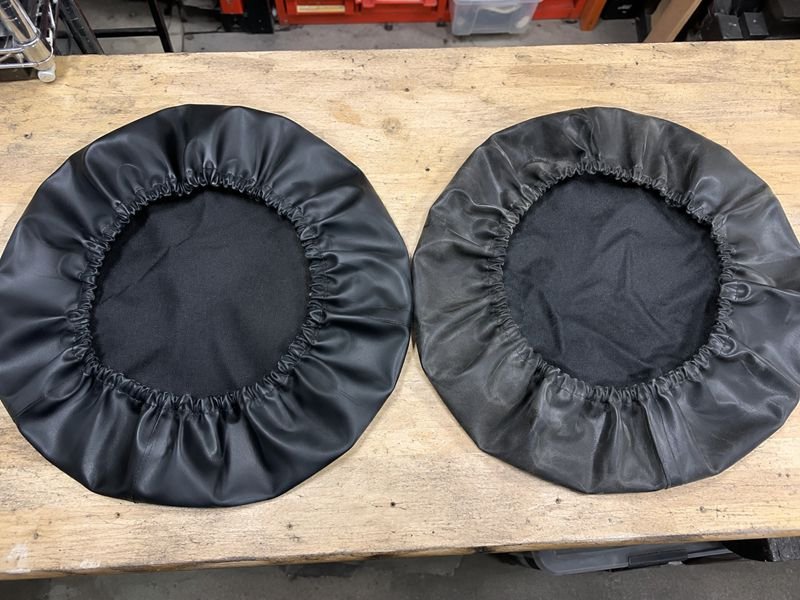
A PU tire cover does not have one fixed service life. Several years may be a reasonable expectation for a well-specified product under ordinary outdoor conditions, but actual longevity varies with PU grade, UV intensity, heat, humidity, coating quality, backing fabric, fit, printing, maintenance, and storage. The material specification matters more than a simple “PU leather” label.
What Is a Realistic Outdoor Lifespan?
People naturally want a number when they ask how long a tire cover lasts, but a useful lifespan estimate must begin with the material grade and the environment in which the product will be used. Commercial PU tire covers on the market are sometimes described with expected service periods around a few years, but such figures should be viewed as product-specific references rather than universal industry guarantees. An inexpensive decorative PU used occasionally and a premium outdoor PU exposed year-round should not be expected to age at the same rate.
Within Szoneier’s tire-cover material control system, standard PU is treated as a soft-touch material for personalized and moderate-outdoor applications rather than as an automatic long-term, high-UV solution. A typical standard construction is approximately 0.45–0.60 mm thick with a finished weight around 350–500 g/m². The internal material platform also separates premium and outdoor-oriented PU instead of treating every polyurethane synthetic leather as equivalent.
Premium PU moves into a different performance range, with typical thickness around 0.60–0.80 mm and finished weight around 500–650 g/m². More importantly, the grade is selected for better flexibility, improved hydrolysis resistance, stronger backing options, and higher outdoor-performance targets. A high-UV project may require an explicitly UV-stabilized outdoor formulation rather than simply choosing a material that feels thicker or more expensive.
For practical product development, the better question is therefore not “Can PU last exactly three years?” It is “What PU grade, backing, UV level, hydrolysis resistance, climate, construction, and test criteria support the service life this product is expected to deliver?” That question produces a specification a manufacturer can actually control.
Why Is There No Fixed Lifespan?
Outdoor aging follows exposure, not the calendar. A vehicle parked under cover for most of the day may expose its tire cover to far less solar radiation than an RV stored permanently in an open lot. A humid subtropical location creates a different aging pattern from a dry desert because temperature, moisture, UV radiation, condensation, and repeated wet-dry cycles affect different parts of the material system.
PU itself also varies considerably. A proper specification should describe more than the phrase “PU leather.” Szoneier’s material system records the PU type, surface layer, base fabric, hydrolysis grade, UV grade, thickness, GSM, cold-flex performance, and print compatibility. These details explain why visually similar materials can perform differently after long periods outdoors.
Construction adds another variable. A loose tire cover can move continuously in wind or at highway speed. That movement bends the same edge repeatedly, rubs the surface against nearby hardware, and loads the seam and elastic system thousands of times. A cover that is too tight creates the opposite problem by keeping the material under excessive tension around the rear opening, seam lines, and camera cutout.
Usage habits also matter. Harsh cleaning chemicals, stiff brushes, pressure washing, folding the cover while wet, leaving dirt trapped against the surface, or frequently removing and reinstalling the product can all contribute to wear. The final lifespan is therefore the result of material chemistry, construction, climate, fit, maintenance, and exposure working together rather than one isolated variable.
What Is Functional vs Appearance Life?
A PU tire cover usually has at least two different lifespans: its appearance life and its functional life. Appearance life ends when fading, gloss change, yellowing, print deterioration, or cosmetic abrasion becomes unacceptable to the owner. Functional life ends when the cover can no longer remain secure, maintain its structure, or provide the expected level of coverage.
These two points do not always occur together. A black PU cover may lose some color intensity while the backing, coating, seams, elastic, and overall fit remain structurally sound. That product is cosmetically aged but can still function. In another case, a cover may still look acceptable from a distance while the backside coating has started separating, the edge elastic has weakened, or repeated flexing has created small cracks around a high-stress area.
| Condition | Typical Sign | Practical Meaning |
| Cosmetic aging | fading, gloss loss, mild color change | Product may still be fully usable |
| Surface aging | stiffness, light abrasion, fine cracking | Material deterioration has started |
| Structural aging | peeling, seam opening, weak elastic | Reliability is declining |
| Fit deterioration | slipping, flapping, loose rear edge | Mechanical stress and loss risk increase |
| End of service | major tearing, delamination, failed retention | Replacement is advisable |
For premium automotive products, appearance life may be commercially just as important as physical durability because customers often judge quality by color retention, print condition, and surface finish. A manufacturer developing a branded tire-cover program should therefore define both acceptable appearance and acceptable structural performance instead of treating lifespan as a single pass-or-fail date.
What Shortens PU Tire Cover Life?

Strong UV exposure, elevated temperature, prolonged humidity, hydrolysis, weak coating adhesion, excessive flexing, abrasion, poor fit, and incompatible printing are the main factors that shorten PU tire cover life. These stresses frequently act together, which is why premature deterioration should be investigated as a material-and-construction system rather than blamed on one visible symptom.
How Does UV Damage PU?
Ultraviolet radiation is one of the most important outdoor-aging factors because the exposed face of a spare tire cover can receive sunlight day after day for years. The earliest visible sign may be gradual fading, especially on dark materials or printed graphics. Longer exposure can also contribute to changes in gloss, yellowing, hardening, reduced flexibility, surface cracking, and deterioration of the coating.
The phrase “UV resistant” should not be treated as a binary claim. Different PU grades have different levels of stabilization and different intended applications. Within the internal material platform, standard PU is positioned for moderate outdoor exposure, while higher-grade PU is used when stronger weathering performance is needed. Premium outdoor projects require a formulation with a defined UV-stabilization system rather than assuming every premium-feeling PU is suitable for continuous intense sunlight.
Accelerated testing is useful for comparing materials, but the results need careful interpretation. An accelerated UV test exposes samples to controlled radiation, moisture, and temperature cycles so engineers can compare changes in color, flexibility, cracking, printing, and coating integrity. The number of laboratory exposure hours should not be converted directly into a fixed number of outdoor years. Szoneier’s testing rules specifically prohibit treating accelerated UV hours as a simple calendar-year conversion.
For real product decisions, a more useful question is whether Material A remains measurably more stable than Material B after the same test cycle and whether the selected grade matches the expected climate and exposure intensity.
How Do Heat and Humidity Affect PU?
Heat and humidity create a different durability challenge because certain polyurethane systems can deteriorate through hydrolysis when exposed to prolonged moisture and elevated temperature. Depending on formulation and construction, this process may eventually appear as softening, tackiness, powdering, cracking, peeling, or loss of adhesion between the surface layer and backing.
This is particularly important in tropical, subtropical, coastal, and high-humidity markets. A PU tire cover used in a dry, hot desert and one used in a hot, humid coastal location may both experience high temperatures, but the dominant degradation mechanisms can be different. In the dry environment, UV and thermal aging may dominate, while hydrolysis and adhesion stability deserve more attention in prolonged humidity.
Szoneier therefore treats hydrolysis performance as a separate material-control parameter rather than assuming all PU behaves the same way. Standard and premium PU use different internal hydrolysis targets, with higher-grade products selected for demanding applications and humid environments. These targets are screening criteria for material development and should not be interpreted as guarantees that a finished product will survive an identical number of outdoor calendar years.
A practical product specification for a humid market should combine hydrolysis resistance with coating adhesion, backing stability, UV performance, seam construction, and proper drying after use. Focusing only on material thickness or GSM can miss the real weakness.
Why Do PU Covers Peel?
Peeling is a symptom rather than one single type of defect. The visible PU surface is part of a layered material, so failure can begin inside the polymer, between coating layers, at the interface between coating and backing, around repeated folds, or in the printing layer applied to the surface.
Large-area peeling after prolonged hot and humid exposure may indicate material degradation or hydrolysis. Local delamination concentrated around folds can suggest insufficient flex resistance or weak adhesion between layers. Fine cracks on stretched areas may indicate UV aging, cold-flex problems, or repeated bending. Ink that lifts while the PU underneath remains intact usually points to a printing-adhesion issue rather than failure of the complete base material.
Mechanical wear can create similar symptoms. A loose cover repeatedly flapping in wind may flex the same edge thousands of times. Dirt trapped between the cover and tire can act as an abrasive. Poorly positioned reinforcement around a backup-camera opening can concentrate load in a small area, while rough cleaning may damage the surface and create weak points where weathering progresses faster.
| Failure Sign | Possible Cause | What to Check |
| Broad peeling | hydrolysis or coating deterioration | PU formulation and humidity resistance |
| Edge delamination | weak bonding or repeated flex | coating adhesion and fold performance |
| Fine surface cracks | UV aging or low-temperature stress | UV grade and cold-flex data |
| Ink lifting | print incompatibility | ink adhesion and surface preparation |
| Local abrasion | loose fit or rubbing | size, tension, vehicle contact points |
| Sticky surface | polymer deterioration | PU chemistry and hydrolysis stability |
| Fold whitening | excessive flex stress | bend and fold resistance |
For that reason, material approval should not rely on appearance alone. Szoneier’s PU/PVC qualification process includes tear, sewing, fold, print-adhesion, scratch, water-resistance, and cold-flex checks, while premium outdoor programs add accelerated UV, color-change, coating-adhesion, and PU hydrolysis evaluations.
Which PU Specifications Matter Most?

The most useful PU specifications include material grade, thickness, GSM, textile backing, UV resistance, hydrolysis resistance, tear strength, low-temperature flexibility, coating adhesion, and print compatibility. No single number can predict service life because outdoor durability comes from the complete PU-and-backing system working together.
Is Outdoor-Grade PU Different?
Outdoor-grade PU is different because it is selected around environmental performance rather than appearance alone. Synthetic leather designed for furniture, fashion accessories, gifts, or indoor products may have excellent hand feel and surface quality but still lack the UV, hydrolysis, adhesion, or cold-flex performance required for a tire cover that remains outside for months at a time.
A tire cover experiences repeated bending during packaging and installation, stretching around a curved tire, moisture, road contamination, heat, sunlight, and airflow. Material choice therefore needs to reflect how and where the vehicle will actually be used. Standard PU may be suitable for moderate exposure, personalized products, and applications where premium softness and appearance are priorities. Premium or specifically stabilized outdoor PU becomes more appropriate when exposure becomes more severe.
Questions that help define the correct grade include:
- Will the vehicle remain outdoors year-round or only occasionally?
- Is the climate hot and dry, hot and humid, cold, coastal, or moderate?
- How strong is the expected UV exposure?
- What low temperature must the material tolerate?
- Is the cover printed or decorated with additional branding?
- Will it be removed and folded frequently?
- Is there a backup-camera opening or reinforced cutout?
- Is the product aimed at premium appearance or maximum outdoor life?
These questions are more useful than asking whether the material is simply “premium.” A higher price or softer hand does not automatically indicate better outdoor stability.
How Do Coating and Backing Matter?
PU tire-cover material is a layered structure. The visible surface contributes color, feel, weather protection, printability, and appearance, while the textile backing helps carry load, control stretching, support sewing, and maintain dimensional stability when the material is stretched around a tire.
Standard PU commonly uses polyester textile backing, while higher-grade materials may use higher-density knitted polyester, woven polyester, or selected microfiber structures depending on performance and appearance requirements.
Backing quality becomes especially important around seams, elastic channels, binding, camera holes, reinforced openings, and areas that experience frequent folding. If the backing is too weak, stitching can become a tear-initiation point. If it stretches excessively, the product can gradually lose shape. If adhesion between the PU layer and textile is weak, repeated flexing may trigger delamination even when the outside surface initially looks normal.
Typical development ranges illustrate how PU grades can differ in measurable ways.
| PU Type | Typical Thickness | Typical GSM | Internal UV Target | Low-Temperature Target | Tear Target |
| Standard PU | 0.45–0.60 mm | 350–500 g/m² | 200–300 QUV h | about -20°C | ≥30–40 N |
| Premium PU | 0.60–0.80 mm | 500–650 g/m² | 300–500 QUV h | about -25°C | ≥45–55 N |
| Textured PU | 0.60–0.80 mm | 500–700 g/m² | 300–500 h; premium 500 h+ | -20°C to -25°C | ≥45–60 N |
These figures are Szoneier’s internal development and screening ranges rather than universal industry standards or fixed lifespan guarantees. Their value is that they show why a complete specification is much more informative than the material name alone.
Does PU Thickness Determine Lifespan?
Thickness affects structure, feel, sewing behavior, resistance to handling, and sometimes abrasion resistance, but it does not determine outdoor lifespan by itself. A 0.80 mm PU with weak hydrolysis resistance can deteriorate earlier in a humid environment than a 0.60 mm material formulated for outdoor use. A heavy material without UV stabilization can still fade, harden, or crack, while a thick coating with poor backing adhesion can still peel.
GSM should be treated the same way. A higher finished weight normally means that more material is present, but it does not automatically prove stronger UV performance, better polyurethane chemistry, higher coating adhesion, or better cold flexibility. Comparing materials only by thickness and weight can therefore lead to poor product decisions.
Printing adds another variable. Printable PU in Szoneier’s internal material platform typically falls around 0.45–0.60 mm and 380–520 g/m². Because PU surface chemistry can vary, production material is checked for ink adhesion, bending, scratching, and color before it is approved for ongoing orders.
A much stronger commercial specification would state that a product requires an outdoor-grade matte PU, a defined polyester backing, an agreed UV target, hydrolysis target, tear requirement, cold-flex requirement, coating-adhesion validation, and an approved print system. That description gives engineering and production teams something measurable to control.
How Is PU Durability Tested?
PU durability is evaluated by reproducing the stresses that cause real-world failure, including UV radiation, heat, humidity, cold, flexing, scratching, tearing, printing stress, and coating separation. These tests do not provide an exact replacement date; they help compare materials, identify weaknesses, and verify suitability before production.
What Does UV Aging Test Show?
Accelerated UV testing allows engineers to evaluate weathering without waiting several years for natural exposure. Samples are subjected to controlled light, temperature, and moisture cycles, and their condition is checked periodically for changes that are relevant to outdoor products.
Typical observations include color change, gloss loss, yellowing, hardening, cracking, printing fade, and coating failure. Within Szoneier’s internal testing framework, fluorescent-UV testing references ASTM G154 concepts, with different accelerated-exposure levels used for material screening and comparison.
The most important part of UV testing is not the number of hours by itself. If two materials are tested under the same cycle and one shows far less color change, cracking, or hardening, that provides useful evidence for material selection. It does not mean that an accelerated exposure of 500 hours automatically equals a specific number of outdoor years.
Real sunlight varies by region, season, elevation, vehicle orientation, cloud cover, parking habits, and surface temperature. A spare tire mounted on a vehicle parked in direct Arizona sun may age very differently from one on a garage-kept vehicle in a mild coastal climate.
For that reason, Szoneier’s test rules explicitly state that accelerated UV exposure hours must not be directly converted into claims such as “500 hours equals five years outdoors.”
How Are Hydrolysis and Adhesion Checked?
Hydrolysis testing evaluates how PU responds to prolonged heat and moisture. This is particularly useful for products intended for humid climates, where material that looks excellent when new can still deteriorate prematurely if its polymer system is not sufficiently resistant to moisture-related degradation.
After aging, samples can be examined for cracking, peeling, softening, tackiness, powdering, discoloration, or separation between layers. Coating adhesion testing addresses a related but different issue by checking whether the surface layer remains bonded to the textile backing after stress.
These two tests are valuable together because failure can occur in different places. A PU coating may remain chemically stable while the interface between coating and backing weakens. Another material may retain good adhesion but deteriorate chemically. A printed product may retain both yet fail because the ink layer is incompatible with repeated flexing.
For premium outdoor programs, Szoneier’s material qualification process includes both coating-adhesion and PU hydrolysis evaluation in addition to the standard physical tests.
This approach helps identify the actual weakest layer rather than treating every surface problem as the same defect. That becomes especially important in repeat production, where corrective action is much more effective when the source of failure is clearly understood.
What Do Mechanical Tests Show?
A tire cover experiences much more mechanical stress than a flat sample sitting on a laboratory table. It is folded during packing, unfolded by the customer, stretched over the tire, exposed to airflow, cleaned, removed, and sometimes reinstalled many times during its service life.
Fold and bend tests help show whether the PU whitens, cracks, or separates after repeated deformation. Scratch testing simulates handling, cleaning, installation, road debris, and contact with nearby surfaces. Tear testing helps evaluate how the material responds when load concentrates around a cut, seam, damaged edge, or reinforced opening.
Cold-flex testing becomes especially important for winter markets because materials that feel soft at room temperature can become significantly stiffer in low temperatures. Within Szoneier’s PU platform, Standard PU targets approximately -20°C, while Premium PU normally targets around -25°C. Higher-grade projects may be developed toward lower temperatures when material documentation and internal validation support the requirement.
Print testing should also use the actual PU surface selected for production. Surface chemistry, texture, contamination, migration, and flexibility can change ink adhesion. Printable PU lots are therefore checked for ink adhesion, bending, scratching, and color before they are released for ongoing production.
These checks are especially valuable before large orders because finding an unsuitable material during sampling is far less disruptive than finding the same weakness after finished products have reached the market.
Is PU Better Than Other Materials?

PU is often a strong choice when softness, leather-like appearance, premium feel, flexibility, and customization are important. It is not automatically the best material for every outdoor application. PVC, marine-grade vinyl, polyester, and Oxford fabrics each have strengths, so material choice should reflect climate, exposure, appearance, construction, and target product position.
Is PU Better Than PVC?
PU and PVC are frequently compared because both can be used to create smooth or leather-like tire covers and both support custom branding. Their strengths, however, are different.
PU generally provides a softer hand, more premium tactile feel, lower weight, and stronger flexibility at low temperatures. Those characteristics make it attractive for premium Jeep, Bronco, SUV, personalized, and automotive-style products where appearance and touch matter.
PVC generally forms a strong water-blocking surface, offers good abrasion resistance, is easy to clean, and can provide attractive commercial pricing in larger production programs. In the internal material comparison, PU performs better in softness and low-temperature flexibility, while PVC has advantages in extreme water resistance and cost. Long-term high-UV PU applications require an appropriate outdoor-grade formulation.
The correct choice depends on the vehicle and intended use. A premium black tire cover used mainly as a branded automotive accessory may benefit from matte or textured PU. A product frequently exposed to mud, washing, and rough outdoor use may be better served by a more functional PVC or heavy-duty fabric construction.
Price alone does not determine quality, and the more expensive material is not always the better one. A well-matched material usually provides better value than an unnecessarily premium material selected without considering the actual environment.
Is Marine Vinyl More Durable?
Marine-grade vinyl is generally selected when long-term outdoor performance has greater priority than softness. It is commonly considered for products exposed to extended sunlight, rain, moisture, outdoor storage, RV use, coastal environments, and premium long-term protection programs.
Within Szoneier’s internal material hierarchy, Marine-Grade Vinyl sits in the Marine / Extreme Outdoor category, while Premium PU is more strongly associated with premium soft touch, flexibility, and automotive appearance.
That does not mean every project should automatically upgrade to marine vinyl. Higher outdoor-grade materials normally increase cost and may feel heavier or less soft than premium PU. If the target customer keeps the vehicle in a garage much of the time and values a refined leather-like surface, premium PU may provide a more appropriate balance of appearance, feel, printability, and cost.
For RV storage products that remain outdoors for months at a time, the priorities can shift toward maximum weather resistance. The material decision should therefore follow real exposure conditions rather than the assumption that one material is universally superior.
Which Material Fits Each Climate?
Climate is one of the most practical filters for material selection because different environments tend to accelerate different types of failure. Material selection should begin by identifying the dominant risk rather than choosing the highest GSM or thickest coating available.
| Environment | Main Durability Risk | Material Priority |
| Hot and dry | UV exposure, heat, fading, hardening | UV stabilization and heat stability |
| Hot and humid | hydrolysis and adhesion loss | hydrolysis-resistant outdoor grade |
| Cold climate | stiffness and cracking | low-temperature flexibility |
| Coastal | moisture, UV, salt contamination | outdoor-grade coating and stable hardware |
| Mild / garage-kept | moderate environmental aging | standard or premium PU can work well |
| Long-term outdoor storage | cumulative UV and weathering | premium outdoor or marine-grade solution |
For hot regions, UV performance, color stability, and thermal behavior deserve particular attention. For humid climates, hydrolysis resistance may matter more than simply increasing thickness. In cold climates, low-temperature flexibility can be more valuable than maximum material weight.
Szoneier’s internal application logic gives Premium PU strong consideration for colder regions because of its flexibility, while long-term extreme outdoor applications may shift toward marine-grade vinyl, higher-grade Oxford, solution-dyed outdoor materials, or specifically stabilized PU depending on the product.
The best material choice is therefore not defined by one global ranking. A successful tire cover matches material chemistry and construction to the environment in which the product actually spends its life.
How Do You Make PU Tire Covers Last Longer?

PU tire covers last longer when the correct material is selected before production and avoidable stress is reduced during use. Proper sizing, secure fit, gentle cleaning, correct drying, reduced unnecessary UV exposure, compatible printing, and early attention to cracking or peeling can all improve real service life.
How Should PU Covers Be Cleaned and Fitted?
Cleaning should remove dirt without damaging the PU surface. Dust, dried mud, road grime, sand, pollen, and salt can become abrasive when they are rubbed aggressively against the material, so a soft cloth or sponge with mild soap and clean water is usually more appropriate than stiff brushes, strong solvents, bleach, aggressive degreasers, or abrasive cleaners.
After washing, the cover should be allowed to dry before being folded or stored for an extended period. Moisture trapped against the material for long periods is undesirable, particularly for products operating in humid environments.
Fit is equally important because a loose cover may move constantly in strong wind or while the vehicle is being driven. Every movement bends the material and loads the seams, elastic channel, binding, and printed areas. A product that flaps thousands of times can develop abrasion and flex fatigue even when the base material is good.
An excessively tight cover is not ideal either. Constant high tension can place unnecessary stress around seams, edges, camera openings, and reinforced zones. Correct sizing should consider overall tire diameter, tire width, cover depth, rear-opening dimensions, and camera position where relevant.
A well-fitted tire cover should remain secure without excessive stretching and should not move enough to rub repeatedly against nearby vehicle components. For new vehicle-specific products, physical fitment validation is more reliable than depending only on a generic nominal tire-size label.
When Should a PU Cover Be Replaced?
Replacement should be based on physical condition rather than a fixed anniversary. Mild fading alone does not necessarily mean the product has stopped working. If the PU remains flexible, the coating is intact, the seams are sound, and the cover remains secure, it may still provide useful protection.
More serious warning signs include large peeling areas, spreading cracks, major delamination, brittle material, sticky or powdering surfaces, open seams, damaged elastic channels, poor retention, torn reinforcement, or cracks around a camera opening.
Inspection is more useful when several areas are checked rather than only the visible front graphic. The upper surface commonly receives high solar exposure, while the lower edge may collect more moisture, mud, and road contamination. Rear openings, binding, and folded edges experience frequent mechanical stress. Camera cutouts can also become local stress concentration points.
For vehicles parked outdoors continuously, inspecting the cover every few months is a sensible habit. Gently flexing an inconspicuous section can reveal stiffness or fine cracking that is difficult to see when the material is stretched over the tire.
Replacing a cover before structural failure is preferable to waiting until the retention system becomes unreliable or the material begins detaching during use.
What Should Customers Ask a Manufacturer?
Customers developing private-label or customized products can reduce uncertainty by replacing vague requests such as “premium PU” with measurable requirements. A useful discussion includes the intended market, climate, outdoor exposure, PU grade, thickness, GSM, backing construction, hydrolysis requirement, accelerated UV requirement, low-temperature target, tear strength, coating adhesion, print process, fitment system, and required inspection criteria.
Climate should be part of the specification. Products intended for very cold markets need appropriate low-temperature flexibility. Hot and humid regions require stronger attention to hydrolysis and adhesion. Strong-sun markets need clearly defined UV performance. Products used for long-term outdoor storage may justify a different material from premium accessories used mostly on garage-kept vehicles.
Repeat orders should also control the material identity rather than allowing an unverified “similar PU” substitution. Surface appearance alone cannot confirm that a replacement material has the same backing, PU chemistry, UV stability, adhesion, hydrolysis resistance, or print compatibility.
Szoneier’s material approval process checks thickness, GSM, visual condition, tear performance, sewing behavior, folding, print adhesion, scratching, water resistance, and cold flexibility before PU or PVC is accepted into the approved material platform. Premium outdoor programs add accelerated UV, color-change, coating-adhesion, and hydrolysis testing.
That evidence-based approach creates a more useful durability discussion than promising an arbitrary number of years. The objective is to connect the material specification to the actual vehicle, climate, appearance requirement, construction, printing method, and expected outdoor exposure before production begins.
A PU tire cover can be an excellent choice when softness, premium appearance, flexibility, full-color customization, and automotive styling are important, but its real durability depends on far more than the letters “PU.” The formulation, backing, UV stability, hydrolysis resistance, coating adhesion, print compatibility, fit, and environment all influence how the product ages. Rather than chasing the longest lifespan claim, a better approach is to select a material whose measurable characteristics match the conditions it will actually face. That makes product quality easier to validate, repeat production easier to control, and long-term performance easier to explain to customers.
For custom tire-cover programs, Szoneier can evaluate the intended climate, tire size, vehicle, visual requirements, printing method, and target outdoor performance together before material selection and sampling. This helps prevent a common mistake in custom manufacturing: choosing a material because it looks right on day one without first checking how it is likely to behave after months or years of real outdoor exposure.
Frequently Asked Questions
How many years does a PU tire cover normally last?
A well-specified PU tire cover can remain usable for several years under normal outdoor conditions, but there is no universal number that applies to every product. Intense UV exposure, high temperatures, humidity, hydrolysis, loose fit, abrasion, cleaning methods, and material grade can shorten service life significantly. Claims about fixed lifespan should therefore be tied to a specific material, use environment, construction, and validation method rather than PU as a broad material category.
Does sunlight make PU tire covers crack?
Long-term sunlight can contribute to fading, hardening, loss of flexibility, and eventually cracking, particularly when the material has limited UV stabilization. The rate depends on UV intensity, exposure time, surface temperature, material chemistry, and color. Outdoor-grade PU is a better choice for vehicles that remain in direct sunlight for long periods, while moderate-outdoor grades are better suited to less demanding exposure.
Why does PU leather peel outdoors?
PU can peel because of hydrolysis, weakened coating adhesion, prolonged UV and heat exposure, repeated bending, abrasion, or incompatibility between the surface and printing system. Peeling around folds can indicate flex or adhesion problems, while widespread deterioration in hot, humid conditions may point toward material aging. Identifying the location and pattern of failure is more useful than treating every peeling problem as the same defect.
Is PU or PVC better for a tire cover?
PU is often preferred for a softer hand, premium appearance, lower-temperature flexibility, and leather-like automotive styling. PVC generally offers strong water resistance, good abrasion performance, easy cleaning, and competitive cost. Neither material is universally better. A premium SUV cover may benefit from PU, while a product exposed to frequent mud, washing, or rough use may be better suited to PVC or another heavy-duty material.
Is marine vinyl better than PU for outdoor use?
Marine-grade vinyl is generally more appropriate when long-term outdoor exposure, moisture, UV, and weather resistance are the main priorities. Premium PU may still be preferable when a soft leather-like feel, lower-temperature flexibility, and premium automotive appearance are important. The best choice depends on how long the vehicle stays outdoors, the local climate, visual requirements, target price, and expected maintenance.
Can accelerated UV test hours be converted into years outdoors?
No. Accelerated UV exposure is useful for comparing materials and observing fading, cracking, hardening, and coating deterioration under controlled conditions, but the hours cannot be converted directly into a fixed number of outdoor years. Real exposure varies substantially with climate, UV intensity, vehicle orientation, elevation, temperature, shade, moisture, and daily parking conditions.
How can I make a PU spare tire cover last longer?
Start with an outdoor-grade PU appropriate for the climate, then make sure the cover fits securely without excessive tension or wind movement. Clean it with mild soap and soft materials, avoid harsh solvents and aggressive abrasion, let it dry before long-term storage, and inspect seams, elastic, folds, and camera openings periodically. Reducing unnecessary direct sun exposure when the vehicle is stored can also slow material aging.


