 Skip to content


Choosing a tire cover seems straightforward until you compare the number printed on the tire with the sizes shown on a tire-cover product page. A vehicle may use a 17-inch wheel, carry a tire marked 265/70R17, have an overall tire diameter close to 32 inches, and include a backup camera mounted through the spare wheel. Every one of those measurements affects the product in a different way, and confusing them is one of the main reasons covers arrive too loose, too tight, badly centered, or unable to clear the vehicle hardware.
The correct tire cover size is primarily determined by the tire’s actual outside diameter and width, not by the rim diameter alone. Start with the complete tire code or measure the mounted spare, determine the approximate overall diameter, and then match that dimension to a cover designed for the corresponding diameter and width range. For exact-fit covers, vehicle year, spare-wheel carrier, closure design, material behavior, and camera configuration may also need to be considered.
A useful tire cover size chart therefore does more than place a 33-inch tire beside a 33-inch cover. It should help you understand what happens when a calculated tire diameter is 32.7 inches, when a 35-inch mud-terrain tire is much wider than a road tire, when a Wrangler has been upgraded from its factory tire size, or when a Bronco camera sits directly through the spare. Once these details are understood, choosing the right cover becomes much more predictable.
What Tire Cover Size Do You Need?
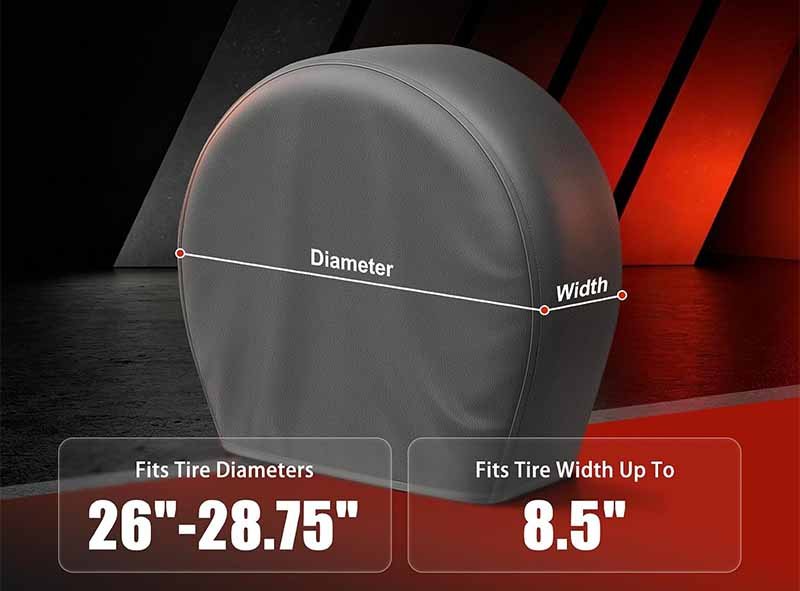
The right tire cover normally starts with two measurements: the tire’s overall diameter and its width. The number describing the wheel, such as the “17” in 265/70R17, does not represent the full tire diameter. Universal covers are usually designed around a controlled fit range, while exact-fit covers also consider tire depth, material stretch, closure tension, spare-carrier geometry, and camera hardware when present.
Rim Size vs. Tire Size
One of the most common mistakes is assuming that a 17-inch wheel requires a 17-inch tire cover. That number only describes the wheel on which the tire is mounted. The tire itself extends well beyond the wheel because the sidewall adds height above and below the rim. A 265/70R17 tire, for example, has a calculated overall diameter of roughly 31.6 inches, which places it around the 32-inch tire-cover category rather than anywhere near 17 inches.
This distinction matters because the same wheel diameter can support several very different tire sizes. A 17-inch wheel can be fitted with tires around 30, 32, 33, 35 inches, or even larger depending on tire width, aspect ratio, and the vehicle setup. Looking only at the final number in the tire code therefore tells you very little about the cover size that will actually fit.
The problem becomes more noticeable on modified vehicles. A Jeep Wrangler may leave the factory with tires around the 32-inch class and later receive 35-inch tires without changing the basic vehicle name or wheel diameter. If the tire cover is purchased only from the vehicle model or rim diameter, the result can be several inches away from the true fit requirement.
For practical sizing, treat the wheel diameter as only one component of the calculation. The actual tire outside diameter should be the main reference, especially when the vehicle uses replacement tires, aftermarket wheels, suspension modifications, or non-standard off-road tires.
Diameter and Width
Outside diameter controls the main circular dimension of the cover, while tire width determines how much material is needed to wrap around the tread and reach the rear retention point. A tire cover can therefore have enough front diameter and still feel too shallow if the tire is significantly wider than the pattern was designed to accommodate.
This is particularly important in the 31-to-35-inch range, where many Jeep and Bronco applications overlap. A 31–33-inch cover may typically need to accommodate tire widths approaching roughly 9.5–12 inches, while covers intended for the 33–35-inch range may need additional depth to accommodate tires around 10.5–12.5 inches wide. These differences become more visible with aggressive all-terrain and mud-terrain tires.
A 33-inch road-oriented tire and a 33×12.50 off-road tire may share a similar overall diameter, yet the second tire occupies substantially more space around the tread. If the side section of the cover is too shallow, the front panel can appear correctly sized while the rear elastic or drawstring struggles to reach a secure position behind the tire.
For custom or branded products, this is one of the reasons Szoneier evaluates both diameter and width rather than treating a nominal “33-inch cover” as a complete specification. A properly developed pattern accounts for the full three-dimensional shape of the installed tire, which helps maintain cleaner appearance, better retention, and more consistent repeat production.
Universal vs. Exact Fit
Universal covers are designed to accommodate a range of nearby tire sizes. They are useful when a retailer wants fewer SKUs or when the product is expected to serve several vehicles with similar overall tire dimensions. Elastic, bungee, and drawstring systems provide additional tolerance, allowing one cover to work across a controlled diameter and width range.
Exact-fit covers operate differently. They use a more narrowly defined pattern based on the intended tire dimensions, material, side depth, and installation geometry. This approach becomes more valuable when appearance matters, when a printed logo must stay centered, or when the cover needs an opening for a rear camera or another fixed vehicle component.
Neither approach is automatically superior. Universal sizing offers inventory efficiency and broader compatibility, which is useful for mass retail and marketplace products. Exact fit provides better visual control and more predictable alignment, making it attractive for automotive accessory brands, premium products, private-label programs, and vehicle-specific applications.
The key is to know which type of product you are purchasing. A universal 31–33-inch cover may intentionally include more dimensional tolerance than a dedicated 33-inch exact-fit pattern. Comparing only the number printed on the label can therefore be misleading unless you also understand the actual tire range, side depth, material, and closure system.
Which Tire Cover Size Fits?

Choose the cover range that contains the tire’s actual outside diameter, then confirm that its width also falls within the intended pattern range. Common spare-tire covers extend from roughly 21–23 inches for small vehicles and trailers to 40–42 inches for heavily modified off-road vehicles. Tires beyond approximately 42 inches are usually better handled as custom applications because carrier geometry and tire width vary considerably.
| Tire Cover Range | Recommended Tire OD | Typical Tire Width | Common Applications |
| 21–23” | 21–23” | 6–8” | Small SUV, small trailer |
| 23–25” | 23–25” | 7–9” | Compact 4×4, trailer |
| 24–26” | 24–26” | 7–9.5” | Small SUV, compact off-road |
| 26–28” | 26–28” | 8–10” | SUV, small Jeep, trailer |
| 27–29” | 27–29” | 8–10” | Jeep, SUV, trailer |
| 29–31” | 29–31” | 9–11” | Jeep, SUV, off-road |
| 31–33” | 31–33” | 9.5–12” | Wrangler, Bronco, FJ Cruiser |
| 33–35” | 33–35” | 10.5–12.5” | Off-road, 35” upgrades |
| 35–37” | 35–37” | 11–13” | Modified Jeep or Bronco |
| 37–40” | 37–40” | 12–14” | Large modified 4×4 |
| 40–42” | 40–42” | 13–15” | Extreme off-road |
| 42”+ | 42”+ | Custom | Specialty vehicles |
21–29 Inch Tires
The lower tire-cover ranges are common on compact SUVs, small 4×4 vehicles, utility trailers, lightweight campers, and recreational equipment. These sizes often overlap because universal products need enough tolerance to accommodate small dimensional differences between tire manufacturers and vehicle applications.
A tire measuring approximately 24 inches in outside diameter may be suitable for a 23–25-inch or 24–26-inch pattern depending on tire width, side-panel depth, material flexibility, and closure design. Around 27–28 inches, the practical choices normally move toward the 26–28-inch or 27–29-inch range.
The most reliable approach is not simply to choose whichever number appears closest. A tire cover needs enough diameter to sit naturally across the face of the tire and enough side depth to travel around the tread. A pattern that fits the front but does not reach far enough around the side can still be incorrect.
Trailer tires make this especially easy to overlook because many are narrower than SUV tires with similar overall diameters. Two tires may both measure about 28 inches tall while having noticeably different widths. For basic universal covers, the difference can often be absorbed by the closure system. For cleaner private-label fitment, separating patterns by both diameter and width produces more consistent results.
30–35 Inch Tires
The 30–35-inch group is one of the most important parts of the tire-cover market because it includes many Jeep Wrangler, Ford Bronco, Toyota FJ Cruiser, and other SUV or off-road applications. It also contains many of the tire sizes commonly fitted after an owner upgrades wheels, suspension, or off-road equipment.
A tire around 30 inches may fall into a 29–31-inch pattern, while tires around 31–33 inches are commonly seen on standard and moderately modified 4×4 vehicles. The next 33–35-inch category covers many larger off-road applications and nominal 35-inch upgrades. Tire width generally increases as the diameter increases, so side depth becomes more important toward the upper end of this group.
For example, a 265/70R17 tire calculates to approximately 31.6 inches overall. A 285/70R17 is roughly 32.7 inches. A 315/70R17 is approximately 34.4 inches. These three tires can all use 17-inch wheels, yet their cover requirements are clearly different.
For consumers, this is a good reason to read the actual tire code before ordering. For brands and distributors, it is useful to connect each product SKU to an approved diameter and width range. That makes fitment instructions clearer and reduces the chance that customer-service staff rely only on vehicle names or rough size descriptions.
35–42+ Inch Tires
Once a tire reaches roughly 35 inches and above, overall width and tread profile become increasingly important. These sizes are commonly found on modified Jeeps, Broncos, large SUVs, specialty 4×4 vehicles, and extreme off-road builds. Many use deep tread blocks and pronounced shoulders that increase the amount of material the cover must pass over during installation.
A nominal 35×12.50R17 tire, for example, is approximately 35 inches tall and 12.5 inches wide. A cover that provides enough front diameter but was designed for a significantly narrower tire may still be difficult to pull into position. The side panel must have enough depth to wrap around the tread without forcing the rear closure to operate at its maximum tension.
The same challenge increases with 37-, 40-, and 42-inch tires. Typical width requirements may move from approximately 11–13 inches in the 35–37-inch category to 12–14 inches around 37–40 inches and roughly 13–15 inches around 40–42 inches.
Above approximately 42 inches, standardized sizing becomes less dependable. Large off-road tires are often installed with custom carriers, spacers, reinforcement brackets, and unusual wheel offsets. In these situations, measured diameter, tire width, side photographs, rear photographs, and carrier dimensions are more useful than trying to force the vehicle into a generic size chart.
How Do You Calculate Tire Diameter?

For a metric tire such as 265/70R17, calculate the sidewall height from the tire width multiplied by the aspect ratio, double it to account for both sidewalls, convert the millimeters to inches, and add the wheel diameter. Flotation sizes such as 33×12.50R17 are simpler because the first number already represents the nominal overall tire diameter.
Reading Metric Tire Codes
A tire marked 265/70R17 provides the information needed to estimate its outside diameter. The first number, 265, is the nominal section width in millimeters. The second number, 70, is the aspect ratio, meaning each sidewall is approximately 70 percent of the tire width. The final number, 17, is the wheel diameter in inches.
The calculation begins with the sidewall height. Multiplying 265 by 0.70 gives 185.5 millimeters. Because there is one sidewall above the wheel and another below it, the combined height is approximately 371 millimeters. Converting that value to inches gives roughly 14.61 inches, and adding the 17-inch wheel produces an estimated overall diameter of about 31.61 inches.
This calculation explains why wheel diameter cannot be used directly for selecting a cover. The tire in this example fits a 17-inch wheel but needs a cover in the approximate 32-inch range.
Calculated diameter is an excellent starting point, although it is not a guaranteed physical measurement. Actual tire dimensions can differ slightly because of tread design, casing construction, manufacturer tolerance, inflation pressure, wheel width, and load conditions. When the cover needs to be particularly precise, checking the tire manufacturer’s specification or measuring the installed spare is worthwhile.
Common Tire Conversions
Metric tire codes become easier to understand when common sizes are converted into approximate overall diameters. These figures are useful for narrowing the correct tire-cover range before checking width and construction details.
| Tire Size | Approx. Diameter | Practical Cover Class |
| 225/75R15 | 28.3” | 28–29” |
| 235/75R15 | 28.9” | Around 29” |
| 245/75R16 | 30.5” | 30–31” |
| 265/70R17 | 31.6” | Around 32” |
| 255/75R17 | 32.1” | Around 32” |
| 285/70R17 | 32.7” | Around 33” |
| 315/70R17 | 34.4” | 34–35” |
These calculations should be treated as a selection tool rather than an absolute production dimension. A tire measuring roughly 32.7 inches may work with a nominal 33-inch product or within a universal 31–33-inch range depending on how the pattern, material, elastic allowance, and side depth were designed.
This is also why different tire-cover manufacturers can label products differently. One supplier may use a dedicated nominal 33-inch pattern, while another may sell a 31–33-inch universal size intended to absorb several nearby tire codes. Comparing the supported OD and width range is therefore more useful than comparing the product name alone.
For repeated commercial production, a structured conversion table linked to pattern numbers, packaging labels, and QC specifications is much more reliable than manually rounding each tire diameter when an order is placed.
Flotation Tire Sizes
Flotation tire codes are easier to read because they state the nominal overall diameter directly. A 33×12.50R17 tire is approximately 33 inches in diameter, 12.5 inches wide, and designed for a 17-inch wheel. Similarly, 35×12.50R17 describes a nominal 35-inch tire with a width of about 12.5 inches.
This system makes the first sizing step easier, but nominal dimensions are still not identical to guaranteed mounted measurements. Depending on tire manufacturer, tread pattern, measuring rim, inflation, and construction, a tire sold as a 35-inch model may measure somewhat below or above that number in real use.
For a general universal cover, the normal tolerance of the pattern and closure system can usually accommodate those differences. For exact-fit products, especially those made from heavier materials or carrying printed graphics, the actual tire dimensions deserve more attention.
Large off-road tires also have more pronounced tread shoulders than many road tires. Those shoulder blocks can make installation feel tighter even when the measured diameter looks correct. For custom products, the tire manufacturer and model can therefore provide useful additional information beyond the basic flotation code.
Measuring the Mounted Spare
If the spare tire is already mounted on the vehicle, direct measurement provides a useful cross-check. Measure straight across the complete tire through the center, from the outer tread surface on one side to the outer tread surface on the opposite side. The measurement should include the rubber tire, not just the metal wheel.
Width can be measured across the tire from one outer side area to the other, taking into account the tread and shoulder profile. On aggressive mud-terrain tires, shoulder blocks can increase the effective width that the cover needs to pass over, so measuring only a narrow central tread section may understate the real installation requirement.
Whenever possible, measure the tire in its normal installed and inflated condition. This reflects the real geometry the cover will encounter. For unusual or modified installations, photographs are also valuable because they reveal spacers, aftermarket carriers, cameras, brackets, and other details that may not appear in a tire code.
For ordinary online shopping, the calculated diameter is usually enough to identify the correct size family. For exact-fit product development, combining the tire code with actual diameter, width, and vehicle photographs gives a much stronger foundation.
Which Size Fits Your Vehicle?

Vehicle name is useful for narrowing the likely range, but the tire actually installed on the vehicle should determine the final cover. Model year, trim, aftermarket tire changes, spare-wheel carrier, and rear-camera hardware can all alter fitment. A dependable vehicle-specific process confirms the vehicle first and then checks actual tire size, overall diameter, width, carrier geometry, and camera configuration.
Jeep Wrangler Fitment
Jeep Wrangler is a good example of why vehicle-only sizing can cause mistakes. TJ, JK, JL, and JLU generations have been produced with different wheels, tires, carriers, and rear hardware, while owners frequently install larger aftermarket tires. A product labeled simply as a “Jeep Wrangler tire cover” therefore covers a much wider range of possibilities than the name suggests.
Many Wrangler applications fall in the 31-to-35-inch area, while modified vehicles may move to 37 inches or beyond. A common 285/70R17 tire calculates to roughly 32.7 inches and is normally considered close to the 33-inch class. If the owner later installs a nominal 35-inch tire, a cover designed around the earlier setup may no longer provide sufficient diameter or side depth.
JL and JLU models add another consideration because the rear camera may pass through the spare-wheel area. A tire cover can match the tire dimensions and still be unusable if the camera opening is missing or positioned incorrectly.
For reliable Wrangler fitment, confirm the generation, model year, actual tire code, tire width when necessary, camera configuration, and any aftermarket spare-carrier changes. The vehicle name narrows the search, but the physical tire and hardware determine the final product.
Ford Bronco Fitment
The modern Ford Bronco presents similar variation. Standard trims, Badlands, Wildtrak, Sasquatch-equipped vehicles, and modified builds can use very different spare-tire dimensions. A universal “Bronco size” is therefore not precise enough for every application, particularly when the product is intended to look fitted rather than loosely universal.
Some Broncos fall around the low-30-inch range, while Sasquatch and aftermarket builds often move toward 35 inches. Larger modifications may reach 37 inches. As with the Wrangler, the actual tire code should be checked before selecting the cover because the vehicle itself does not guarantee that the factory tire is still installed.
The rear camera is another important part of Bronco fitment. A camera-compatible cover needs to clear the housing and support structure without compromising the cover’s retention or appearance. A simple circular hole is not always enough because the camera body, arm, and surrounding hardware occupy physical space.
Printed artwork also needs to account for that opening. A centered logo or detailed illustration can lose important elements if the camera passes directly through the design. For premium or branded products, the camera location should be incorporated into the pattern and artwork before production rather than corrected after the cover has already been manufactured.
RV and Trailer Fitment
RV and trailer applications should not be treated exactly like rear-mounted spare-tire covers because many products are designed to protect the road wheels during parking or storage. The cover may be intended for a single tire, a pair of adjacent tires, a dual-axle arrangement, or several wheels on a large recreational vehicle.
Typical single-wheel ranges can start around 18–21 inches for small trailers and increase through 21–24, 24–27, 27–30, 30–33, and 33–36 inches for larger campers, travel trailers, and fifth wheels. Large motorhomes may require 37–41-inch or 40–42-inch covers depending on the tire configuration.
Dual-axle products introduce an additional measurement: axle spacing. Two trailers may use identical 30-inch tires but require different joined covers if the distance between the axles is different. A product that fits both tires vertically can still be too short or too long across the horizontal span.
Trailer tires frequently use ST designations, such as ST205/75R15 or ST235/85R16. These codes should be converted into overall diameter just like other metric tire sizes. For multi-wheel products, tire diameter, quantity, axle spacing, and the intended method of securing the cover should all be confirmed before final sizing.
Aftermarket Tires
Aftermarket tires are one of the strongest reasons to verify the actual spare rather than relying on a vehicle fitment list. Owners routinely upgrade tire diameter, width, wheel offset, suspension height, and spare carriers, especially on Jeeps, Broncos, 4×4 vehicles, and overlanding builds.
A vehicle that originally used tires around 32 inches may later run 33-, 35-, or 37-inch tires. Even if the wheel diameter remains unchanged, the tire-cover requirement changes substantially. Larger tires usually require more circumference and side depth, while wider tread patterns place additional stress on the rear closure.
For an individual owner, the simplest habit is to read the tire code directly from the mounted spare before ordering. For brands selling many vehicle-specific products, a structured fitment database is more useful. Each record can connect the vehicle generation, model year, actual tire size, outside diameter, width, carrier, camera configuration, and approved pattern.
That structured approach also makes future product development easier. Instead of rebuilding fitment knowledge every time a new order arrives, validated combinations can be reproduced consistently and updated when new tire or vehicle configurations enter the market.
How Tight Should a Tire Cover Fit?
A tire cover should feel secure without being excessively stretched. It should sit smoothly across the front of the tire, wrap around the tread, and remain seated behind the tire during normal driving conditions. At the same time, installation should not require extreme force or create constant stress in the elastic, seams, front panel, or camera opening.
If the Cover Is Too Large
An oversized tire cover can usually be installed, which is why the problem is sometimes underestimated. The cover may appear acceptable at first but develop wrinkles across the front, loose folds around the side, or excessive movement when exposed to wind. On a premium printed product, those issues can make the cover look much cheaper than the materials or printing actually are.
Loose material can also affect graphic positioning. A logo intended to sit in the visual center may sag or shift, while text and circular artwork can become uneven. If the product includes a camera opening, excess movement in the front panel can make the opening appear poorly aligned even when the original cutting position was correct.
Some allowance is necessary because the cover still needs to be installed and removed. The objective is not to eliminate all flexibility but to keep it controlled. A universal product intentionally designed for a 31–33-inch range will naturally have more tolerance than an exact-fit 33-inch product.
For brands selling a size across several tires, it is useful to test the smallest and largest intended tire rather than testing only the middle of the range. This reveals whether the cover remains stable throughout the advertised fit envelope.
If the Cover Is Too Small
An undersized tire cover usually causes more immediate problems. The user may struggle to pull it over the tread, the elastic may be stretched close to its limit, and the seam connecting the front and side panels can remain under continuous tension after installation. In severe cases, the cover may not install at all.
Printed covers make excessive tension particularly visible. Circular logos may become oval, straight text may curve, and photographic designs can appear stretched toward the perimeter. The material itself may be capable of stretching farther, but that does not mean the finished product is operating within a sensible structural range.
Camera-compatible covers are even less forgiving. If the front panel is pulled too tightly, the camera opening can shift relative to the fixed vehicle hardware. This can concentrate stress around the reinforced hole and make the product difficult to install even though the nominal diameter seems close.
When a tire falls near the boundary between two listed sizes, do not assume that sizing up is always the correct answer. Different cover patterns use different allowances. Compare the tire OD and width with the actual range specified for the product rather than relying only on a nominal label.
Material and Closure
Material choice changes how the same pattern behaves on a tire. PVC, PU, polyester, Oxford fabric, and marine-style vinyl have different thickness, stiffness, drape, and flexibility. A softer material may tolerate small dimensional differences without looking stressed, while a heavier or stiffer material can require more precise pattern dimensions.
Closure design is equally important. Elastic provides automatic tension and allows fast installation. A drawstring lets the user manually tighten the rear opening. Bungee systems provide controlled flexibility over a specific range, while straps or buckles can be used when additional retention is required for a special application.
Because of these differences, two products labeled “33 inch” may not fit the same tire in exactly the same way. One cover may use a deeper side section, another may have more elastic allowance, and another may rely on a stiffer material that requires tighter pattern control.
For commercial product development, it is more useful to compare recommended tire OD, width, side depth, finished dimensions, material, and closure method than to compare only the nominal size printed on the package.
How Do You Confirm Exact Fit?
Exact fit requires more than selecting a row in a size chart. Confirm the full tire code, outside diameter, width, vehicle model and year, spare-wheel carrier, and any rear-camera hardware. For modified vehicles or unusual tires, add photographs and physical measurements. These inputs can then be converted into a controlled pattern with defined side depth, closure allowance, camera clearance, and dimensional QC.
Width and Side Depth
Tire width is essential when a close fit is required because a tire cover is a three-dimensional sewn product. The circular front panel only addresses the visible diameter. The side section has to travel over the tread and extend far enough behind the tire for the closure to hold securely.
A cover can therefore be correct in diameter and still be wrong in depth. This is common when comparing wide off-road tires with narrower road or trailer tires. A 33-inch road tire and a 33×12.50 mud-terrain tire may be very similar in height but quite different in the amount of material required around the side.
The difference is particularly important with heavier materials because they may have less ability to conform around a wide tire. Excessive stretching can place unnecessary load on the side seam and rear elastic, while an overly deep side section can create loose folds behind the tire.
For repeat production, each cover size is better defined by an accepted OD range and width range rather than a single nominal number. This creates a measurable standard for pattern making, sample approval, inspection, and future reorders.
Camera Compatibility
Rear-camera compatibility changes the tire cover from a simple circular product into a vehicle-specific component. The opening must align with the camera hardware while the cover remains properly positioned around the tire. This requires the tire dimensions and the camera geometry to work together.
Important considerations can include camera position, camera housing size, support arm, spare-carrier structure, hole diameter, reinforcement area, and the location of printed artwork. A hole that is too small can interfere with the hardware, while a hole that is unnecessarily large can weaken the structure or reduce visual quality.
The printed design should also include a safe zone around the opening. A large centered logo, face, or block of text may look fine in a normal tire-cover mockup but become partially removed once a camera opening is introduced.
For vehicle-specific programs, a verified camera-compatible pattern is more dependable than cutting the opening approximately during bulk production. Once the tire-and-camera combination has been validated, the same pattern can be reproduced consistently for repeat orders.
Fitment Information
The amount of information required depends on how precise the product needs to be. A basic universal cover may only require the tire code and overall diameter, while a custom or vehicle-specific product benefits from a more complete fitment record.
| Fitment Input | Practical Purpose |
| Full tire code | Establishes nominal dimensions |
| Actual tire OD | Confirms front-panel size |
| Tire width | Determines side depth |
| Vehicle model | Identifies application family |
| Model year | Narrows vehicle configuration |
| Tire brand/model | Helps with tight-tolerance products |
| Spare carrier | Identifies installation constraints |
| Camera position | Determines opening location |
| Camera housing | Determines required clearance |
| Front and side photos | Shows modifications and actual setup |
| Material choice | Affects pattern allowance |
| Closure method | Determines retention and fit range |
For unusual tires, extremely wide off-road setups, or products above roughly 42 inches, measurements and photographs become far more valuable than generic fitment descriptions. The same applies when the vehicle has a custom spare carrier, wheel spacer, reinforcement plate, or other hardware around the tire.
When Szoneier develops custom tire-cover projects, these details can be reviewed together with material, artwork, closure, packaging, and expected order structure. Treating fitment as part of product engineering rather than as a last-minute size choice helps make the finished cover more predictable for both the brand and the final user.
Final Thoughts
A good tire cover should not draw attention to its sizing. Once installed, it should sit naturally across the tire, stay secure in normal conditions, keep printed artwork reasonably centered, and clear any camera or spare-carrier hardware without forcing the user to fight with the product. Achieving that result starts with one simple rule: use the complete tire dimensions, not the wheel diameter or vehicle name alone.
For most standard applications, the process is straightforward. Read the tire code, calculate or measure the overall diameter, compare that number with the cover range, and confirm the tire width. For a universal cover, those steps are normally enough to identify the right size family. When the application involves wide off-road tires, vehicle modifications, premium materials, exact-fit construction, or rear cameras, the fitting process should go one step further.
That extra attention is particularly worthwhile for brands, dealers, RV accessory companies, and vehicle-accessory programs that need the same fit to be reproduced across hundreds or thousands of products. A clear dimensional specification, approved pattern, and controlled fitment record provide a much stronger foundation than a simple label such as “33-inch cover.”
The size chart is therefore best viewed as the beginning of the decision rather than the entire decision. It quickly tells you where to start. The actual tire, its width, the way the cover is constructed, and the hardware around the spare determine whether the final fit feels genuinely correct.
Frequently Asked Questions
What size tire cover do I need for a 265/70R17 tire?
A 265/70R17 tire has a calculated overall diameter of approximately 31.6 inches. That normally places it around the 32-inch tire-cover category or within a universal range designed for roughly 31–33-inch tires. Before ordering, check the cover manufacturer’s specified width range because the finished pattern, side depth, elastic allowance, and material can differ between products even when they use similar size labels.
What size tire cover fits a 285/70R17 tire?
A 285/70R17 tire calculates to approximately 32.7 inches in overall diameter, so it is commonly treated as a tire in the 33-inch class. A cover designed for approximately 31–33-inch tires may be suitable, although exact fit depends on the tire’s real mounted dimensions, width, tread profile, and the construction of the cover. Vehicle-specific camera hardware should also be checked separately.
Should I buy a 32-inch or 33-inch tire cover for a 32.5-inch tire?
The best choice depends on the actual fit range of the cover rather than the number printed in the product name. A universal 31–33-inch cover may be designed specifically for a 32.5-inch tire, while a dedicated 32-inch cover from another manufacturer could be too tight. Compare the recommended tire OD, width, material, side depth, and closure before deciding instead of automatically rounding up or down.
How do I measure a spare tire for a cover?
Measure straight across the full mounted tire through the center, from the outer tread edge on one side to the opposite side. This gives the approximate outside diameter. Then measure the tire width across the tread and side area. Do not measure only the wheel. For modified vehicles or unusually wide tires, take front and side photographs as well because carrier hardware and tread shape can affect installation.
Does a 17-inch tire need a 17-inch tire cover?
No. A 17-inch measurement usually refers to the wheel diameter, not the outside diameter of the complete tire. A tire such as 265/70R17 uses a 17-inch wheel but measures approximately 31.6 inches overall. Tire covers are normally selected according to the complete tire OD and width, so this example would require a cover around the 32-inch class rather than a 17-inch cover.
What size tire cover do I need for a 35×12.50R17 tire?
A 35×12.50R17 is nominally about 35 inches in diameter and 12.5 inches wide. A cover designed around the 35–37-inch range may be appropriate when its side depth can accommodate a 12.5-inch-wide off-road tire. Because actual measurements vary by tire manufacturer and tread pattern, exact-fit products should be checked against the mounted tire before finalizing the pattern.
Does a backup camera change the tire cover size?
The basic tire diameter does not change, but a backup camera can change the required cover pattern. Camera-compatible covers must account for the location and size of the camera housing, the support structure, the tire dimensions, and the reinforced opening. The artwork may also need to be repositioned around a camera safe zone, so camera fitment should be confirmed separately from the normal tire-size calculation.


